Vik


EIZO FlexScan EV2451 & EV2456 Launched: Thin Bezels in 16:9 and 16:10
EIZO FlexScan EV2451 & EV2456 Launched: Thin Bezels in 16:9 and 16:10

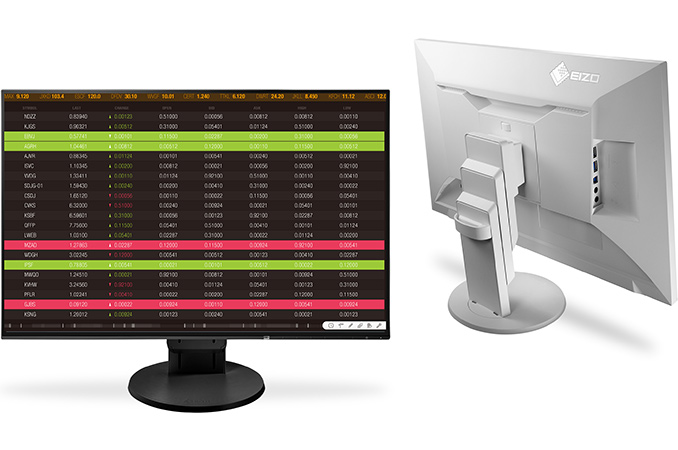
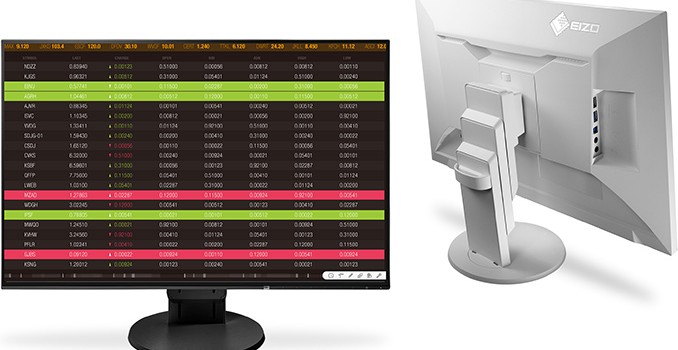
EIZO has introduced two new displays designed for specialized and business environments that require multi-monitor setups. The new FlexScan EV2451 and EV2456 are equipped with ultra-thin bezels for their standout feature, and are IPS panels with 178° viewing angles as well as four display inputs to maximize compatibility.

The FlexScan EV2451 and EV2456 monitors have generally typical specifications for today’s office displays: 1920×1080 and 1920×1200 resolution (respectively), 250 and 350 nits brightness (respectively), a 60 Hz refresh rate and a rated 1000:1 contrast ratio. The monitors can use DisplayPort, HDMI, DVI-D or D-Sub to connect to host PCs such that they can be used with new and legacy computers. In addition, they support EIZO’s EcoView Optimizer 2 feature, which dynamically adjusts backlight brightness in accordance with environment brightness to reduce power consumption.

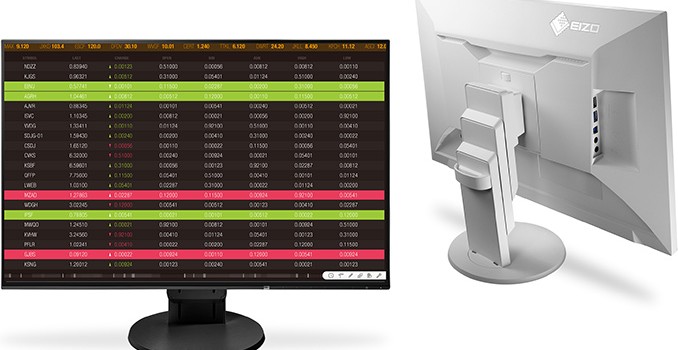
The key features of the two monitors are their ultra-thin bezel sizes: 1 mm on the sides and top as well as 4.6 mm on the bottom (keep in mind that that the monitors also have black borders between bezels and screens, hence, we cannot call them completely borderless). Such thin bezels mean that EIZO is aiming these displays for multi-monitor setups used in trading and control rooms. Moreover, such bezels make the FlexScan EV2451 and EV2456 monitors plausible candidates for gamers, who might use multiple monitors to play titles like flight simulators.

EIZO FlexScan EV2451 and EV2456
  FlexScan EV2451 FlexScan EV2456
Panel 23.8″ IPS 24.1″ IPS
Native Resolution 1920 × 1080 1920 × 1200
Maximum Refresh Rate 60 Hz
Response Time 5 ms
Brightness 250 cd/m² 350 cd/m²
Contrast 1000:1
Viewing Angles 178°/178° horizontal/vertical
Inputs 1 × DP 1.2
1 × HDMI 1.4
1 × DVI-D
1 × D-Sub
USB Hub 2-port USB 3.0 hub
Audio 1 W × 2
audio in/out ports
Power Consumption Typical 13 W 11 W
Maximum 42 W 44 W

To maximize flexibility for multi-display environments, both monitors also use new stands with height-adjustment range of 158.6 mm (EV2456) and 172.7 mm (EV2451) as well as 40° (5° down, 35° up) tilt, 344° swivel, and 90° pivot for viewing in portrait mode. The stands can be easily removed using their quick-release buttons, and the screens can be installed onto a VESA-compatible mounting device. Finally, EIZO also supplies special Screen InStyle software that lets users adjust the color, circadian dimming and power settings on multiple FlexScan displays at once. This includes flicker free modes, blue-light reduction modes, and paper-reading modes.

EIZO plans to start shipments of its new monitors shortly, their prices will naturally vary by country. The predecessor of the FlexScan EV2456 (the EV2455) has an MSRP of $569 in the U.S., whereas the predecessor of the FlexScan EV2451 (the EV2450) costs $399 in the U.S. As for warranty, the FlexScan monitors come with a five-year warranty with a six-month zero bright sub-pixel guarantee.
EIZO FlexScan EV2451 & EV2456 Launched: Thin Bezels in 16:9 and 16:10

EIZO FlexScan EV2451 & EV2456 Launched: Thin Bezels in 16:9 and 16:10

EIZO has introduced two new displays designed for specialized and business environments that require multi-monitor setups. The new FlexScan EV2451 and EV2456 are equipped with ultra-thin bezels for their standout feature, and are IPS panels with 178° viewing angles as well as four display inputs to maximize compatibility.

The FlexScan EV2451 and EV2456 monitors have generally typical specifications for today’s office displays: 1920×1080 and 1920×1200 resolution (respectively), 250 and 350 nits brightness (respectively), a 60 Hz refresh rate and a rated 1000:1 contrast ratio. The monitors can use DisplayPort, HDMI, DVI-D or D-Sub to connect to host PCs such that they can be used with new and legacy computers. In addition, they support EIZO’s EcoView Optimizer 2 feature, which dynamically adjusts backlight brightness in accordance with environment brightness to reduce power consumption.

The key features of the two monitors are their ultra-thin bezel sizes: 1 mm on the sides and top as well as 4.6 mm on the bottom (keep in mind that that the monitors also have black borders between bezels and screens, hence, we cannot call them completely borderless). Such thin bezels mean that EIZO is aiming these displays for multi-monitor setups used in trading and control rooms. Moreover, such bezels make the FlexScan EV2451 and EV2456 monitors plausible candidates for gamers, who might use multiple monitors to play titles like flight simulators.

EIZO FlexScan EV2451 and EV2456
  FlexScan EV2451 FlexScan EV2456
Panel 23.8″ IPS 24.1″ IPS
Native Resolution 1920 × 1080 1920 × 1200
Maximum Refresh Rate 60 Hz
Response Time 5 ms
Brightness 250 cd/m² 350 cd/m²
Contrast 1000:1
Viewing Angles 178°/178° horizontal/vertical
Inputs 1 × DP 1.2
1 × HDMI 1.4
1 × DVI-D
1 × D-Sub
USB Hub 2-port USB 3.0 hub
Audio 1 W × 2
audio in/out ports
Power Consumption Typical 13 W 11 W
Maximum 42 W 44 W

To maximize flexibility for multi-display environments, both monitors also use new stands with height-adjustment range of 158.6 mm (EV2456) and 172.7 mm (EV2451) as well as 40° (5° down, 35° up) tilt, 344° swivel, and 90° pivot for viewing in portrait mode. The stands can be easily removed using their quick-release buttons, and the screens can be installed onto a VESA-compatible mounting device. Finally, EIZO also supplies special Screen InStyle software that lets users adjust the color, circadian dimming and power settings on multiple FlexScan displays at once. This includes flicker free modes, blue-light reduction modes, and paper-reading modes.

EIZO plans to start shipments of its new monitors shortly, their prices will naturally vary by country. The predecessor of the FlexScan EV2456 (the EV2455) has an MSRP of $569 in the U.S., whereas the predecessor of the FlexScan EV2451 (the EV2450) costs $399 in the U.S. As for warranty, the FlexScan monitors come with a five-year warranty with a six-month zero bright sub-pixel guarantee.
Seagate Introduces New Generation of Enterprise Performance 15K HDDs with NAND Caching

Seagate Introduces New Generation of Enterprise Performance 15K HDDs with NAND Caching

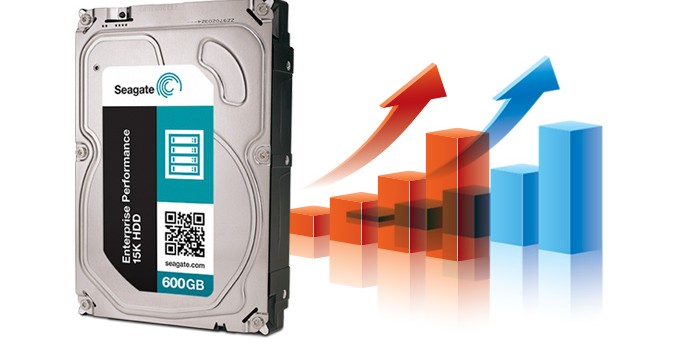
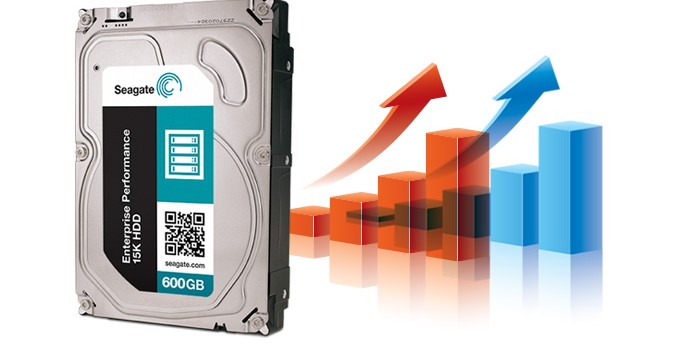
Seagate on Tuesday announced its new generation of hard drives with 15K spindle speed and up to 900 GB capacity. The new HDDs use NAND caching to boost response times, offer additional SED and SED-FIPS security features at no extra cost and boast with enhanced reliability for 24×7 workloads.

The new Seagate Enterprise Performance 15K v6 HDDs come in 300, 600 and 900 GB configurations. Just like their predecessors, they use a dual port SAS 12 Gbps interface as well as a 2.5”/15 mm form-factor. The new Enterprise Performance 15K v6 hard drives have single or dual level caches: either a 256 MB of DRAM cache only or a 256 MB of DRAM cache and a 16 GB of NAND flash cache (4Kn/512E models only). The latter is used for caching of frequently used “hot” data to maximize read performance and reduce latencies (Seagate offers similar capability with its consumer-grade FireCuda and other SSHDs). It is noteworthy that Seagate reduced the amount of NAND flash compared to previous-generation 15K HDDs, but the company seems to believe that its improved caching algorithms will ensure that the new drives are faster than their predecessors.

When compared to predecessors, the new sixth-generation 15K HDDs are rated for a 27% increase in sequential read write speed: up to 315 MB/s. In addition, the drives also promise 100% faster random write performance. Seagate claims that its advanced caching algorithms promote hot data three times faster when compared to 512N drives without NAND, but it does not reveal exact performance numbers for its NAND cache. When it comes to reliability, Seagate declares 2 million hours MTBF and an annualized failure rate of 0.44%, which is in line with the predecessors.

Seagate Enterprise Performance 15K v6 Family at Glance
Capacity 300 GB 600 GB 900 GB
Model Number Standard Model 512N ST300MP0006 ST600MP0006 ST900MP0006
512E/4Kn ST300MP0106 ST600MP0136 ST900MP0146
SED 512N ST300MP0016 ST600MP0016 ST900MP0016
512E/4Kn ST300MP0116 ST600MP0146 ST900MP0156
FIPS 140-2 512N ST600MP0026 ST900MP0126
512E/4Kn ST600MP0156 ST900MP0166
Controller Seagate’s proprietary LSI
DRAM Cache 256 MB DRAM
NAND Flash Cache 512N none
512E/4Kn 16 GB of read cache
Form-Factor, Interface 2.5″, SAS 12 Gbps
Sustained Transfer Rate (Outer to Inner Diameter) 512N 300 MB/s ~ 210 MB/s
512E/4Kn 315 MB/s ~ 215 MB/s
Average Latency 2 ms
Random Read IOPS 720 IOPS
Random Write IOPS 400 IOPS
Power Consumption 6.9 W 7.2 W 7.6 W
TCG Opal Encryption Yes
Warranty 5 years
MTBF 2,000,000 hours
MSRP Unknown Unknown Unknown

To simplify inventory management, Seagate will offer Seagate Enterprise Performance 15K v6 hard drives with its FastFormat feature, which allows formatting the drives to either 512 emulation or 4K native formats, thus reducing the number of models the manufacturer has to produce and its resellers have to keep in stock.

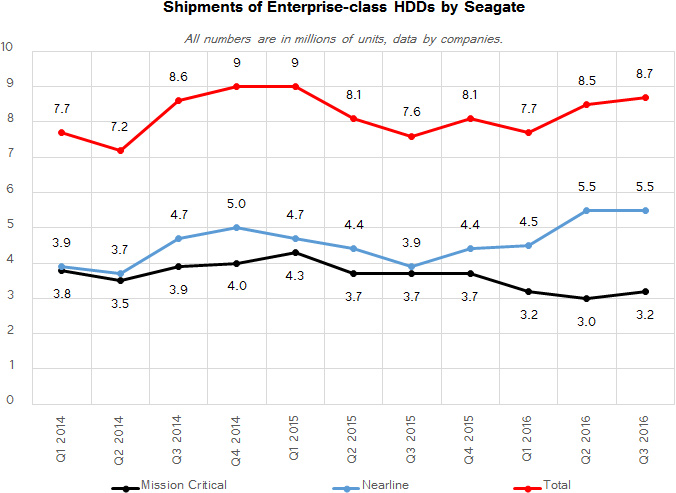
Nowadays 15K HDDs are no longer the fastest storage devices, even in RAID environments – modern high-end enterprise-class SSDs usually offer considerably higher random and sequential performance. Nonetheless, 10K and 15K hard drives for mission-critical applications are still used by multiple datacenters worldwide. Moreover, some say that there are deployments that use both mission-critical SSDs as well as fast mission-critical HDDs, which suggests that the new drives will have some demand. In fact, Seagate claims that the total available market for such HDDs is around six million units per quarter, but admits that sales of 15K drives have been declining recently. Still, the company itself sells roughly three million of such drives every three months. Given the very long life cycles of mission-critical HDDs, it looks like development of this 15K generation makes sense for Seagate.

Exact pricing of Seagate’s sixth-generation Enterprise Performance 15K HDDs will depend on volumes and contracts. Interested parties should get in contact directly with their local Seagate distribution partners.

Seagate Introduces New Generation of Enterprise Performance 15K HDDs with NAND Caching

Seagate Introduces New Generation of Enterprise Performance 15K HDDs with NAND Caching

Seagate on Tuesday announced its new generation of hard drives with 15K spindle speed and up to 900 GB capacity. The new HDDs use NAND caching to boost response times, offer additional SED and SED-FIPS security features at no extra cost and boast with enhanced reliability for 24×7 workloads.

The new Seagate Enterprise Performance 15K v6 HDDs come in 300, 600 and 900 GB configurations. Just like their predecessors, they use a dual port SAS 12 Gbps interface as well as a 2.5”/15 mm form-factor. The new Enterprise Performance 15K v6 hard drives have single or dual level caches: either a 256 MB of DRAM cache only or a 256 MB of DRAM cache and a 16 GB of NAND flash cache (4Kn/512E models only). The latter is used for caching of frequently used “hot” data to maximize read performance and reduce latencies (Seagate offers similar capability with its consumer-grade FireCuda and other SSHDs). It is noteworthy that Seagate reduced the amount of NAND flash compared to previous-generation 15K HDDs, but the company seems to believe that its improved caching algorithms will ensure that the new drives are faster than their predecessors.

When compared to predecessors, the new sixth-generation 15K HDDs are rated for a 27% increase in sequential read write speed: up to 315 MB/s. In addition, the drives also promise 100% faster random write performance. Seagate claims that its advanced caching algorithms promote hot data three times faster when compared to 512N drives without NAND, but it does not reveal exact performance numbers for its NAND cache. When it comes to reliability, Seagate declares 2 million hours MTBF and an annualized failure rate of 0.44%, which is in line with the predecessors.

Seagate Enterprise Performance 15K v6 Family at Glance
Capacity 300 GB 600 GB 900 GB
Model Number Standard Model 512N ST300MP0006 ST600MP0006 ST900MP0006
512E/4Kn ST300MP0106 ST600MP0136 ST900MP0146
SED 512N ST300MP0016 ST600MP0016 ST900MP0016
512E/4Kn ST300MP0116 ST600MP0146 ST900MP0156
FIPS 140-2 512N ST600MP0026 ST900MP0126
512E/4Kn ST600MP0156 ST900MP0166
Controller Seagate’s proprietary LSI
DRAM Cache 256 MB DRAM
NAND Flash Cache 512N none
512E/4Kn 16 GB of read cache
Form-Factor, Interface 2.5″, SAS 12 Gbps
Sustained Transfer Rate (Outer to Inner Diameter) 512N 300 MB/s ~ 210 MB/s
512E/4Kn 315 MB/s ~ 215 MB/s
Average Latency 2 ms
Random Read IOPS 720 IOPS
Random Write IOPS 400 IOPS
Power Consumption 6.9 W 7.2 W 7.6 W
TCG Opal Encryption Yes
Warranty 5 years
MTBF 2,000,000 hours
MSRP Unknown Unknown Unknown

To simplify inventory management, Seagate will offer Seagate Enterprise Performance 15K v6 hard drives with its FastFormat feature, which allows formatting the drives to either 512 emulation or 4K native formats, thus reducing the number of models the manufacturer has to produce and its resellers have to keep in stock.

Nowadays 15K HDDs are no longer the fastest storage devices, even in RAID environments – modern high-end enterprise-class SSDs usually offer considerably higher random and sequential performance. Nonetheless, 10K and 15K hard drives for mission-critical applications are still used by multiple datacenters worldwide. Moreover, some say that there are deployments that use both mission-critical SSDs as well as fast mission-critical HDDs, which suggests that the new drives will have some demand. In fact, Seagate claims that the total available market for such HDDs is around six million units per quarter, but admits that sales of 15K drives have been declining recently. Still, the company itself sells roughly three million of such drives every three months. Given the very long life cycles of mission-critical HDDs, it looks like development of this 15K generation makes sense for Seagate.

Exact pricing of Seagate’s sixth-generation Enterprise Performance 15K HDDs will depend on volumes and contracts. Interested parties should get in contact directly with their local Seagate distribution partners.

Microsoft Announces the Surface Studio: 28-inch AIO with Touch, Pen, 4500x3000, Skylake, GTX 980M

Microsoft Announces the Surface Studio: 28-inch AIO with Touch, Pen, 4500×3000, Skylake, GTX 980M

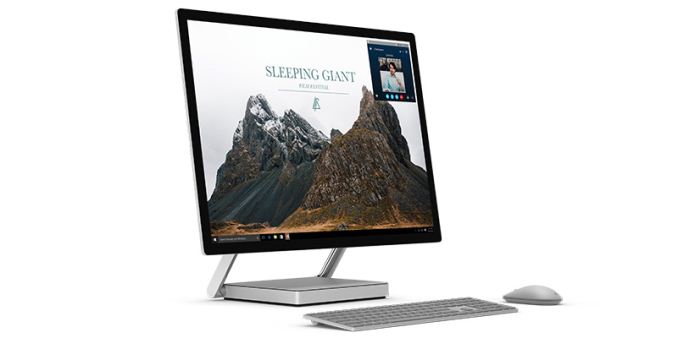
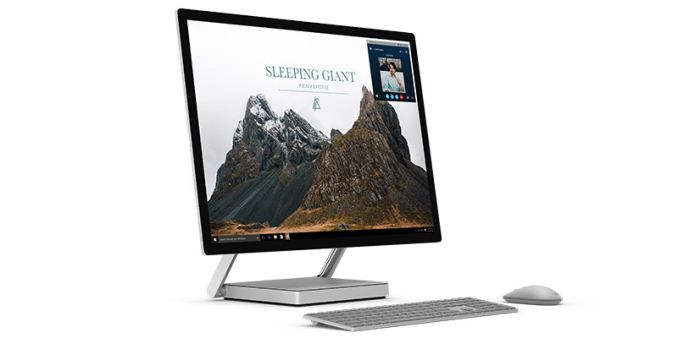
As part of the now annual Microsoft Surface event, Panos Panay announced the next member of the Surface family, the Surface Studio. The Studio is ultimately a prosumer all-in-one device promising more functionality and versatility than any other desktop all-in-one PC by allowing the device to also turn a desk into a studio.

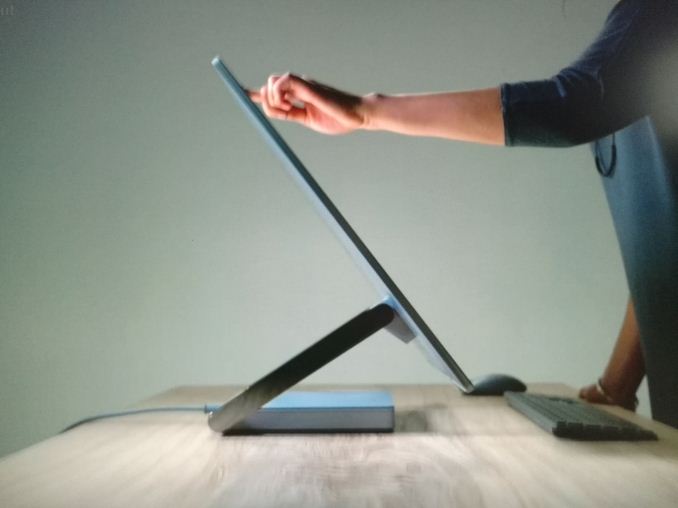
Front and center in what makes the Studio impressive is the size of the display: a 28-inch thin-bezel LCD display with a 3:2 aspect ratio, coming in at a 4500×3000 resolution and 192 pixels per inch. By contrast to 4K, this is 13.5 million pixels compared to 8.3 million in UHD, and Microsoft is promoting True Scale with the studio such that two A4 pieces of paper can be rendered side by side at full resolution and at a higher DPI than most standard office printers. The display is 12.5mm thin, with Microsoft redesigning the LCD stack to ensure a slim profile.

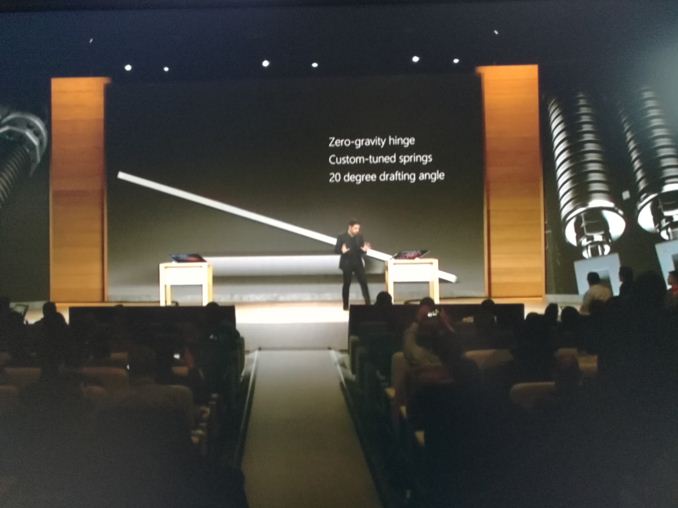
The display connects to the base via a specialist hinge, featuring 80 machined parts on each side for what Microsoft calls a ‘Zero Gravity Hinge’. This allows the display to be moved seamlessly and for any plausible angle, as well as taking on extra weight in studio mode. The display has two buttons on the right-hand side for power and volume. On the top of the display is the Windows Hello-enabled camera, with a 5.0 MP element capable of 1080p video (we assume 30 FPS). The Studio supports the Surface Pen, which can attach to the side of the display.

For color reproduction, Microsoft is advertising the display as supporting both DCI-P3 and sRGB with a simple toggle on the Windows sidebar to switch between the two. While Microsoft says that the displays are calibrated for both, this has fundamental issues with color reproduction.

In the base is a set of arguably last-generation specifications: 6th generation (Skylake) Intel Core i5 and Core i7 processor options (probably 65W desktop parts?) paired with up to 32GB of DDR4 memory (probably DDR4-2133). This comes with a NVIDIA GTX 965M 2GB for two of the three options, and a GTX 980M 4GB on the high-end model. Connectivity comes via USB 3.0, rather than USB 3.1/Thunderbolt. Storage is labeled as ‘1TB or 2TB Rapid Hybrid Drive’ options, which in the presentation looked like an M.2 drive but as yet it has been unstated if this is SATA or PCIe (or if a Rapid Hybrid Drive actually means an SSHD).

Microsoft Surface Studio
CPU Intel Core i5
Skylake
Intel Core i7
Skylake
Intel Core i7
Skylake
GPU NVIDIA
GTX 965M 2GB
NVIDIA
GTX 980M 4GB
DRAM 8GB DDR4 16 GB DDR4 32GB DDR4
Storage 1TB 1TB 2TB
‘Rapid Storage Drive’ (SATA? PCIe? SSHD?)
Display 28-inch 4500×3000 LCD Display
12.5mm thin
10-point MultiTouch
Magnetic Pen Support
Connectivity 802.11ac WiFi (Intel AC 8260?)
Gigabit Ethernet
Xbox Wireless
IO 4 x USB 3.0
Full-Size SD card reader (SDXC)
Mini DisplayPort
3.5mm Headset
Camera 5MP Front Facing
Windows Hello
1080p Recording
OS Windows 10 Pro
30-day Office Trial
Dimensions Display: 637.35 x 438.90 x 12.50 mm
Base: 250.00 x 200.00 x 32.2 mm
Weight: 9.56 kg / 21 lbs
Price $2999 $3499 $4199

Connectivity comes via four USB 3.0 ports, a full-size SD card reader, a mini DisplayPort output and a 3.5mm headset jack. WiFi is provided by an 802.11ac unit, although Microsoft does not say which one (I’d hazard a guess and say Intel’s AC8260 2×2 solution). The unit also supports Xbox Wireless, allowing for Xbox controllers to also be connected for gaming.

The whole unit weighs in at 21 lbs (9.5 kg), and Microsoft has stated that it will be available only in limited quantities during Q4, with the official release date as 15th December. Current configurations available will be:

$2999 : Intel Core i5 (Skylake), 8 GB DDR4, 1TB, GTX 965M 2GB
$3499 : Intel Core i7 (Skylake), 16 GB DDR4, 1TB, GTX 965M 2GB
$4199 : Intel Core i7 (Skylake), 32 GB DDR4, 2TB, GTX 980M 4GB

Windows 10 Pro is included with a 30-day Office trial.

Edit: Originally this piece was posted with the incorrect Intel Generation code name in the title. It should read ‘Skylake’, not ‘Haswell’. The piece has been edited to clarify.