News


Intel's 10nm Briefly Appears: Dual Core Cannon Lake in Official Documents

Intel’s 10nm Briefly Appears: Dual Core Cannon Lake in Official Documents

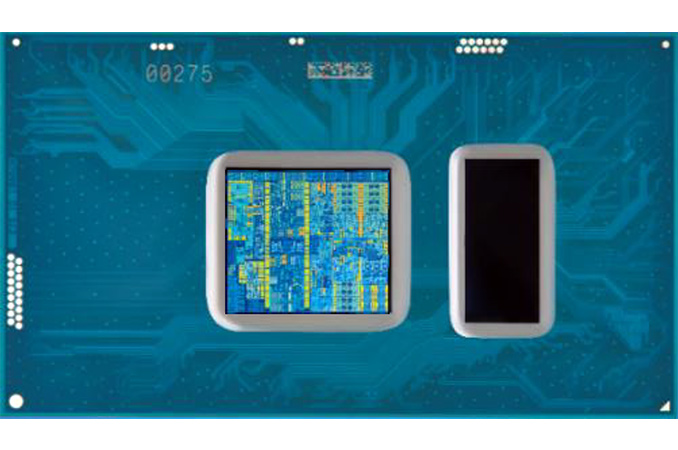
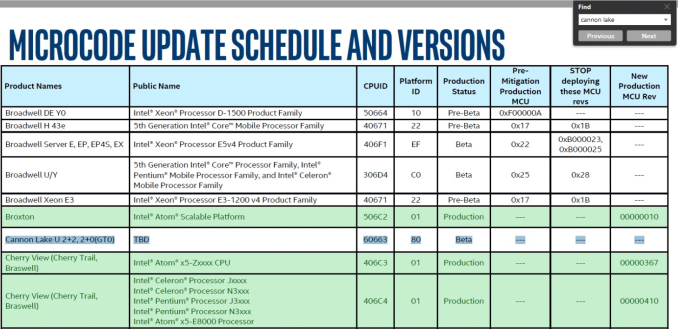
Intel briefly listed two 10nm Cannon Lake processors in a microcode update document this week, confirming that it has shipped such chips, although we expect it to be in small quantities. Intel has since removed the references to them from the public version of the paper.

Intel has adjusted its 10nm roadmap multiple times in the recent years. Back in 2013, the company planned to make CPUs produced using its 10nm technology available in 2015. Then, the company pushed them to 2016, but that was a minor change. In mid-2015 the chipmaker delayed its 10 nm products to late 2017. Then in early-2016, Intel switched its “Tick-Tock” cadence to “Process-Architecture-Optimization” model, officially prolonging lifecycles of its manufacturing technology nodes and changing its approach to new product development in general. When it comes to 10 nm products, Intel has not made formal announcements about any product family yet, but said earlier this year in a side-presentation to its CES keynote that it had shipped some of them to customers in 2017.

Since the company did not disclose any details about the 10nm CPUs it shipped, it naturally caused further questions on the state of Intel’s 10nm process in general and when the Cannon Lake products, expected to be the first on 10nm, were coming. Fortunately, our friends at Tom’s Hardware noticed Cannon Lake processors in the latest version of Intel’s microcode update document earlier this week. After the fact, Intel has since removed the references from the document.

The first version of the document, as it appears, suggests that Intel has shipped Cannon Lake-U CPUs in 2+2 and 2+0 configurations to undisclosed customers. The “2+2” denotes that a chip has two processing cores (the first number) as well as GT2-class graphics (the second number), whereas the “2+0” indicates that a dual-core chip has no iGPU at all. Intel’s “U” series parts, aimed at the 15W notebook market, usually feature an integrated chipset in the CPU package. Therefore, the CNL-U 2+2 and CNL-U 2+0 parts are aimed primarily at mobile and low-power applications.

It is noteworthy that in the recent years Intel has begun commercial roll-outs of its new CPUs starting with ultra-low-power 4.5W Y-series processors, e.g., Broadwell-Y in 2014, Skylake-Y in 2015, and Kaby Lake-Y in 2016. If Intel is launching its U-series chips with a TDP of 15 W first for 10nm, this would indicate a change in policy. So it is surprising to see that Intel has started shipments of Cannon Lake-U, but not Cannon Lake-Y.

A natural question that arises because of the listing is whether Intel has started to ship its CNL-U parts in mass quantities to PC makers. Intel has not disclosed where these parts have been sold, which could be for entry-level low-power laptops, or to certain specific customers and requests with custom/semi-custom CNL products. While a CNL-U 2+2 CPU could be used for inexpensive notebooks, a CNL 2+0 part would fit into applications that either do not require a display controller at all (such as routers, NAS, DAS, etc.), or can use a discrete GPU (a low-end PC with a low-end/outdated dGPU – there are a lot of such machines sold in developing countries, a system for software/hardware development/compatibility tests/etc.). Unfortunately, at this point it is completely unclear where Intel has shipped these 10nm parts. 

Related Reading

Corsair ONE Gets Caffeinated: Now with Coffee Lake

Corsair ONE Gets Caffeinated: Now with Coffee Lake

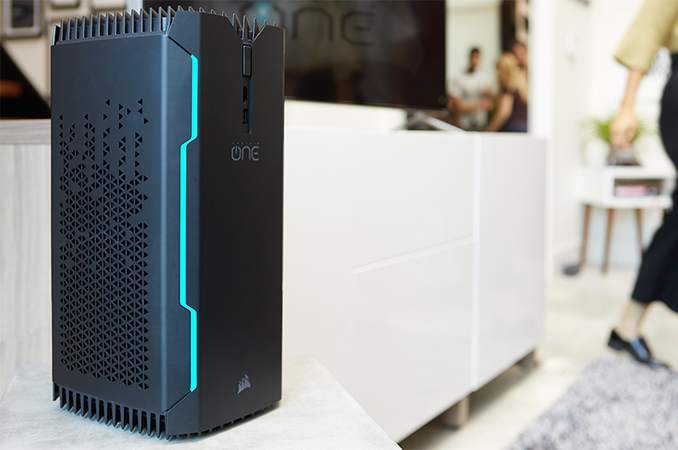
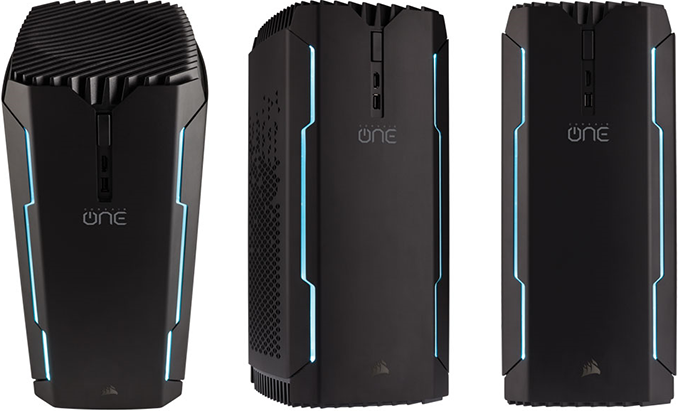
This week Corsair introduced two new versions of its small form-factor desktop, called the ‘ONE’. The new versions upgrade the processor to the latest generation Intel six-core Coffee Lake processors. The end result is more performance, with a corresponding increase in price. The new versions, called the ONE Pro Plus and the ONE Elite, represent the best performance versions of the Corsair One, while the model at the bottom of the stack is discontinued.

Corsair’s new ONE Pro Plus and ONE Elite systems are based on Intel’s Core i7-8700K processor, and subsequently get an upgrade to a Z370 based motherboard. The new Corsair ONE PCs come in the familiar 12L aluminum chassis with a custom liquid cooling system, featuring dual liquid cooling loops that are used to cool down the CPU and the GPU separately. For the new units, the GPU is also upgraded, to NVIDIA’s GeForce GTX 1080 Ti graphics card. Despite packing rather significant compute horsepower then, the use of the liquid cooling loops allows Corsair to promote the ONE Pro Plus and ONE Elite as quiet.

As for other components, the new high-end Corsair ONE models are outfitted with 16 GB of Vengeance LPX DDR4-2400 (ONE Plus) or 32 GB of Vengeance LPX DDR4-2666 (Elite) memory, a 480 GB M.2 NVMe SSD, and a 2 TB 2.5” 5400-RPM HDD. Since the systems use industry-standard components, they are upgradeable. Technically the CPU and GPU can also be overclocked, as long as cooling performance and 500W PSU are sufficient.

Specifications of Early-2018 Corsair ONE Gaming PCs
Model ONE Pro
CS-9000011
ONE Pro
CS-9000015
ONE Pro Plus
CS-9000013
ONE Elite
CS-9000014
CPU Core i7 7700K with liquid cooling Core i7 8700K with liquid cooling
GPU GeForce GTX 1080 w/LCS GeForce GTX 1080 Ti /w LCS
DRAM 16 GB DDR4-2400 32 GB DDR4-2400 16 GB DDR4-2400 32 GB DDR4-2666
Motherboard mini-ITX, Z270 chipset mini-ITX, Z370 chipset
Storage SSD 480 GB NVMe
HDD 2 TB HDD, 5400 RPM
PSU 400 W SFX 500 W SFX
Warranty 2 years
MSRP $2300 $2500 $2800 $3000

The new ONE Pro Plus and ONE Elite gaming machines exist alongside Corsair’s existing ONE Pro systems, featuring Intel’s Core i7-7700K as well as NVIDIA’s GeForce GTX 1080. At the same time, Corsair has EOLed its original ONE computer based on the Core i7-7700 and the GeForce GTX 1070. Corsair says that customer interest for the $1800 system was low, so it decided to discontinue the SKU. As a result, the range now starts at $2300, while the most expensive Corsair ONE Elite model retails for $3000.

The new Corsair ONE Pro Plus and Corsair ONE Elite will be available worldwide directly from Corsair as well as its resellers.

Related Reading

AMD Releases Radeon Pro Software Enterprise Edition 18.Q1 WHQL: Adrenalin Comes To Enterprise

AMD Releases Radeon Pro Software Enterprise Edition 18.Q1 WHQL: Adrenalin Comes To Enterprise

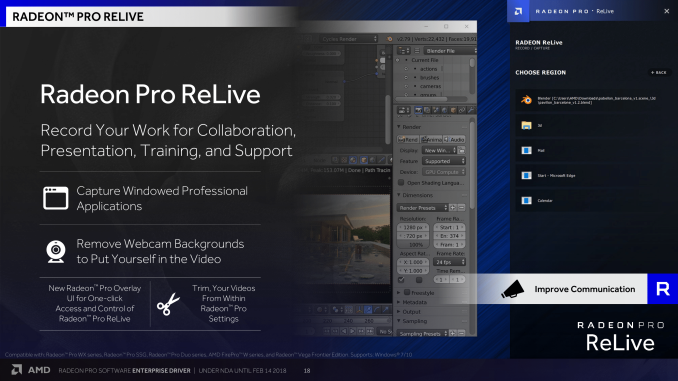
This week AMD has released the first quarterly Radeon Pro Software Enterprise Edition driver drop of the year, aptly numbered 18.Q1 WHQL. Coming on the heels of December’s major driver update on the consumer side, this is the first enterprise package based on Adrenalin Edition Pro drivers. As such, 18.Q1 incorporates new Adrenalin Pro ReLive enhancements, Pro Overlay, Pro-oriented Connect Tab, and ProRender plugin updates. Likewise, as the first post-Windows 10 Fall Creators Update enterprise driver, 18.Q1 is intended for Fall Creators Update and formally supports Mixed Reality. Rounding out this quarterly release are performance optimizations for professional applications, VDI & graphics virtualization updates, and a number of bug fixes.

First things first, AMD is implementing a slight rename from Radeon Pro Software “Enterprise Driver” to “Enterprise Edition,” making it consistent to the overall Radeon Software naming. This streamlining has not been extended, however, to the latest gaming driver now supported by 18.Q1 Driver Options, which remains “Radeon Software Adrenalin Edition for Radeon Pro 18.2.1.”

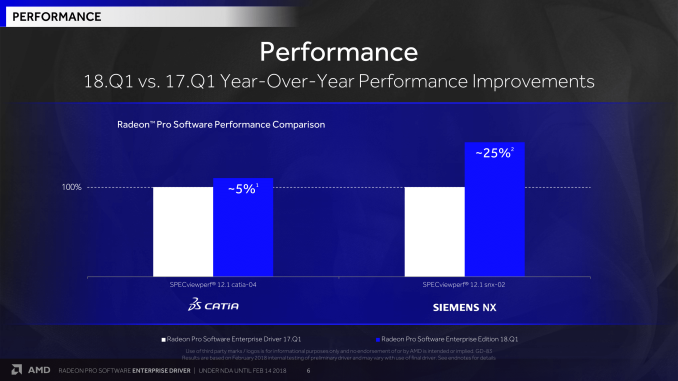
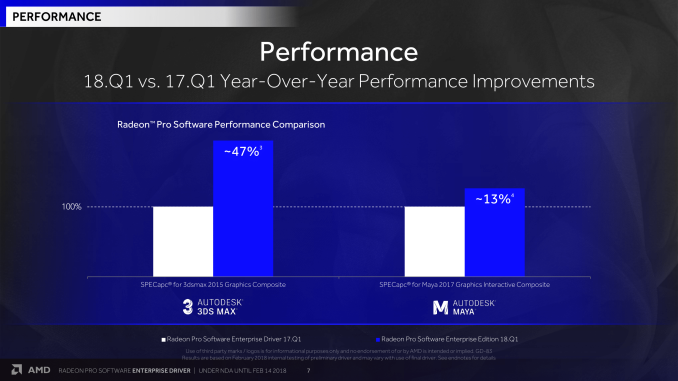
Touching on the highlights of Adrenalin Pro features, AMD referred to new Pro ReLive features like borderless region capture, microphone track separation, and chroma key background transparency, as well as Radeon Pro Overlay for Pro ReLive. This also includes the several ProRender plugin updates introduced with the inaugural Adrenalin Pro 17.12.1 Meanwhile, for performance improvements, AMD is citing year-over-year uplifts compared to 17.Q1 using SPECapc and SPECviewperf testing, notably a 47% improvement in Autodesk 3ds Max and 25% improvement in Siemens NX.

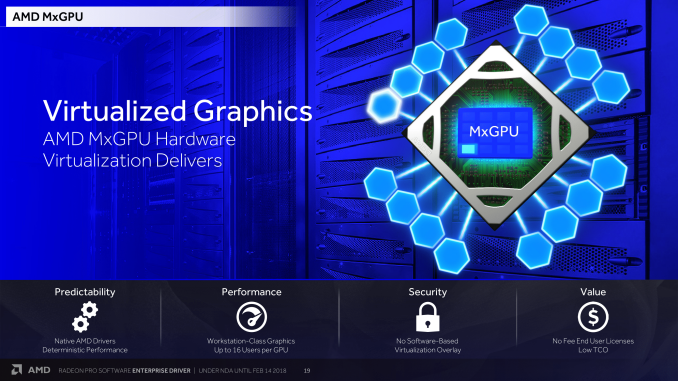
Moving on to AMD’s MxGPU, their hardware-based SR-IOV virtualized graphics solution, 18.Q1 is coupled with the January technical preview host driver for Citrix XenServer MxGPU, while production-level XenDesktop and XenApp guest drivers have been updated with 18.Q1 binaries for cloud-deployed 64-bit Windows 10, 7, Server 2016, and Server 2008 R2 platforms. The packages and compatibility notes can be found on AMD’s Citrix Pro Driver page.

In a similar vein, their Guest Interface Manager (GIM) open source KVM host OS driver remains available on GitHub as a technical preview, though the guest drivers have not been updated since Adrenalin Pro 17.12.2.

Wrapping things up, 18.Q1 comes with a list of bug fixes and documented issues typical of professional and enterprise drivers.

Bug Fixes & Resolved Issues

  • [Pro Application] Viewport in Modo may hang when using lighting set to scene on normal map.
  • [Pro Application, Vega] Unexpected behavior in Adobe Premiere Pro CC 8K playback when resuming from sleep and hibernate on Radeon Pro SSG.
  • Intermittently, only one display per GPU is selectable for setting Timing-Client.
  • Radeon Settings may crash when opening Global Settings using Radeon Software Crimson ReLive Edition for Radeon Pro 17.9.1 driver. 
  • ReLive toolbar may not appear using Radeon Software Crimson ReLive Edition for Radeon Pro 17.9.1 driver. 
  • Advanced Radeon Pro Settings may not open for mobile platforms. 

Known Issues

AMD notes that Multi-GPU Single Large Surface on Windows 10 is not currently supported on any hardware for 18.Q1.

  • [Pro Application] SOLIDWORKS Viewport may appear black during resizing of the camera view of the assembly. 
  • [VDI] When more than three 2K displays are connected in Horizon View 7.1 and Horizon View 7.4, VDI may fail to resize the desktop.
  • [VDI] VM may disconnect when upgrading the driver and unable to connect until reboot.
  • [VDI] Extended monitor configuration may not function as intended in VDI environment with Windows 10 Fall Creators Update and Windows 7 using Citrix XenDesktop. 
  • [VDI] VM may disconnect to Horizon View client during driver un-install and cannot connect until reboot on blast.
  • [VDI] Radeon Pro Settings may crash on initial VM launch with Citrix XenDesktop.
  • [Vega] Unexpected behavior when resume from sleep on Radeon Pro SSG.
  • [Vega] The user may experience unexpected behavior creating 4×1 or 6×1 AMD Eyefinity display configurations with 5K displays for “Vega”-based hardware.
  • [Vega] Application profiles may not be automatically created for “Vega”-based hardware.
  • Workstation features may not appear in Advanced Radeon Pro Settings such as 10-bit, Stereo 3D, SDI and EDID for mobile platforms.
  • User may see Radeon branding when uninstalling the driver in Professional Mode, if a Radeon Software Crimson ReLive Edition for Radeon Pro gaming driver is installed. 
  • User may see Radeon Pro Settings icon in taskbar to be red instead of blue.
  • Radeon Pro Settings may become unresponsive when user clicks “Restore Factory Defaults”.
  • Sun Temple application (Unreal Engine demo) may crash when launched in Vulkan mode in Windows 7.
  • D2D applications may hang when switching to fullscreen using LiquidVR.
  • Radeon Pro Overlay may not appear during clone mode with 2 displays.
  • BSOD may be triggered while running Nuke Benchmark on Windows 7 OS with AMD FirePro W9100 and AMD FirePro 8100.
  • Blank screen may be seen with hot unplug and plug of 8K display. 
  • Radeon Settings may crash when opening “Global Settings” using Radeon Vega Frontier Edition with the Radeon Software Crimson ReLive Edition for Radeon Pro 17.9.1 gaming driver. 
  • User may encounter difficulties switching to older gaming drivers. 
  • Radeon Software branding may be observed with driver un-install from control panel during un-installation process in professional mode, if at least one gaming driver is installed. 
  • Device Manager may show yellow bang after installation and error message when opening Radeon Pro Settings. 

ISV Certification Notes

  • Due to Maya-MtoA software issue “Trac #3142,” some Viewport Draw modes for stand-ins draw an infinite line. Workaround is to toggle the Viewport Draw Mode of the stand-in in the Attribute Editor.
  • Autodesk Maya 2017/2018 may show gray patch in playback in certain models due to Maya issue “Maya 41945.” Workaround is to click on a different frame on timeline or to click on first frame.

For Linux support, details can be found in the release notes for Radeon Pro Software Enterprise Edition 18.Q1 for Linux.

The updated drivers for AMD’s professional workstation GPUs are available online at the AMD’s professional graphics driver download page. More information on this update and further issues can be found in the Radeon Pro Software Enterprise Edition 18.Q1 release notes and Radeon Pro newspost on 18.Q1.

New Radeon Pro Software Enterprise Editions are released on the 2nd Wednesday of the 2nd month of the quarter. The next releases will follow on 5/9/18, 8/8/18, and 11/14/18.

Xiaomi Launches Redmi Note 5 & Redmi Note 5 Pro with 18:9 5.99-Inch LCDs

Xiaomi Launches Redmi Note 5 & Redmi Note 5 Pro with 18:9 5.99-Inch LCDs

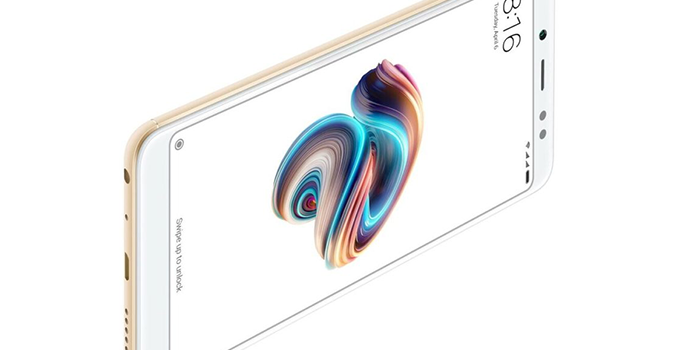
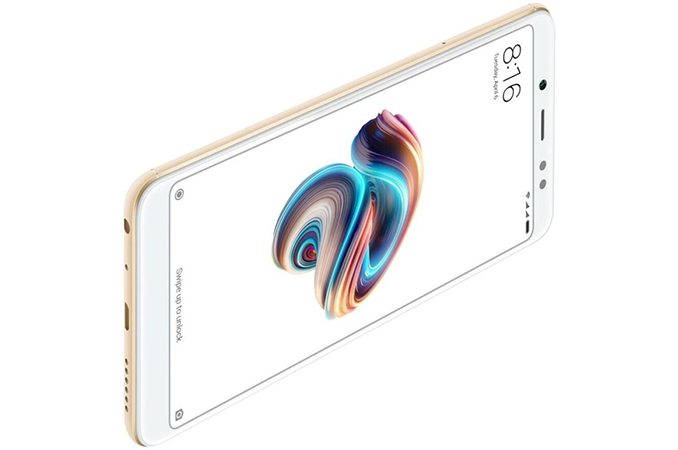
Xiaomi on Wednesday introduced its new Redmi Note 5 and Redmi Note 5 Pro smartphones in India. The key difference between the new phablets and their predecessors is a large 5.99” display with an 18:9 aspect ratio, but there are many other improvements too, including new design, camera, software and so on. The Redmi Note 5 will continue to employ the Qualcomm Snapdragon 625 SoC, but the Redmi Note 5 Pro will use a more powerful Snapdragon 636. The Redmi Note 5 will be priced below $200, whereas the Redmi Note 5 Pro will address audiences demanding higher performance/improved features and will therefore cost more than $200.

New Display & Look

Displays with an 18:9 aspect ratio introduced to the mass market by the LG G6 and the Samsung Galaxy S8/S8+ last year will become more widespread on higher-end, mainstream and specialized smartphones this year. The new Redmi Note 5 and Redmi Note 5 Pro handsets from Xiaomi are outfitted with large 5.99” IPS displays featuring a 1080×2160 resolution and covered by Corning Gorilla Glass for protection.

The larger screens naturally have an impact on overall design of the new smartphones, so it is not surprising that the Redmi Note 5 and Redmi Note 5 Pro look significantly different than their predecessors. Both phones come in an aluminum unibody chassis with rounded edges and antenna separated from the rest of the back cover using polycarbonate strips that look like metal. When compared to the Redmi Note 4, the tapered back covers of the Redmi Note 5/Note 5 Pro seem to have even more rounded edges and a slightly different texture. Xiaomi says that the new shape is more comfortable to use, but keep in mind that all physical features of all mobile gadgets are very individual.
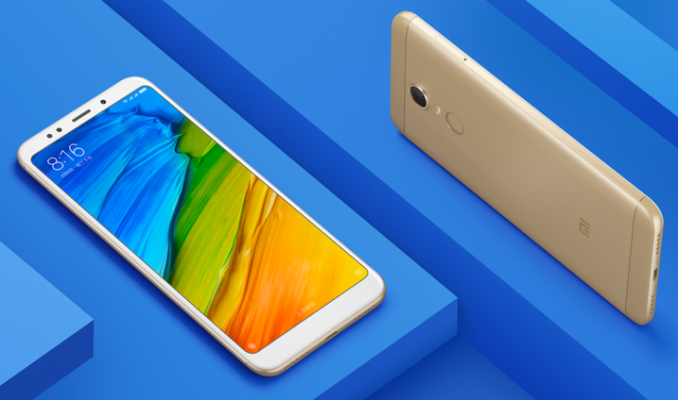
In addition to new design, Xiaomi will also offer a broader choice of colors with the new phablets. The Redmi Note 5 and Redmi Note 5 Pro will be available in matte black, matte blue, matte gold and matte rose gold colors in India. The color lineup might be different in other countries, but it is hard to make guesses about what exactly the manufacturer will offer at this point.

Under the Hood

Now, let’s take a look under the hood. The Xiaomi Redmi Note 5 is based on the Qualcomm Snapdragon 625 SoC, the same model was used for the Redmi Note 4. The chip has eight ARM Cortex-A53 general-purpose cores, the Adreno 506 graphics processor as well as Qualcomm’s X9 LTE modem, its performance and capabilities are well known, so there is nothing new here. It is a bit strange to see one SoC be inside both Redmi Note 4 and Redmi Note 5, but perhaps Xiaomi decided to stick to the chip due to cost reasons in a bid to price the RM5 competitively.

By contrast, the Xiaomi Redmi Note 5 Pro is powered by the Snapdragon 636 featuring Kryo 260 CPU (four semi-custom ARM Cortex A73 cores at 1.8 GHz and four semi-custom ARM Cortex-A53 cores at 1.6 GHz), the Adreno 509 GPU, an LPDDR4X memory controller as well as Qualcomm’s X12 LTE modem. Since A73 cores are among the highest-performing mobile CPU cores today, the Redmi Note 5 Pro will offer significantly higher peak general-purpose performance than the Redmi Note 5. Meanwhile, the S636 will also maintain similar energy efficiency in power saving mode (when compared to the S625) since low-power A53 derivatives are still there; besides, both SoCs are made using Samsung’s 14LPP process technology and therefore their voltages and other physical characteristics are similar.

When it comes to DRAM and storage configurations, Xiaomi will offer various versions of the Redmi Note 5 and Redmi Note 5 Pro — there will be models with 3 GB of memory and 32 GB of NAND flash (the entry-level Note 5), variants with 4 GB of DRAM and 64 GB of storage as well as 6 GB of LPDDR4X with 64 GB of NAND (the flagship Note 5 Pro model). The new Redmi Note 5 smartphones have microSD slots that support cards of up to 128 GB, so it is easy to upgrade internal storage of the new devices (but keep in mind that you are going to need microSD cards with A1 or A2 badges to install software on them).

As for operating system, the new Redmi Note 5 and Redmi Note 5 Pro will ship with the Android Nougat version 7.1.2 with the MIUI 9 on top.

Imaging: New Sensors, Improved Software and LED Flash for Selfies

In addition to different SoCs, the Redmi Note 5 and Redmi Note 5 Pro have vastly different imaging capabilities. The Redmi Note 5 is outfitted with a 12 MP sensor with f/2.2 aperture and a dual-tone LED flash on the back as well as a 5 MP sensor with f/2.0 aperture and a LED flash on the front. Xiaomi claims that the new back-facing camera works better in low light conditions and also has an improved white balance, but one has to test the handset to verify such claims.

By contrast, the Redmi Note 5 Pro comes with a ‘dual’ camera on the back that is comprised of a Sony IMX 486 12 MP (f/2.2, 1.25 μm) sensor, a 5 MP (f/2.0, 1.12 μm) depth sensor from Samsung and a dual-tone LED flash. The camera supports electronic image stabilization, phase detection autofocus as well as a variety of capabilities enabled by a depth sensor. Xiaomi says that the Redmi Note 5 Pro rear camera software features machine learning-based enhancements for more accurate edge detection by using semantic segmentation. On the front, the phone has a Sony IMX376 20 MP (f/2.0, 1/2.8”) sensor with a 4500K LED flash. This camera is also outfitted with the same ML-based software for edge detection, but since it does not have a depth sensor, the algorithm probably works a bit differently here. To further improve quality of selfies made by the front camera, Xiaomi also furnished its Redmi Note 5 Pro smartphone with its Beautify 4.0 software enhancement that supports multiple filters to remove various face imperfections. It is noteworthy that the camera software with Beautify 4.0 enhancements was tuned with India in mind and it remains to be seen whether the company introduces region- and/or country-specific camera enhancements in different parts of the world.

Connectivity, Battery, Security

Connectivity is a mixed bag for the Redmi Note 5. The smartphones support 802.11n Wi-Fi, Bluetooth 4.2 and a microUSB 2.0 port for charging. Both 802.11n and microUSB look a tad outdated for 2018 smartphones. Capping Wi-Fi to 802.11n is something that Xiaomi did to the  S625-based Redmi Note 4, so it is not completely surprising that the company did the same to the Xiaomi Redmi Note 5. Perhaps, Xiaomi will rethink its Wi-Fi support for the Redmi Note 5 aimed at different markets, but only time will tell (frankly, it is something unlikely to happen). Connectivity of the Redmi Note 5 Pro was improved considerably compared to the RN4/RN5. The handset supports 802.11ac Wi-Fi and Bluetooth 5.0, but it still uses microUSB 2.0 port for charging.

As for WWAN connectivity, the Snapdragon 625 and 636 support LTE, WCDMA, CDMA and GSM, but since this was an India-specific announcement, Xiaomi revealed bands fthat are relevant for this country and particular models. In any case, the best thing one can get out of the S625/X9 is 300 Mbps DL and 150 Mbps UL, whereas the S636/X12 supports up to 600 Mbps DL and 150 Mbps UL. Exact capabilities of particular smartphones depend on what manufacturers decide to support.

Next up is biometric security, which is a standard capability nowadays. The Redmi Note 5 and Redmi Note 5 Pro are equipped with fingerprint readers, but the latter will also support Face Unlock feature after it gets an OTA update in late March. According to Xiaomi, its face recognition mechanism works faster than its fingerprint reader, but at present the company does not go beyond that.

Both new smartphones from Xiaomi are equipped with a 4000 mAh battery that enables them to last for at least a day of active usage (based on the manufacturer’s clams). The company is known for using high-capacity batteries in its handsets, so the Redmi Note 5 and Redmi Note 5 Pro are not exceptions.

Xiaomi Note 5 and Note 5 Pro Smartphones
  Redmi Note 5
3 GB/32 GB
Redmi Note 5
4 GB/64 GB
Redmi Note 5 Pro
4 GB/64 GB
Redmi Note 5 Pro
6 GB/64 GB
SoC Qualcomm Snapdragon 625
8 × ARM Cortex-A53 at 2 GHz
Adreno 506 at 624 MHz
Qualcomm Snapdragon 636
4 × custom ARM Cortex-A73 at 1.8 GHz
4 × custom ARM Cortex-A53 at 1.6 GHz
Adreno 509
RAM  3 GB LPDDR3 4 GB LPDDR3 4 GB LPDDR4X 6 GB LPDDR4X
Storage 32 GB + microSD 64 GB + microSD
Display 5.99″ 2160×1080 (403 ppi)
450 nits brightness
1000:1 contrast ratio
84% NTSC color gamut
Network 4G: LTE FDD 1/3/5, LTE TDD 40/41
3G: WCDMA 1/2/5/8
2G: 2/3/5/8
LTE Down: 300 Mb/s
Up: 150 Mb/s
Down: 600 Mb/s
Up: 150 Mb/s
Fingerprint  Yes
Dimensions 158.5 × 75.5 × 8.1 mm
6.24 × 2.97 × 0.32 inches
Weight ~180 grams
Rear Camera

12 MP (f/2.2 aperture)

dual-tone LED flash

12 MP (f/2.2, 1.25 μm)
Sony IMX 486 sensor

5 MP (f/2.0, 1.12 μm)
Samsung depth sensor

Dual-tone LED flash

Front Camera 5 MP (f/2.0 aperture)
LED flash
Sony IMX376 20 MP (f/2.0, 1/2.8”) sensor
4500K LED flash
Battery 4000 mAh
OS Google Android 7.1.2 with MIUI 9
Connectivity 802.11 b/g/n Wi-Fi, Bluetooth 4.2, microUSB 2.0, 3.5mm TRRS 802.11 b/g/ac Wi-Fi, Bluetooth 5
microUSB 2.0, 3.5mm TRRS
Navigation GPS + GLONASS
SIM Size Nano SIM + micro SD/Dual Nano SIM
Colors Black, Gold, Blue, Rose Gold
Launch Countries India
Price Rs. 9,999
$156
Rs. 11,999
$187
Rs. 13,999
$219
Rs. 16,999
$265

Price & Availability

Xiaomi will start selling its new Redmi Note 5 and Redmi Note 5 Pro smartphones in India this month and will gradually expand their availability to other markets in the coming months and quarters. The Redmi Note 5 will retail starting from Rs. 9,999 ($156) for the 3 GB + 32 GB version and Rs. 11,999 ($187) for the 4 GB + 64 GB variant. The Redmi Note 5 Pro will naturally be more expensive: the flagship model with 6 GB of LPDDR4X and 64 GB of NAND will cost Rs. 16,999 ($265), whereas a SKU with 4 GB of DRAM and 64 GB of storage will be priced at Rs. 13,999 ($219).

Related Reading:

Source: Xiaomi