News


MWC 2017: Oppo Demonstrates 5X Optical Zoom for Smartphones
MWC 2017: Oppo Demonstrates 5X Optical Zoom for Smartphones

This year at MWC, Oppo showed off a smartphone prototype that used a new implementation of dual cameras to offer a 5X optical zoom. The company did not reveal anything about the actual plans to use it for products, nor did they reveal the cost of its implementation, but it is likely that it will reach the market sometimes in the future.

Imaging capabilities of smartphones have been evolving rapidly since the introduction of the first handsets with cameras. Throughout the history of phones making photos, manufacturers have developed new lens packs, new CMOS sensors and extensive ISPs (image sensor processors) in order to improve the capability and/or quality of images. For a while, a number of makers tended to install higher-resolution sensors simply because the ‘megapixel number’ was easier to explain than the quality of optics or advanced ISPs. A lot has changed in the recent years as various smartphone makers have invested in high-end lenses (co-developed with Carl Zeiss, Leica, etc.), developed their own SoCs/ISPs for image processing, and other potential differentiators in a cramped smartphone ecosystem.

So at MWC 2017, multiple smartphone manufacturers demonstrated their products with dual back-facing sensors (RGB+RGB or RGB+IR) to further improve their photography acumen. One of those was Oppo using the two sensors to build a portable camera system with a 5X optical zoom in a very different configuration to what we have seen before.

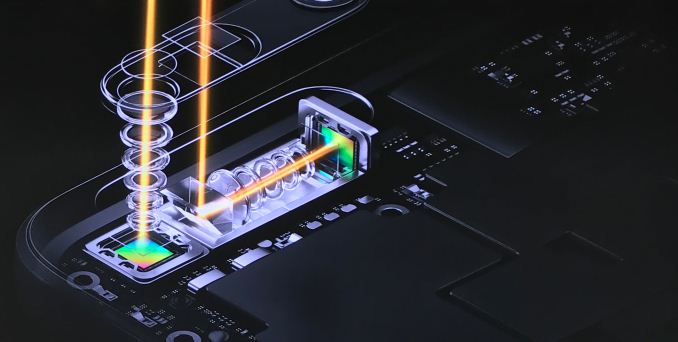
Optical zoom is not anything new for smartphones, but Oppo’s approach is a little bit different compared to that used by other makers. The 5X dual camera optical zoom from Oppo relies on two image sensors:

  • The first is placed inline with the motherboard (just like sensors inside all smartphones) and is equipped with a regular lens pack such that the light hits the sensor with minimal adjustment.  
  • The second is placed perpendicularly to the motherboard and is equipped with other optics with image stabilization and optical zoom. It is possible that the lens system here can physically move to allow for extra enhancement.

To direct the light to the second sensor, Oppo uses a special prism mirror placed perpendicularly to the motherboard (so, basically, everything works like a periscope) and which it can precisely regulate angles as low as 0.0025 degrees to compensate shaking. To enable 5X optical zoom, an unknown ISP processes images from both sensors.
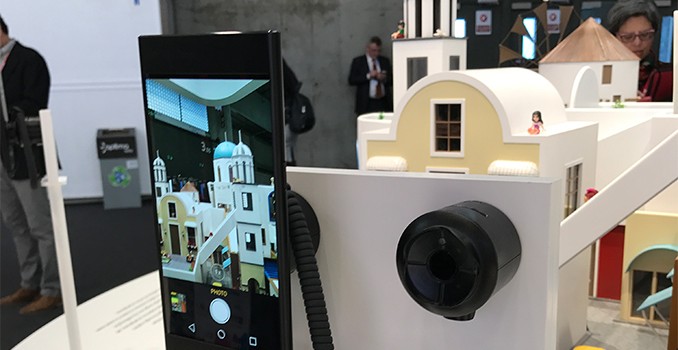
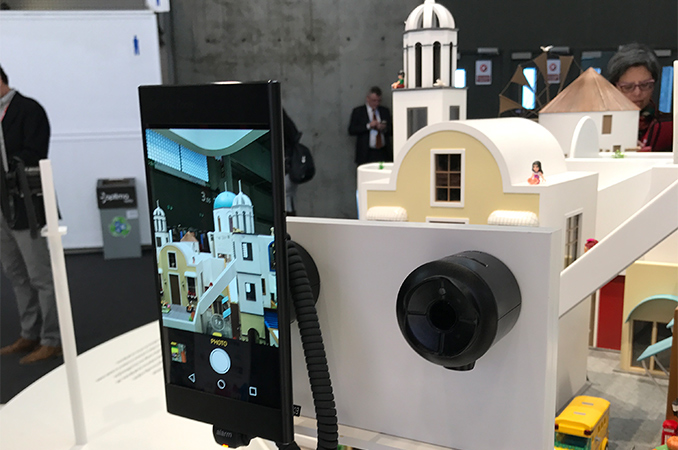
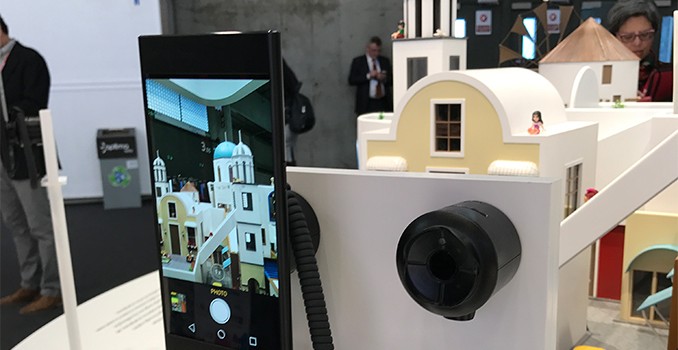
In its booth at the MWC 2017, Oppo demonstrated promo videos describing the added qualities of its optical zoom capabilities, as well as its optical image stabilization. In addition, the company allowed visitors to try out the prototype devices. One of the concerns, when you use mirrors to transfer light, is that luminous intensity drops as well as a drop in the quality of images. In its video at the trade show, Oppo showcased that the quality of the photos made using the prototype featuring its 5X dual camera optical zoom in dark conditions was better when compared to images made by an ‘unknown’ rival. With a minor hands-on, we noticed no immediate problems shooting the images in light conditions. There are other phones with prisms used in the market it should be noted, however not quite used in this way.
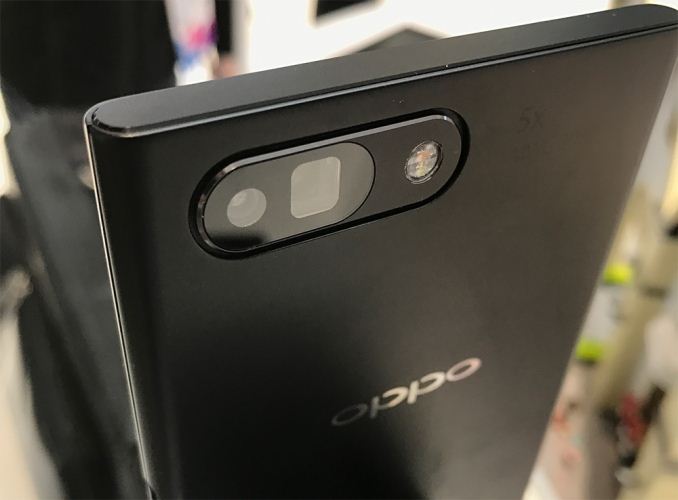
Oppo did not mention which smartphones are going to use its 5X dual camera optical zoom technology, nor did it mention when. The reference system on the show floor looks slim, so it could be installed into various handsets by Oppo and give the company an opportunity to use it for its top-of-the-range smartphones with large displays, or perhaps for smaller models as well (provided that they have appropriate SoCs/ISPs).
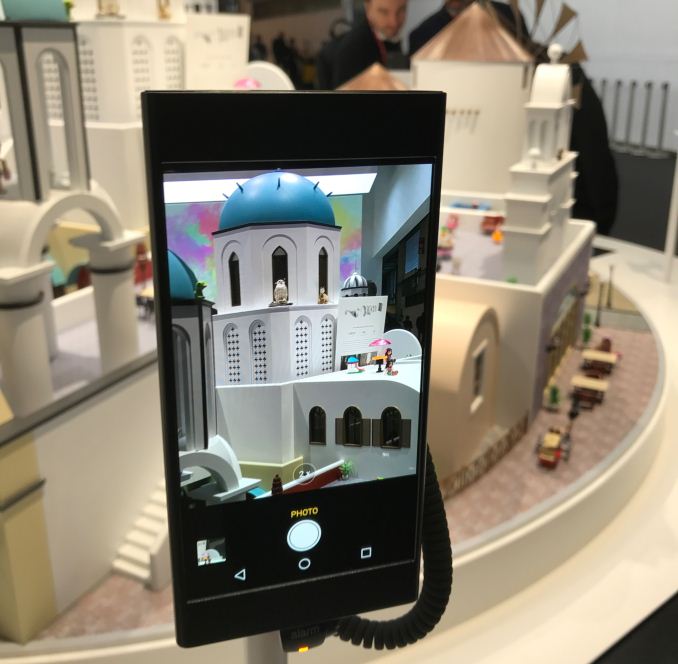
It is noteworthy that in its briefing materials, Oppo did not state the type of sensors in use, but solely emphasized only the 5X dual cam optical zoom. This may likely be a work in progress for a future device, which may or may not be a smartphone.

MWC 2017: Oppo Demonstrates 5X Optical Zoom for Smartphones

MWC 2017: Oppo Demonstrates 5X Optical Zoom for Smartphones

This year at MWC, Oppo showed off a smartphone prototype that used a new implementation of dual cameras to offer a 5X optical zoom. The company did not reveal anything about the actual plans to use it for products, nor did they reveal the cost of its implementation, but it is likely that it will reach the market sometimes in the future.

Imaging capabilities of smartphones have been evolving rapidly since the introduction of the first handsets with cameras. Throughout the history of phones making photos, manufacturers have developed new lens packs, new CMOS sensors and extensive ISPs (image sensor processors) in order to improve the capability and/or quality of images. For a while, a number of makers tended to install higher-resolution sensors simply because the ‘megapixel number’ was easier to explain than the quality of optics or advanced ISPs. A lot has changed in the recent years as various smartphone makers have invested in high-end lenses (co-developed with Carl Zeiss, Leica, etc.), developed their own SoCs/ISPs for image processing, and other potential differentiators in a cramped smartphone ecosystem.

So at MWC 2017, multiple smartphone manufacturers demonstrated their products with dual back-facing sensors (RGB+RGB or RGB+IR) to further improve their photography acumen. One of those was Oppo using the two sensors to build a portable camera system with a 5X optical zoom in a very different configuration to what we have seen before.

Optical zoom is not anything new for smartphones, but Oppo’s approach is a little bit different compared to that used by other makers. The 5X dual camera optical zoom from Oppo relies on two image sensors:

  • The first is placed inline with the motherboard (just like sensors inside all smartphones) and is equipped with a regular lens pack such that the light hits the sensor with minimal adjustment.  
  • The second is placed perpendicularly to the motherboard and is equipped with other optics with image stabilization and optical zoom. It is possible that the lens system here can physically move to allow for extra enhancement.

To direct the light to the second sensor, Oppo uses a special prism mirror placed perpendicularly to the motherboard (so, basically, everything works like a periscope) and which it can precisely regulate angles as low as 0.0025 degrees to compensate shaking. To enable 5X optical zoom, an unknown ISP processes images from both sensors.

In its booth at the MWC 2017, Oppo demonstrated promo videos describing the added qualities of its optical zoom capabilities, as well as its optical image stabilization. In addition, the company allowed visitors to try out the prototype devices. One of the concerns, when you use mirrors to transfer light, is that luminous intensity drops as well as a drop in the quality of images. In its video at the trade show, Oppo showcased that the quality of the photos made using the prototype featuring its 5X dual camera optical zoom in dark conditions was better when compared to images made by an ‘unknown’ rival. With a minor hands-on, we noticed no immediate problems shooting the images in light conditions. There are other phones with prisms used in the market it should be noted, however not quite used in this way.

Oppo did not mention which smartphones are going to use its 5X dual camera optical zoom technology, nor did it mention when. The reference system on the show floor looks slim, so it could be installed into various handsets by Oppo and give the company an opportunity to use it for its top-of-the-range smartphones with large displays, or perhaps for smaller models as well (provided that they have appropriate SoCs/ISPs).

It is noteworthy that in its briefing materials, Oppo did not state the type of sensors in use, but solely emphasized only the 5X dual cam optical zoom. This may likely be a work in progress for a future device, which may or may not be a smartphone.

MWC 2017: Panasonic Demonstrates Store Window as a Transparent Screen

MWC 2017: Panasonic Demonstrates Store Window as a Transparent Screen

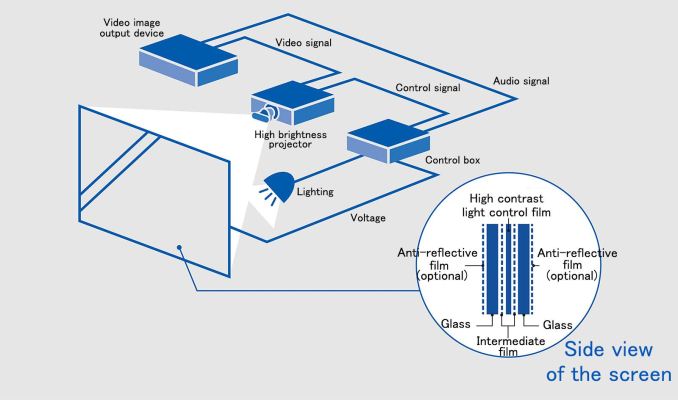
At Mobile World Congress this year, Panasonic demonstrated a glass that can be turned into a display in an instant. The solution relies on a thin film between the sheets of glass that can quickly change its properties when electricity is supplied, allowing a rear projector to focus and provide an image. The system is currently aimed at retailers that want to attract more attention to their stores and shelves. The company says that the first deployments of the technology are expected this spring.

There are typically two ways for stores to attract the attention of those passing by. Either put something interesting in the shop window, or replace the window with LCD screens that showcase something appealing. The new solution that Panasonic is showing blends traditional showcases and displays, enabling owners of stores to have both. The technology behind the solution appears to be relatively simple: Panasonic takes two glasses and puts a special light-control film between them.

The film is matte and can be used to display images that are projected onto it using a conventional off-the-shelf projector. But when electricity is applied to the film, it becomes transparent. Similar opaque glass technologies are in frequent use, applying a potential difference across two electrodes embedded in the glass and between an electrolyte whereby larger particles in the electrolyte self-assemble in the presence of an electronic charge to allow light to pass through. This ends up being a natural extension of what Panasonic has shown at other recent events regarding large glass projection display technology.

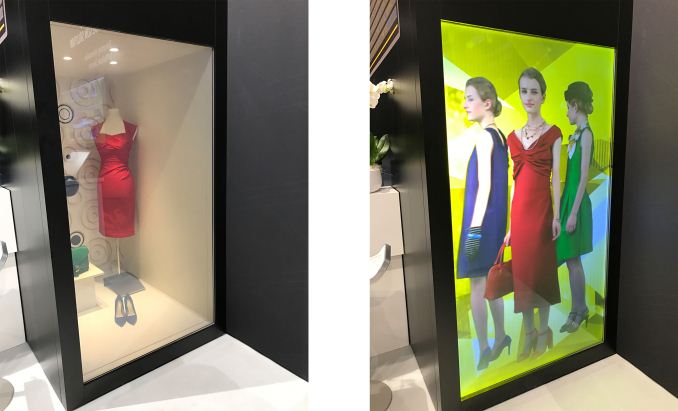
At MWC 2017, Panasonic showed a booth with a mannequin wearing a red dress, a pair of black shoes, a green handbag. The lens of the projector was camouflaged with the environment. Once the film is “switched”, the 1×2 meter window can be used as a screen and this is where Panasonic is demonstrating a video with a model wearing that exact red dress (albeit, with red shoes). The manufacturer says that the resolution of the display depends entirely on the resolution of the projector, but the density of the non-transparent particles as well as the placement of the projector have its effect on the quality too. Meanwhile, since the videos are displayed using a projector, it should not be too hard for stores to set everything up for transparent screens.

Panasonic does not reveal the tech behind its smart glass and as there are multiple types of films that can change their properties when electricity is applied, which makes estimating difficult without an official announcement. What is important here is that the glass can either be a screen, or completely transparent. So, unless you stick several glasses together, the window will be either a window or a display, which limits the number of applications that can use the tech.

At present, a 1×2 meter wall (XC-CSG01G) is the maximum size of Panasonic’s “transparent screen”, so, if someone wants a larger wall, they have to use several glasses and projectors in sync. The total cost for a single 1×2 meter display with a control box (XC-CSC01G-A1) like this will be around $3000-$4000 according to a Panasonic rep at the booth (not sure if this includes the projector, it doesn’t sound like it does, but that price is minus a support contract). Panasonic states that the company already has customers interested in these products and are basically ready to accept delivery. The high price of Panasonic’s transparent screen glass is conditioned not only by its capabilities but also by the fact that everything has to be rugged and work properly for different weather and temperatures. Panasonic plans to start selling its “transparent screens” in Japan first and then look for customers in other parts of the world as well.

MWC 2017: Panasonic Demonstrates Store Window as a Transparent Screen

MWC 2017: Panasonic Demonstrates Store Window as a Transparent Screen

At Mobile World Congress this year, Panasonic demonstrated a glass that can be turned into a display in an instant. The solution relies on a thin film between the sheets of glass that can quickly change its properties when electricity is supplied, allowing a rear projector to focus and provide an image. The system is currently aimed at retailers that want to attract more attention to their stores and shelves. The company says that the first deployments of the technology are expected this spring.

There are typically two ways for stores to attract the attention of those passing by. Either put something interesting in the shop window, or replace the window with LCD screens that showcase something appealing. The new solution that Panasonic is showing blends traditional showcases and displays, enabling owners of stores to have both. The technology behind the solution appears to be relatively simple: Panasonic takes two glasses and puts a special light-control film between them.

The film is matte and can be used to display images that are projected onto it using a conventional off-the-shelf projector. But when electricity is applied to the film, it becomes transparent. Similar opaque glass technologies are in frequent use, applying a potential difference across two electrodes embedded in the glass and between an electrolyte whereby larger particles in the electrolyte self-assemble in the presence of an electronic charge to allow light to pass through. This ends up being a natural extension of what Panasonic has shown at other recent events regarding large glass projection display technology.

At MWC 2017, Panasonic showed a booth with a mannequin wearing a red dress, a pair of black shoes, a green handbag. The lens of the projector was camouflaged with the environment. Once the film is “switched”, the 1×2 meter window can be used as a screen and this is where Panasonic is demonstrating a video with a model wearing that exact red dress (albeit, with red shoes). The manufacturer says that the resolution of the display depends entirely on the resolution of the projector, but the density of the non-transparent particles as well as the placement of the projector have its effect on the quality too. Meanwhile, since the videos are displayed using a projector, it should not be too hard for stores to set everything up for transparent screens.

Panasonic does not reveal the tech behind its smart glass and as there are multiple types of films that can change their properties when electricity is applied, which makes estimating difficult without an official announcement. What is important here is that the glass can either be a screen, or completely transparent. So, unless you stick several glasses together, the window will be either a window or a display, which limits the number of applications that can use the tech.

At present, a 1×2 meter wall (XC-CSG01G) is the maximum size of Panasonic’s “transparent screen”, so, if someone wants a larger wall, they have to use several glasses and projectors in sync. The total cost for a single 1×2 meter display with a control box (XC-CSC01G-A1) like this will be around $3000-$4000 according to a Panasonic rep at the booth (not sure if this includes the projector, it doesn’t sound like it does, but that price is minus a support contract). Panasonic states that the company already has customers interested in these products and are basically ready to accept delivery. The high price of Panasonic’s transparent screen glass is conditioned not only by its capabilities but also by the fact that everything has to be rugged and work properly for different weather and temperatures. Panasonic plans to start selling its “transparent screens” in Japan first and then look for customers in other parts of the world as well.

Intel to Acquire Mobileye for $15 Billion

Intel to Acquire Mobileye for $15 Billion

In an interesting announcement today, Intel and Mobileye have entered into an agreement whereby Intel will commence a tender offer for all issued and outstanding ordinary shared of Mobileye. At $63.54 per share, this will equate to a value of approximately $15 billion.

Mobileye is currently one of a number of competitors actively pursuing the visual computing space, and the high item on that agenda is automotive. We’ve seen Mobileye announcements over the last few years, with relationships with car manufacturers on the road to fully autonomous vehicles. Intel clearly wants a piece of that action, aside from its own movement into automotive as well as cloud computing required for various automotive tasks.

Intel estimates that vehicle systems, data, and the services market for automotive to have a value around $70 billion by 2030, including edge cases through backhaul into cloud. This includes predictions such that 4TB of data per day per vehicle will be generated, which is going to require planning in infrastructure. Intel’s expertise in elements such as the RealSense technology and high-performance general compute will be an interesting match to Mobileye’s portfolio.

“This acquisition is a great step forward for our shareholders, the automotive industry, and consumers,” said Brian Krzanich, Intel CEO. “Intel provides critical foundational technologies for autonomous driving including plotting the car’s path and making real-time driving decisions. Mobileye brings the industry’s best automotive-grade computer vision and strong momentum with automakers and suppliers. Together, we can accelerate the future of autonomous driving with improved performance in a cloud-to-car solution at a lower cost for automakers.”

The acquisition will combine into a single organization under Intel’s Automated Driving Group, to be HQ in Israel and led by Prof Shashua, Mobileye’s co-founder, Chairman and CEO. All current contracts under Mobileye for automotive OEMs and tier-one suppliers will be retained under the single group, which will also be under Doug Davis, Intel’s SVP of Intel’s Automotive.

Mobileye currently offers on its roadmap products such as the EyeQ4 and EyeQ 5 SoCs, for level 3/4 autonomy in 2018 and 2020 respectively, as well as high-performance FPGAs for vision analytical techniques. The acquisition of Altera by Intel over a year ago as a step into the FPGA market may come into play here, as well as Intel’s semiconductor manufacturing facilities. As with Altera, it will likely take some time before full integration between Intel’s resources and Mobileye’s technology occurs.

There will be an investor call webcast on 3/13 at 8:30 am (ET) about this announcement at this link here. The full transaction is expected to close within nine months, subject to regulatory approval, and is not subject to any financing conditions. Intel intends to fund the acquisition with cash from the balance sheet.

As we get more information we will let you know.

Additional 1: For scope, Intel’s purchase of Altera was $16.7 billion, as we reported here.

Additional 2: Here is the Investor Call slide deck.

Additional 3: It will require purchasing 95% of the ordinary stock, and will use offshore cash that Intel has not repatriated into the US.