News


Intel Announces SSD DC P3608 Series
Intel Announces SSD DC P3608 Series

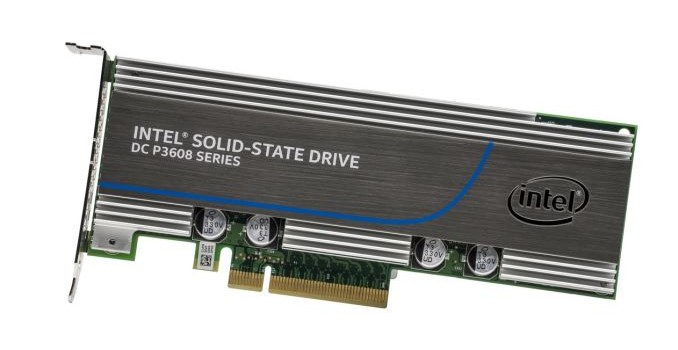
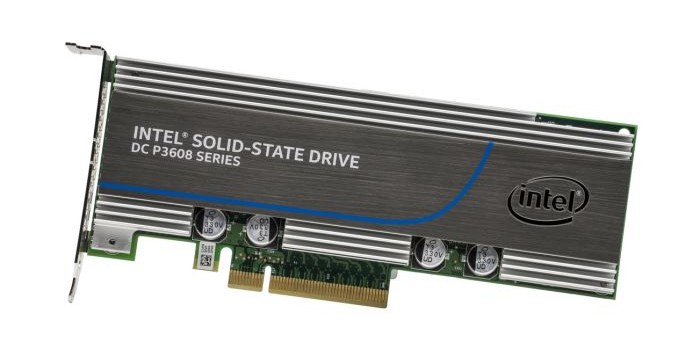
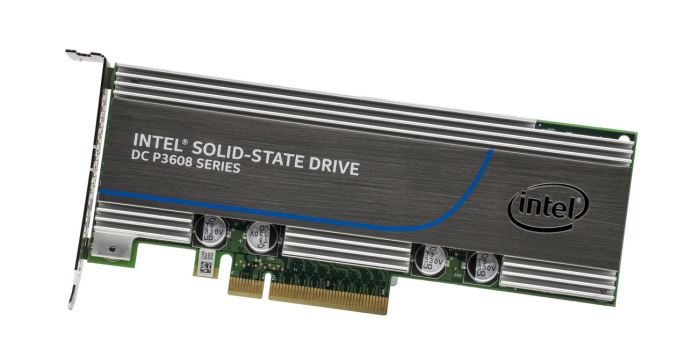
Intel is introducing a new family of enterprise PCIe SSDs with the aim of outperforming their existing DC P3600 series and even beating the DC P3700 series in many metrics. To do this, they’ve essentially put two P3600 SSDs on to one expansion card and widened the interface to 8 lanes of PCIe 3.0. While this does come across as a bit of a quick and dirty solution, it is a very straightforward way for Intel to deliver higher performance, albeit at the cost of sharply increased power consumption.

The SSD DC P3608 appears to the system as two individual NVMe drives behind a PLX PCIe switch chip. This means that extracting full performance from this card will require software RAID-0 or some similar software load-balancing solution. A new version of Intel’s Rapid Storage Toolkit for Enterprise (RSTe) drivers will be providing this capability. The overhead of the PCIe switch and managing two independent controllers means that the P3608 cannot attain an oughtright doubling of the P3600’s performance.

The inclusion of two SSD controllers and a PCIe switch chip also drives idle power consumption up to 11.5W and makes a 2.5″ form factor impossible, so the P3608 series will only be available as a half-height half-length PCIe expansion card. Intel’s not too worried about the form factor constraint, because they’re now able to make full use of the 8-lane PCIe slots that are the most common in the sort of servers these drives are typically used in.

The SSD DC P3608 is available in three capacities, with the smallest 1.6TB configuration having more overprovisioning to boost random write speeds. Active power consumption varies with capacity, but all models support a power governor setting to limit power consumption to 35W or 25W instead of the worst-case 40W. Intel has provided us with a 1.6TB SSD DC P3608, so a full review is on its way.

Intel Enterprise PCIe SSDs
  P3608 4TB P3608 3.2TB P3608 1.6TB P3700 1.6TB P3600 1.6TB
Capacity 4TB 3.2TB 1.6TB 1.6TB 1.6TB
4kB Random Read (IOPS) 850,000 850,000 850,000 450,000 450,000
4kB Random Write (IOPS) 50,000 80,000 150,000 150,000 56,000
Sequential Read (MB/s) 5,000 4,500 5,000 2,800 2,600
Sequential Write (MB/s) 3,000 2,600 2,000 1,900 1,600
Idle Power (W) 11.5 11.5 11.5 4 4
Read Power (W) 20 18 18 10 9
Write Power (W) 40 35 30 22 20
Form Factor PCIe 3.0 x8 HHHL PCIe 3.0 x4 HHHL or 2.5″ 15mm
Endurance Rating 3 DWPD 15 DWPD 3 DWPD
Warranty 5 years


Intel Announces SSD DC P3608 Series

Intel Announces SSD DC P3608 Series

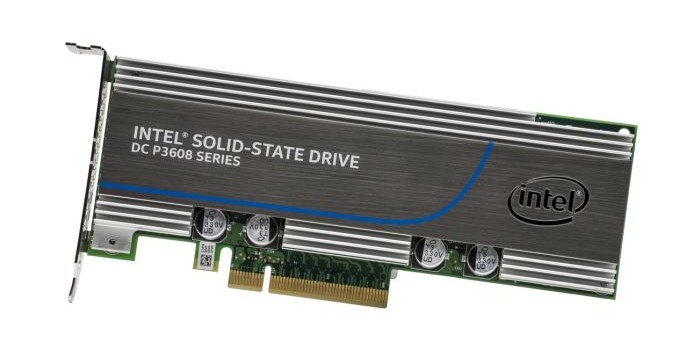
Intel is introducing a new family of enterprise PCIe SSDs with the aim of outperforming their existing DC P3600 series and even beating the DC P3700 series in many metrics. To do this, they’ve essentially put two P3600 SSDs on to one expansion card and widened the interface to 8 lanes of PCIe 3.0. While this does come across as a bit of a quick and dirty solution, it is a very straightforward way for Intel to deliver higher performance, albeit at the cost of sharply increased power consumption.

The SSD DC P3608 appears to the system as two individual NVMe drives behind a PLX PCIe switch chip. This means that extracting full performance from this card will require software RAID-0 or some similar software load-balancing solution. A new version of Intel’s Rapid Storage Toolkit for Enterprise (RSTe) drivers will be providing this capability. The overhead of the PCIe switch and managing two independent controllers means that the P3608 cannot attain an oughtright doubling of the P3600’s performance.

The inclusion of two SSD controllers and a PCIe switch chip also drives idle power consumption up to 11.5W and makes a 2.5″ form factor impossible, so the P3608 series will only be available as a half-height half-length PCIe expansion card. Intel’s not too worried about the form factor constraint, because they’re now able to make full use of the 8-lane PCIe slots that are the most common in the sort of servers these drives are typically used in.

The SSD DC P3608 is available in three capacities, with the smallest 1.6TB configuration having more overprovisioning to boost random write speeds. Active power consumption varies with capacity, but all models support a power governor setting to limit power consumption to 35W or 25W instead of the worst-case 40W. Intel has provided us with a 1.6TB SSD DC P3608, so a full review is on its way.

Intel Enterprise PCIe SSDs
  P3608 4TB P3608 3.2TB P3608 1.6TB P3700 1.6TB P3600 1.6TB
Capacity 4TB 3.2TB 1.6TB 1.6TB 1.6TB
4kB Random Read (IOPS) 850,000 850,000 850,000 450,000 450,000
4kB Random Write (IOPS) 50,000 80,000 150,000 150,000 56,000
Sequential Read (MB/s) 5,000 4,500 5,000 2,800 2,600
Sequential Write (MB/s) 3,000 2,600 2,000 1,900 1,600
Idle Power (W) 11.5 11.5 11.5 4 4
Read Power (W) 20 18 18 10 9
Write Power (W) 40 35 30 22 20
Form Factor PCIe 3.0 x8 HHHL PCIe 3.0 x4 HHHL or 2.5″ 15mm
Endurance Rating 3 DWPD 15 DWPD 3 DWPD
Warranty 5 years


Intel Announces SSD DC P3608 Series

Intel Announces SSD DC P3608 Series

Intel is introducing a new family of enterprise PCIe SSDs with the aim of outperforming their existing DC P3600 series and even beating the DC P3700 series in many metrics. To do this, they’ve essentially put two P3600 SSDs on to one expansion card and widened the interface to 8 lanes of PCIe 3.0. While this does come across as a bit of a quick and dirty solution, it is a very straightforward way for Intel to deliver higher performance, albeit at the cost of sharply increased power consumption.

The SSD DC P3608 appears to the system as two individual NVMe drives behind a PLX PCIe switch chip. This means that extracting full performance from this card will require software RAID-0 or some similar software load-balancing solution. A new version of Intel’s Rapid Storage Toolkit for Enterprise (RSTe) drivers will be providing this capability. The overhead of the PCIe switch and managing two independent controllers means that the P3608 cannot attain an oughtright doubling of the P3600’s performance.

The inclusion of two SSD controllers and a PCIe switch chip also drives idle power consumption up to 11.5W and makes a 2.5″ form factor impossible, so the P3608 series will only be available as a half-height half-length PCIe expansion card. Intel’s not too worried about the form factor constraint, because they’re now able to make full use of the 8-lane PCIe slots that are the most common in the sort of servers these drives are typically used in.

The SSD DC P3608 is available in three capacities, with the smallest 1.6TB configuration having more overprovisioning to boost random write speeds. Active power consumption varies with capacity, but all models support a power governor setting to limit power consumption to 35W or 25W instead of the worst-case 40W. Intel has provided us with a 1.6TB SSD DC P3608, so a full review is on its way.

Intel Enterprise PCIe SSDs
  P3608 4TB P3608 3.2TB P3608 1.6TB P3700 1.6TB P3600 1.6TB
Capacity 4TB 3.2TB 1.6TB 1.6TB 1.6TB
4kB Random Read (IOPS) 850,000 850,000 850,000 450,000 450,000
4kB Random Write (IOPS) 50,000 80,000 150,000 150,000 56,000
Sequential Read (MB/s) 5,000 4,500 5,000 2,800 2,600
Sequential Write (MB/s) 3,000 2,600 2,000 1,900 1,600
Idle Power (W) 11.5 11.5 11.5 4 4
Read Power (W) 20 18 18 10 9
Write Power (W) 40 35 30 22 20
Form Factor PCIe 3.0 x8 HHHL PCIe 3.0 x4 HHHL or 2.5″ 15mm
Endurance Rating 3 DWPD 15 DWPD 3 DWPD
Warranty 5 years


Meizu Announces New PRO 5

Meizu Announces New PRO 5

 
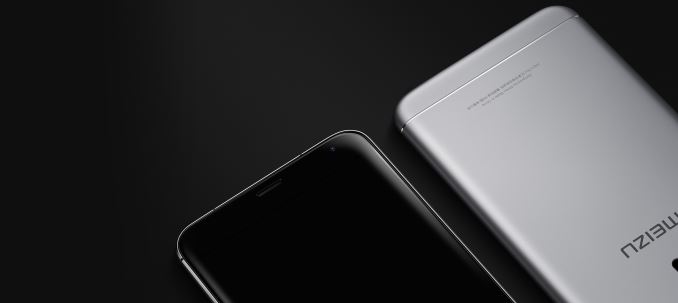
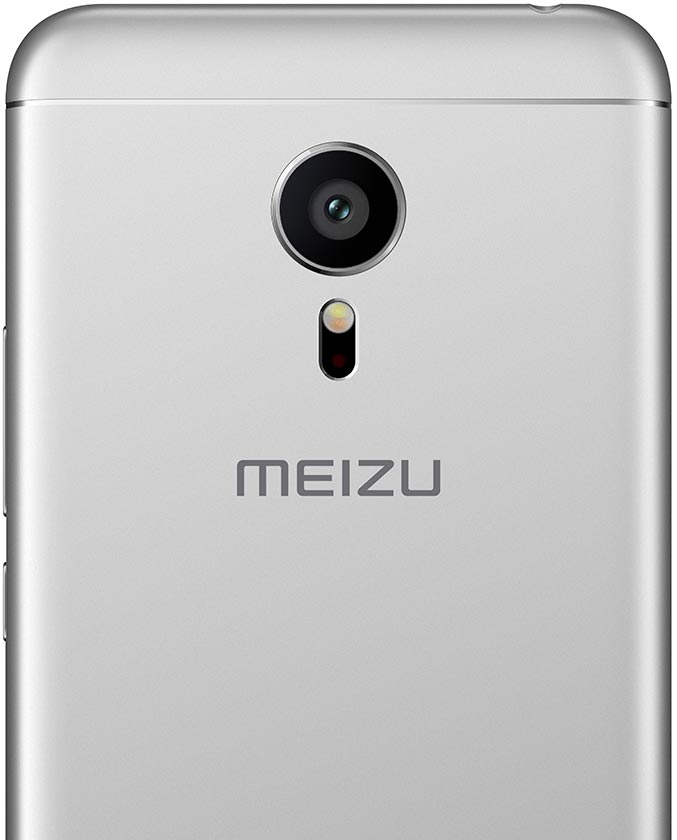
Today Meizu launches its new high-end flagship, the PRO 5. It was expected for Meizu to market this device as the MX5 Pro but it seems Meizu has chosen to separate the lineup to give better exposure to the higher-end “PRO” series. We’ve had a short look at the MX5 announcement earlier this summer, so while keeping that in mind, let’s go over the improvements that the PRO 5 brings with itself.
 
At the heart of the phone we see Samsung’s Exynos 7420 SoC. Meizu is one of the rare vendors besides Samsung Electronics to actually employ S.LSI’s silicon so this puts the Chinese manufacturer in an interesting position this year as this allows them to have a competitive advantage over other manufacturers who chose other SoC suppliers. As we’ve seen earlier in the year, we deemed the Exynos 7420 as one of the highlights of this year so the PRO 5 is well served by the big.LITTLE chipset consisting of 4x Cortex A57 at 2.1GHz and 4x Cortex A53’s at 1.5GHz. Graphics is provided by a Mali T760MP8 at 770MHz – also a top performer among SoCs this year.
 
Meizu PRO 5 Specifications
SoC Samsung Exynos 7420

4x Cortex A57 @ 2.1GHz +
4x Cortex A53 @ 1.5GHz   

Mali T760MP8 @ 770MHz  

RAM 3 / 4GB LPDDR4-3200
NAND / Storage 32 / 64GB UFS 2.0
+ microSD
Display 5.7″ 1920×1080 SuperAMOLED
2.5D Gorilla Glass 3
Network 2G / 3G / 4G LTE
FDD-LTE / TD-LTE / TD-SCDMA / WCDMA / GSM
(Chinese Bands)
Dimensions 156.7 x 78 x 7.5 mm
168 grams
Camera 21.16MP Sony IMX230 sensor F/2.0 Main camera
w/ Laser + PDAF auto-focus
w/ Dedicated Samsung ISP

5MP F/2.0 Front camera

Battery 3050mAh
OS Android 5.1
with Meizu FlymeOS 5.0
Connectivity 802.11 b/g/n/ac + BT 4.1 + BLE, GPS/GNSS
USB Type C
SIM Size nanoSIM + nanoSIM
or 
nanoSIM + microSD

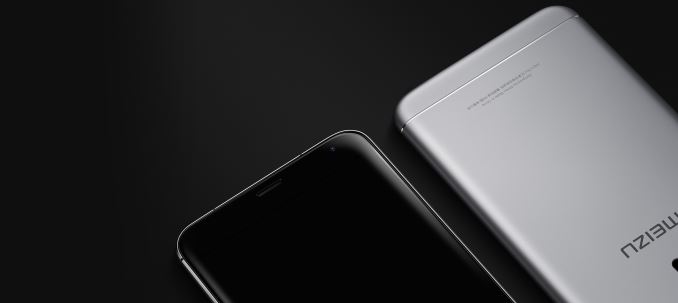
Meizu continues the newly introduced usage of AMOLED screens. Similar to the MX4, the PRO5 uses a 1080p Samsung panel, but this time it increases the size to 5.7″, increasing the footprint of the device to 156.7 x 78mm. The screen now features 2.5D edges and is protected by Corning Gorilla Glass 3. Meizu was able to shave off 0.1mm of the thickness to get to a total of 7.5mm on the new flagship, but it seems the battery slightly lost some capacity in the process as it goes from 3150mAh in the MX5 to 3050mAh in the PRO5.

Storage-wise the device comes with either 32 or 64GB of memory backed by the new generation UFS 2.0 interface. Main memory also varies between 3GB or 4GB depending on the variant. What is new for Meizu is that for the first time the company is employing a microSD card slot that is part of the dual-SIM tray, meaning one can choose to use either two nanoSIMs, or have a combination of a microSD with a nanoSIM. The dual-SIM functionality provides dual-standby.

Meizu doesn’t specify the specific bands or what kind of baseband processor is used on the PRO5. Last year we saw the MX4 Pro make unique use of a Marvell Armada baseband so we’ll have to wait until the device is launched to find out what made it into this year’s unit. It should be mentioned though that for now it seems Meizu limits itself to the Chinese market as the band support for western networks looks to be sparse.

On the camera-side, we now see usage of a new Sony IMX230 sensor. This is the same sensor found on the recently announced Moto X Style and Moto X Play. The sensor is encased in a 6-lens F/2.0 camera module. Interestingly, Meizu advertises usage of a dedicated Samsung ISP that is supposed to improve image quality. The camera is able to record 4K video in HEVC format, which should help reduce file sizes.

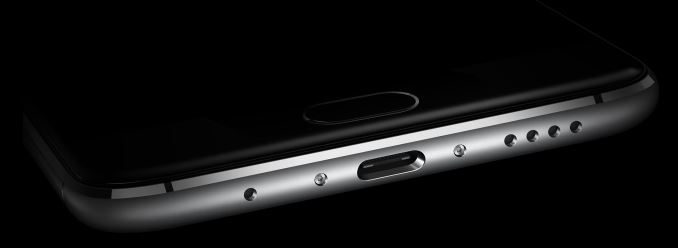
Among the usual top-end connectivity features, the phone comes with a new USB Type C connector which should enable it to be future-proof as the industry transitions over to the new standard. 

The Meizu PRO5 comes in gold, grey, silver and silver & black colour options in either 3GB/32GB or 4GB/64GB variants priced at respectively¥2799 (US$438, 393€) or ¥3099 (US$485, 435€).

Source: Meizu

Meizu Announces New PRO 5

Meizu Announces New PRO 5

 
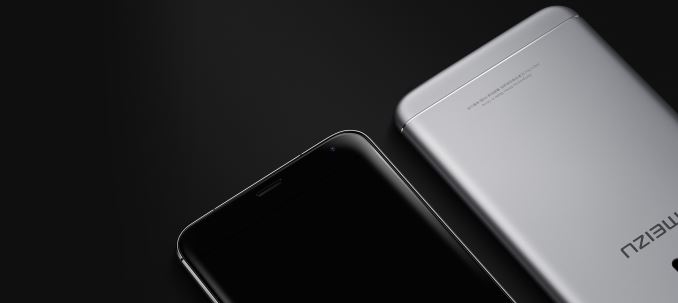
Today Meizu launches its new high-end flagship, the PRO 5. It was expected for Meizu to market this device as the MX5 Pro but it seems Meizu has chosen to separate the lineup to give better exposure to the higher-end “PRO” series. We’ve had a short look at the MX5 announcement earlier this summer, so while keeping that in mind, let’s go over the improvements that the PRO 5 brings with itself.
 
At the heart of the phone we see Samsung’s Exynos 7420 SoC. Meizu is one of the rare vendors besides Samsung Electronics to actually employ S.LSI’s silicon so this puts the Chinese manufacturer in an interesting position this year as this allows them to have a competitive advantage over other manufacturers who chose other SoC suppliers. As we’ve seen earlier in the year, we deemed the Exynos 7420 as one of the highlights of this year so the PRO 5 is well served by the big.LITTLE chipset consisting of 4x Cortex A57 at 2.1GHz and 4x Cortex A53’s at 1.5GHz. Graphics is provided by a Mali T760MP8 at 770MHz – also a top performer among SoCs this year.
 
Meizu PRO 5 Specifications
SoC Samsung Exynos 7420

4x Cortex A57 @ 2.1GHz +
4x Cortex A53 @ 1.5GHz   

Mali T760MP8 @ 770MHz  

RAM 3 / 4GB LPDDR4-3200
NAND / Storage 32 / 64GB UFS 2.0
+ microSD
Display 5.7″ 1920×1080 SuperAMOLED
2.5D Gorilla Glass 3
Network 2G / 3G / 4G LTE
FDD-LTE / TD-LTE / TD-SCDMA / WCDMA / GSM
(Chinese Bands)
Dimensions 156.7 x 78 x 7.5 mm
168 grams
Camera 21.16MP Sony IMX230 sensor F/2.0 Main camera
w/ Laser + PDAF auto-focus
w/ Dedicated Samsung ISP

5MP F/2.0 Front camera

Battery 3050mAh
OS Android 5.1
with Meizu FlymeOS 5.0
Connectivity 802.11 b/g/n/ac + BT 4.1 + BLE, GPS/GNSS
USB Type C
SIM Size nanoSIM + nanoSIM
or 
nanoSIM + microSD

Meizu continues the newly introduced usage of AMOLED screens. Similar to the MX4, the PRO5 uses a 1080p Samsung panel, but this time it increases the size to 5.7″, increasing the footprint of the device to 156.7 x 78mm. The screen now features 2.5D edges and is protected by Corning Gorilla Glass 3. Meizu was able to shave off 0.1mm of the thickness to get to a total of 7.5mm on the new flagship, but it seems the battery slightly lost some capacity in the process as it goes from 3150mAh in the MX5 to 3050mAh in the PRO5.

Storage-wise the device comes with either 32 or 64GB of memory backed by the new generation UFS 2.0 interface. Main memory also varies between 3GB or 4GB depending on the variant. What is new for Meizu is that for the first time the company is employing a microSD card slot that is part of the dual-SIM tray, meaning one can choose to use either two nanoSIMs, or have a combination of a microSD with a nanoSIM. The dual-SIM functionality provides dual-standby.

Meizu doesn’t specify the specific bands or what kind of baseband processor is used on the PRO5. Last year we saw the MX4 Pro make unique use of a Marvell Armada baseband so we’ll have to wait until the device is launched to find out what made it into this year’s unit. It should be mentioned though that for now it seems Meizu limits itself to the Chinese market as the band support for western networks looks to be sparse.

On the camera-side, we now see usage of a new Sony IMX230 sensor. This is the same sensor found on the recently announced Moto X Style and Moto X Play. The sensor is encased in a 6-lens F/2.0 camera module. Interestingly, Meizu advertises usage of a dedicated Samsung ISP that is supposed to improve image quality. The camera is able to record 4K video in HEVC format, which should help reduce file sizes.

Among the usual top-end connectivity features, the phone comes with a new USB Type C connector which should enable it to be future-proof as the industry transitions over to the new standard. 

The Meizu PRO5 comes in gold, grey, silver and silver & black colour options in either 3GB/32GB or 4GB/64GB variants priced at respectively¥2799 (US$438, 393€) or ¥3099 (US$485, 435€).

Source: Meizu