News


ASRock Beebox-S 6200U Review – An Alternative to the Skylake NUC

The Skylake-U platform for mini-PCs has turned out to be an interesting one. Numerous challenges were faced by the first one in the market – the Intel Skylake NUC. Eventual BIOS fixes made the platform realize its full potential. All these aspects made Intel’s partners take it a bit slow when it came to promoting their Skylake-U mini-PCs. Today, we will be taking a look at the ASRock Beebox-S 6200U, which integrates a Core i5-6200U into ASRock’s version of a NUC motherboard.

Micron Announces QuantX Branding For 3D XPoint Memory (UPDATED)

Micron Announces QuantX Branding For 3D XPoint Memory (UPDATED)

In a keynote speech later this morning at Flash Memory Summit, Micron will be unveiling the branding and logo that their products based on 3D XPoint memory will be using. The new QuantX brand is Micron’s counterpart to Intel’s Optane brand and will be used for the NVMe storage products that we will hear more about later this year. 3D Xpoint memory was jointly announced by Intel and Micron shortly before last year’s Flash Memory Summit and we analyzed the details that were available at the time. Since then there has been very little new official information but much speculation. We do know that the initial products will be NVMe SSDs rather than NVDIMMs or other memory bus attached devices.

In the meantime, Micron VP Darren Thomas goes on stage at 11:30 AM PT, and we’ll update with any further information.
Gallery: Gallery Title

UPDATE:

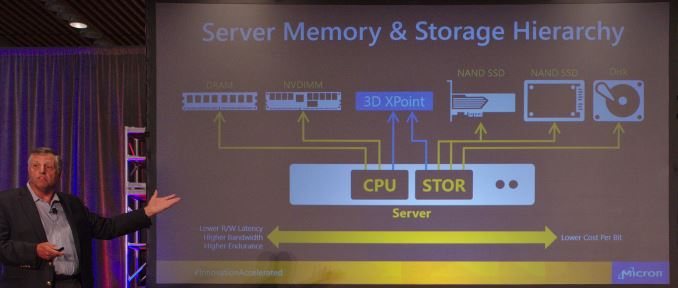
Micron’s keynote reiterated their strategy of positioning 3D XPoint and thus QuantX products in between NAND flash and DRAM, with the advantages of 3d XPoint relative to each highlighted (while the disadvantages go unmentioned). But then they moved on to showing some meaningful performance graphs from actual benchmarks of QuantX drives.
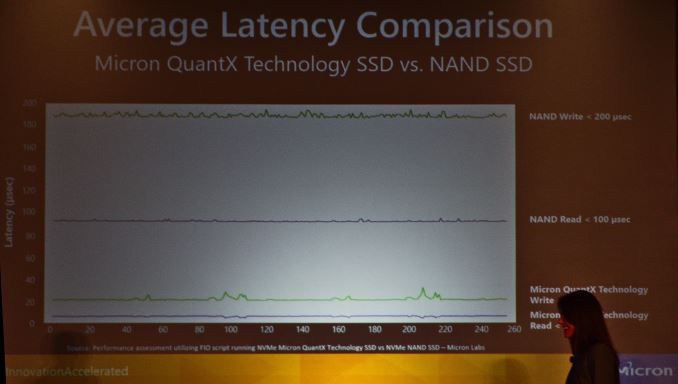
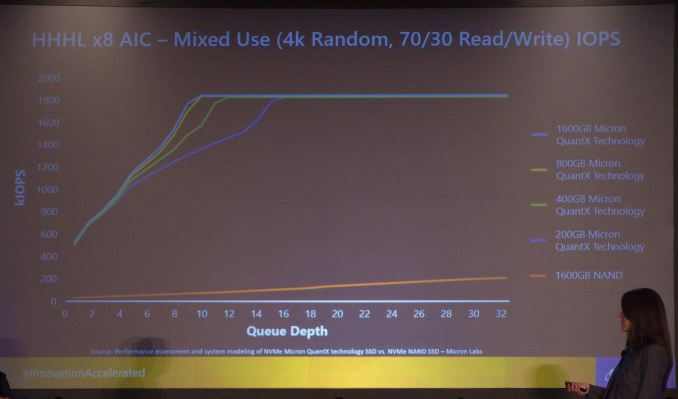
The factor of ten improvement in both read and write latency for NVMe drives is great, but perhaps the more impressive results are the graphs showing queue depth scaling. In a comparison of U.2 NVMe drives, Micron showed performance of QuantX drives ranging from 200GB to 1600GB, relative to a 1600GB NAND flash NVMe SSD. The QuantX drives saturated the PCIe x4 link with a 70/30 mix of random reads and random writes with queue depths of just 4-6, while the NAND SSD gets nowhere close to saturating the link with random accesses. The next comparison was of the PCIe x8 add-in card performance, where the link was saturated with queue depths between 10 and 16, depending on the capacity of the QuantX drive.
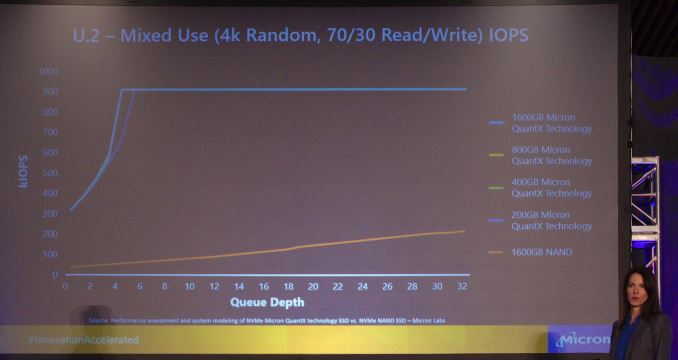
This great performance at low queue depths will make it relatively easy for a wide variety of workloads to benefit from the raw performance 3D XPoint memory offers. By contrast, the biggest and fastest PCIe SSDs based on NAND flash often require careful planning on the software side to achieve full utilization.

Micron Announces QuantX Branding For 3D XPoint Memory (UPDATED)

Micron Announces QuantX Branding For 3D XPoint Memory (UPDATED)

In a keynote speech later this morning at Flash Memory Summit, Micron will be unveiling the branding and logo that their products based on 3D XPoint memory will be using. The new QuantX brand is Micron’s counterpart to Intel’s Optane brand and will be used for the NVMe storage products that we will hear more about later this year. 3D Xpoint memory was jointly announced by Intel and Micron shortly before last year’s Flash Memory Summit and we analyzed the details that were available at the time. Since then there has been very little new official information but much speculation. We do know that the initial products will be NVMe SSDs rather than NVDIMMs or other memory bus attached devices.

In the meantime, Micron VP Darren Thomas goes on stage at 11:30 AM PT, and we’ll update with any further information.

Gallery: Gallery Title

UPDATE:

Micron’s keynote reiterated their strategy of positioning 3D XPoint and thus QuantX products in between NAND flash and DRAM, with the advantages of 3d XPoint relative to each highlighted (while the disadvantages go unmentioned). But then they moved on to showing some meaningful performance graphs from actual benchmarks of QuantX drives.

The factor of ten improvement in both read and write latency for NVMe drives is great, but perhaps the more impressive results are the graphs showing queue depth scaling. In a comparison of U.2 NVMe drives, Micron showed performance of QuantX drives ranging from 200GB to 1600GB, relative to a 1600GB NAND flash NVMe SSD. The QuantX drives saturated the PCIe x4 link with a 70/30 mix of random reads and random writes with queue depths of just 4-6, while the NAND SSD gets nowhere close to saturating the link with random accesses. The next comparison was of the PCIe x8 add-in card performance, where the link was saturated with queue depths between 10 and 16, depending on the capacity of the QuantX drive.

This great performance at low queue depths will make it relatively easy for a wide variety of workloads to benefit from the raw performance 3D XPoint memory offers. By contrast, the biggest and fastest PCIe SSDs based on NAND flash often require careful planning on the software side to achieve full utilization.
Seagate Introduces 10GB/s PCIe SSD And 60TB SAS SSD

Seagate Introduces 10GB/s PCIe SSD And 60TB SAS SSD

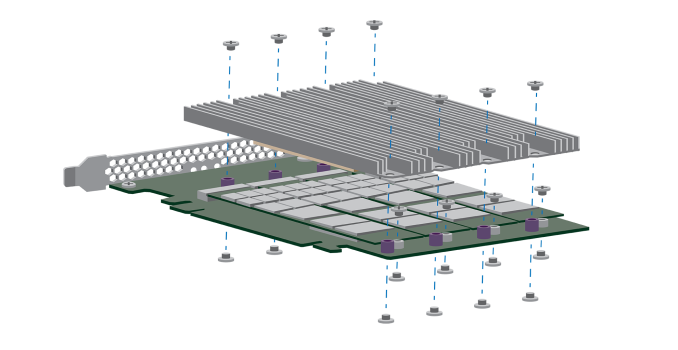
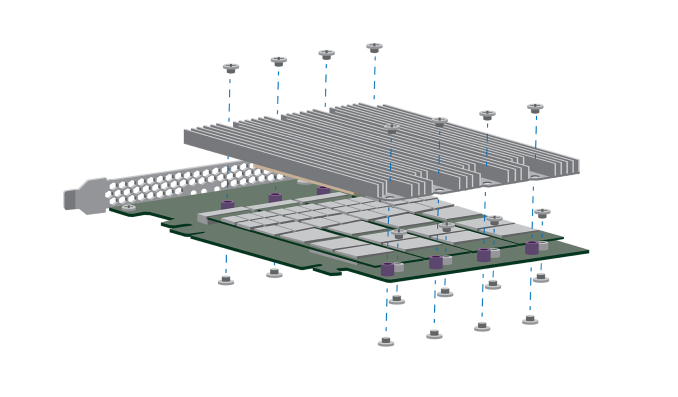
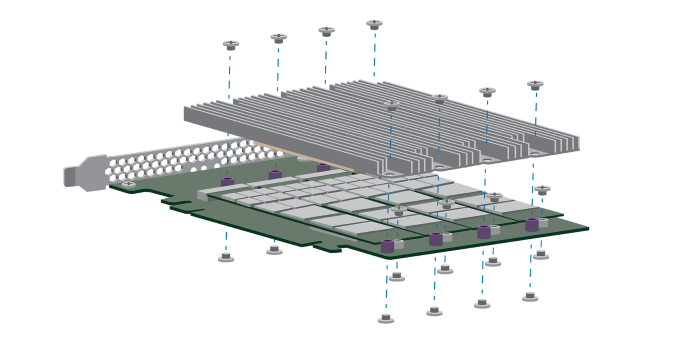
Seagate is looking to break records with two enterprise SSDs they’re showing off at Flash Memory Summit this week. The first drive is one that’s been seen before: the 10GB/s PCIe x16 SSD that Seagate demonstrated in March. It has now been named the Nytro XP7200 and is scheduled for mass production in Q4. Based on four Nytro XM1440 M.2 SSDs under one heatsink on a full height expansion card, the XP7200 is more of a backplane than a drive on its own. Unlike some other multi-controller PCIe SSDs, the XP7200 does not include a PCIe switch chip. This means that the card can only be fully utilized in PCIe x16 slots that support operation as four separate x4 links. Plugging the XP7200 into a PCIe x8 slot would render two of the four M.2 drives inaccessible. And because there are four independent NVMe SSDs on the card, hitting the peak advertised read speed of 10GB/s requires the use of software-based RAID-0 or a similar striping scheme.

Seagate Nytro XP7200 specifications
Capacities 3.8 TB, 7.7 TB
Interface PCIe 3 x16
Sequential read 10000 MB/s
Sequential write 3600 MB/s
Random read IOPS 940K
Random write IOPS 160K
Power during mixed R/W 26 W

The performance specifications of the XP7200 show clearly the impact of using the capacity-optimized XM1440 models rather than the endurance optimized versions. Despite boasting total sequential read speeds of 10GB/s and almost one million IOPS for 4kB random reads, the write performance isn’t earth-shattering. The XP7200 will be available in capacities of either 3.8TB or 7.7TB, as a result of populating it with either the 960GB XM1440 or the newer 2TB model.

With the Nytro XP7200 moving toward production, Seagate has brought out another SSD tech demo with eye-catching specifications. The unnamed SAS SSD packs 60TB of 3D TLC into a 3.5″ drive. In order to connect over a thousand dies of Micron’s 3D TLC NAND to a single SSD controller, Seagate has introduced ONFi bridge chips to multiplex the controller’s NAND channels across far more dies than would otherwise be possible. The rest of the specs for the 60TB SSD look fairly mundane and make for a drive that’s better suited to read-intensive workloads, but the capacity puts even the latest hard drives to shame.

Seagate 60TB SAS SSD Specifications
Usable capacity 60 TB
Interface Dual port 12Gb/s SAS
Sequential read 1500 MB/s
Sequential write 1000 MB/s
Random read IOPS 150K
Random write IOPS unknown
Peak power 15 W

The 60TB SSD is currently just a technology demonstration, and won’t be appearing as a product until next year. When it does, it will probably have a very tiny market, but for now it will give Seagate some bragging rights.

Seagate Introduces 10GB/s PCIe SSD And 60TB SAS SSD

Seagate Introduces 10GB/s PCIe SSD And 60TB SAS SSD

Seagate is looking to break records with two enterprise SSDs they’re showing off at Flash Memory Summit this week. The first drive is one that’s been seen before: the 10GB/s PCIe x16 SSD that Seagate demonstrated in March. It has now been named the Nytro XP7200 and is scheduled for mass production in Q4. Based on four Nytro XM1440 M.2 SSDs under one heatsink on a full height expansion card, the XP7200 is more of a backplane than a drive on its own. Unlike some other multi-controller PCIe SSDs, the XP7200 does not include a PCIe switch chip. This means that the card can only be fully utilized in PCIe x16 slots that support operation as four separate x4 links. Plugging the XP7200 into a PCIe x8 slot would render two of the four M.2 drives inaccessible. And because there are four independent NVMe SSDs on the card, hitting the peak advertised read speed of 10GB/s requires the use of software-based RAID-0 or a similar striping scheme.

Seagate Nytro XP7200 specifications
Capacities 3.8 TB, 7.7 TB
Interface PCIe 3 x16
Sequential read 10000 MB/s
Sequential write 3600 MB/s
Random read IOPS 940K
Random write IOPS 160K
Power during mixed R/W 26 W

The performance specifications of the XP7200 show clearly the impact of using the capacity-optimized XM1440 models rather than the endurance optimized versions. Despite boasting total sequential read speeds of 10GB/s and almost one million IOPS for 4kB random reads, the write performance isn’t earth-shattering. The XP7200 will be available in capacities of either 3.8TB or 7.7TB, as a result of populating it with either the 960GB XM1440 or the newer 2TB model.

With the Nytro XP7200 moving toward production, Seagate has brought out another SSD tech demo with eye-catching specifications. The unnamed SAS SSD packs 60TB of 3D TLC into a 3.5″ drive. In order to connect over a thousand dies of Micron’s 3D TLC NAND to a single SSD controller, Seagate has introduced ONFi bridge chips to multiplex the controller’s NAND channels across far more dies than would otherwise be possible. The rest of the specs for the 60TB SSD look fairly mundane and make for a drive that’s better suited to read-intensive workloads, but the capacity puts even the latest hard drives to shame.

Seagate 60TB SAS SSD Specifications
Usable capacity 60 TB
Interface Dual port 12Gb/s SAS
Sequential read 1500 MB/s
Sequential write 1000 MB/s
Random read IOPS 150K
Random write IOPS unknown
Peak power 15 W

The 60TB SSD is currently just a technology demonstration, and won’t be appearing as a product until next year. When it does, it will probably have a very tiny market, but for now it will give Seagate some bragging rights.