News


Microsoft Announces Q3 FY 2016 Results: Lower Revenue But Strong Cloud Growth
Microsoft Announces Q3 FY 2016 Results: Lower Revenue But Strong Cloud Growth

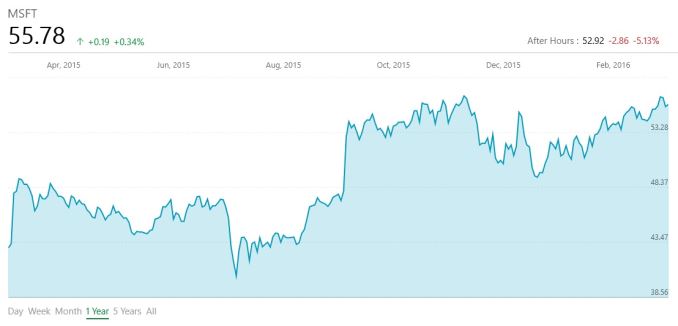
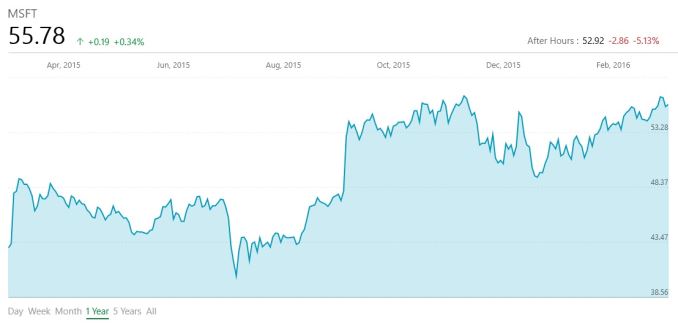
Today Microsoft also announced their earnings for the third quarter of their 2016 fiscal year. Revenue, income and earnings were all down compared to Q3 2015, with revenue for the quarter of $20.5 billion, which is down 6%. Operating income was $5.3 billion, down 20%, and net income was $3.8 billion, which is down 25%. Earnings per share were $0.47, down 23% compared to a year ago.

Microsoft Q3 2016 Financial Results (GAAP)
  Q3’2016 Q2’2016 Q3’2015
Revenue (in Billions USD) $20.531 $23.796 $21.729
Operating Income (in Billions USD) $5.283 $6.026 $6.594
Gross Margin (in Billions USD) $12.809 $13.924 $14.568
Margins 62.4% 58.5% 67.0%
Net Income (in Billions USD) $3.759 $4.998 $4.985
Basic Earnings per Share (in USD) $0.48 $0.63 $0.61

Microsoft also reported non-GAAP earnings, which exclude revenue deferrals and the impact of restructuring charges. On a non-GAAP basis, revenue was $22.1 billion, which is up 2% year-over-year. Operating income was $6.8 billion, up 1%, and net income was $5.0 billion, down 3%. Earnings per share were $0.62, which was flat year over year. In addition to non-GAAP metrics, Microsoft also added constant currency results due to the high US dollar, and based on constant currency (CC), revenue was up 5%, operating income was up 10%, net income was up 6%, and earnings per share were up 10%.

Productivity and Business Processes, which includes Office commercial and consumer, and Office 365 commercial and consumer, as well as Dynamics products, had revenue for the quarter of $6.52 billion, which was up 1% year-over-year, or 6% based on CC. However, the gross margin for this segment fell 4%, and operating income came in at $2.99 billion, which was down 7%. Microsoft attributes the lower margins due to higher numbers of people using cloud services, which means, at least for the moment, the cloud offerings from Microsoft are making them less money than the non-subscription model, which is pretty interesting. I would guess that a lot of that is due to the large spending that is taking place to constantly expand infrastructure to handle new clients, but that is only a guess.

Looking at the numbers of Office though are very interesting. The consumer version of Office 365 increased from 12.4 million a year ago to 22.2 million this year. That is an increase in seats of 79% year-over-year, which is extremely good. A few years ago, I don’t think a subscription version of Office would have worked, but clearly Microsoft has found a solid hook for consumers with the packages. Even more impressive is the commercial seats for Office 365 business. Microsoft doesn’t often announce their user base for this, but on the earnings call, CEO Satya Nadella announced that they have over 70 million monthly active users for Office 365 commercial, and that is an increase in seats of 57% year-over-year. Also good news for Microsoft is that they have seen a 35% quarter-over-quarter growth in their premium protection services offered as part of the higher tiers of Office 365, and a key driver is the new premium tier, Office 365 Suite E5. Not to be outdone by Office, Dynamics CRM Online has seen its seats more than double year-over-year, and 80% of new CRM customers are choosing the cloud version.

Next up is the Intelligent Cloud segment, which includes server and server products, as well as cloud infrastructure such as Azure. Revenue for the quarter was $6.10 billion, which is up 3% year-over-year, or 8% in CC. Gross margin declined 2% (up 3% CC) year-over-year, and once again due to a higher mix of cloud services. The infrastructure expenditure here is a lot, and operating expenses grew 13% with investments in cloud infrastructure. With the lower margins and higher expenses, operating income fell 14% to $2.19 billion. Server products and cloud services had revenue growth of 5% CC, which is pretty stable, but it is Azure that is the big growth here. Azure revenue grew 120% CC this quarter, compared to the same time last year. Azure compute usage and Azure SQL usage more than doubled, and the Enterprise Mobility customer install base grew almost four times.

AWS is still the king of cloud computing, but Microsoft continues to make big gains here. They also are the only major cloud company to offer a hybrid offering, both with the traditional Windows Server elements, as well as the Azure Stack which can be run locally. At Build, they emphasised that are pushing towards more services in Azure as well, rather than having to have companies do the traditional VMs in the cloud. They still have a long way to go to catch AWS, but they continue to show this is a strength going forward.

The final segment of Microsoft is More Personal Computing, and this includes Windows, Surface, Xbox, phone, and search. Phone has certainly been a sore spot for Microsoft, and they took some big write-downs last year to basically write off the entire Nokia acquisition. For this quarter, revenue for this segment was $9.46 billion, which is up 1% year-over-year, or 3% CC. The increase in revenue this quarter was attributed to search and Surface, but lower phone and Windows revenue were a negative impact. Gross margin was 2% higher, once again due to search and Surface, and operating expenses fell 14% with the lower spending on phone. Operating income grew 57% for the quarter, to $1.65 billion. On a revenue basis, this is the largest single segment in Microsoft, but the margins for consumer are a lot lower than the enterprise services.

Windows 10 is now on over 270 million monthly active devices, but Windows OEM Pro declined 11% this quarter, which was worse than the commercial PC market. Revenue for non-Pro though grew 15%, which is quite a bit better than the PC market as a whole did, due to a bigger ratio of higher priced devices being sold. Windows volume licensing grew 6% CC.

On the devices side, revenue for devices fell 9% CC, and this is due to Lumia phone sales dropping off a cliff. Revenue for Lumia fell 46% year-over-year. This negative marred a great performance by the Surface line, and Surface had a 61% CC increase in revenue to $1.111 billion for the quarter, which is the second straight quarter where Surface was over $1 billion in revenue. Sales of the Surface Pro 4 and Surface Book are doing well.

Microsoft no longer breaks out sales numbers for Xbox, but gaming revenue grew 6% CC for the quarter. Microsoft is seeing an increase in Xbox Live transactional revenue, and they have a 26% increase in Xbox Live users compared to a year ago. Video game revenue was up 11% CC, and I would imagine a good chunk of that is still Minecraft. Xbox hardware revenue declined, with less sales of the Xbox 360 which is now officially out of production.

Search revenue, excluding traffic acquisition costs, grew 18% CC. Microsoft is getting more revenue per search, and search volume is also up. As a tidbit, they said that 35% of search revenue in the month of March was on Windows 10 devices.

Microsoft Q3 2016 Financial Results (GAAP)
  Productivity and Business Processes Intelligent Cloud More Personal Computing
Revenue (in Billions USD) $6.52 $6.10 $9.46
Operating Income (in Billions USD) $2.99 $2.19 $1.65
Revenue Change YoY +1%, +6% CC +3%, +8% CC +1%, +3% CC
Operating Income Change YoY -7% -14% +57%

Microsoft paid $6.4 billion back to investors in Q3 2016, with $3.6 billion in share buybacks and $2.8 billion in dividends. Looking ahead to Q4, Microsoft expects revenues to be between $21.7 billion and $22.4 billion.

The company continues to move from a traditional software company to a cloud infrastructure player, and with the results today we can see some big gains there. It was great to get an updated number for Office 365 commercial seats, which are now at over 70 million monthly users, and the growth in Azure is very large. Microsoft missed the boat on mobile, but are making up for it with platform agnostic solutions, and they are looking heavily towards conversations-as-a-service with bot integration in Skype and more. The Surface lineup is now very strong, when only a few years ago it had to endure a massive write-down. Phones, on the other hand, were basically non-existent and the acquisition of Nokia seems to be all for naught.

Source; Microsoft Investor Relations
AMD Reports Q1 FY 2016 Results: Lower Revenue But New IP Licensing Agreement Reached

AMD Reports Q1 FY 2016 Results: Lower Revenue But New IP Licensing Agreement Reached

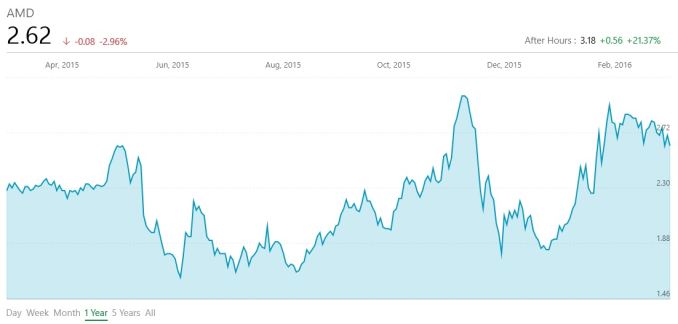
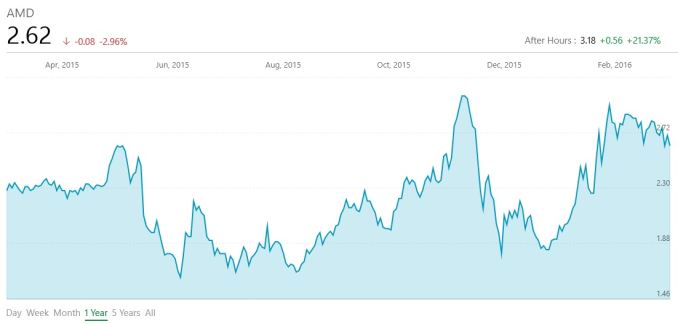
AMD announced their first quarter results from fiscal year 2016. AMD has certainly been struggling of late, but CEO Lisa Su made the announcement that AMD had made a joint-venture with THATIC for x86 processor development for the Chinese market. AMD will receive $52 million immediately and the total agreement is for $293 million, plus future royalties. This is a significant agreement for AMD, and licensing their IP is one of the ways they hope to get back to profitability.

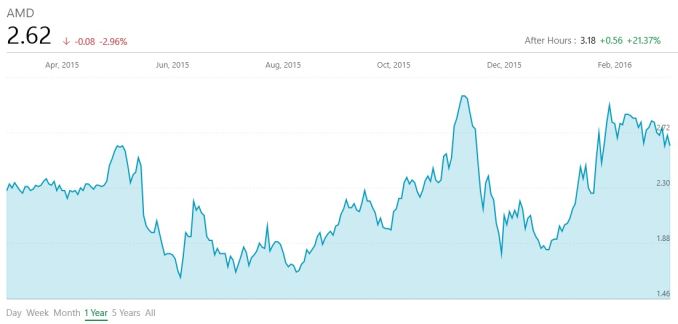
Looking at the overall quarter, AMD had revenues of $832 million, which is down a significant 19% from last year. But the good news for AMD is that their gross margin is up to 32%, an increase over last quarter and having it come back to the same level as a year ago. AMD reported an operating loss of $68 million for the quarter, which is an improvement over the $137 million loss last year. The net loss for the quarter was $109 million, or $0.14 per share, which is once again an improvement over last year’s $180 million loss, or $0.23 per share.

AMD Q1 2016 Financial Results (GAAP)
  Q1’2016 Q4’2015 Q1’2015
Revenue $832M $958M $1030M
Gross Margin 32% 30% 32%
Operating Income -$68M -$49M -$137M
Net Income -$109M -$102M -$180M
Earnings Per Share -$0.14 -$0.13 -$0.23

AMD also reports non-GAAP results, which exclude restructuring costs and stock-based compensation. On a non-GAAP basis, AMD had an operating loss of $55 million, compared to a $30 million loss last year where they had high restructuring charges. Gross margin came in at the same 32%, and there was a net loss of $96 million, or $0.12 per share, compared to a net loss of $73 million, or $0.09 per share last year.

AMD Q1 2016 Financial Results (Non-GAAP)
  Q1’2016 Q4’2015 Q1’2015
Revenue $832M $958M $1030M
Gross Margin 32% 30% 32%
Operating Income -$55M -$39M -$30M
Net Income -$96M -$79M -$73M
Earnings Per Share -$0.12 -$0.10 -$0.09

The Computing and Graphics segment is still the largest part of AMD, and for this quarter they had revenue of $460 million. That is a drop sequentially of 2%, and a year-over-year drop of 14%, but AMD improved their operating loss for this segment, with a loss of $70 million for the quarter. This is an improvement over the $99 million loss last quarter, and an improvement over the $75 million loss a year ago. The revenue drop from last quarter was attributed to a drop in desktop processor sales, and the annual drop is due to a decline in notebook processor sales. Lowered operating expenses were the reason for the better operating loss levels, but both desktop and notebook processors are seeing a decrease in average selling price for AMD. GPU sales also dropped average selling price compared to last quarter, but increase year-over-year with higher channel and professional GPU prices.

AMD Q1 2016 Computing and Graphics
  Q1’2016 Q4’2015 Q1’2015
Revenue $460M $470M $532M
Operating Income -$70M -$99M -$75M

The Enterprise, Embedded, and Semi-Custom segment had revenue of $372 million for the first quarter of this year, which is down 24% from last quarter and 25% from last year. This group is profitable though, although just slightly this quarter, with an operating income of $16 million for the quarter. This compares to a $45 million income in Q1 2015 though, which is a big drop when AMD’s already cutting it pretty close. AMD attributes the revenue drop to lower sales of semi-custom SoCs, of which a big market is consoles. It makes sense that as the consoles mature, sales will trail off, but AMD did well to get inside both the PlayStation 4 and Xbox One on this round of consoles, since both have been selling well compared to the previous generation. The decrease in operating income due to lower sales and higher R&D spending, but was offset by a $7 million IP licensing deal.

AMD Q4 2015 Enterprise, Embedded, and Semi-Custom
  Q1’2016 Q4’2015 Q1’2015
Revenue $372M $488M $498M
Operating Income $16M $59M $45M

The All Other category had an operating loss of $14 million for the quarter, compared to a $107 million loss last year. That is because AMD had some large restructuring charges on the books last year.

Unsurprisingly, AMD is still sorting out their future, and their results reflect that. They have had a pretty large processing disadvantage compared to Intel for a long time now, and later this year they will finally start shipping on 14 nm nodes, but it is the deals for IP licensing which bring in constant revenue without the associated costs of revenue which are the big news this quarter. With rumours of updated consoles, they may also get a bump in their semi-custom SoC if and when that happens. Looking to next quarter, AMD is expecting revenues to come in 15% higher, plus or minus 3%.

Source: AMD Investor Relations

AMD Reports Q1 FY 2016 Results: Lower Revenue But New IP Licensing Agreement Reached

AMD Reports Q1 FY 2016 Results: Lower Revenue But New IP Licensing Agreement Reached

AMD announced their first quarter results from fiscal year 2016. AMD has certainly been struggling of late, but CEO Lisa Su made the announcement that AMD had made a joint-venture with THATIC for x86 processor development for the Chinese market. AMD will receive $52 million immediately and the total agreement is for $293 million, plus future royalties. This is a significant agreement for AMD, and licensing their IP is one of the ways they hope to get back to profitability.

Looking at the overall quarter, AMD had revenues of $832 million, which is down a significant 19% from last year. But the good news for AMD is that their gross margin is up to 32%, an increase over last quarter and having it come back to the same level as a year ago. AMD reported an operating loss of $68 million for the quarter, which is an improvement over the $137 million loss last year. The net loss for the quarter was $109 million, or $0.14 per share, which is once again an improvement over last year’s $180 million loss, or $0.23 per share.

AMD Q1 2016 Financial Results (GAAP)
  Q1’2016 Q4’2015 Q1’2015
Revenue $832M $958M $1030M
Gross Margin 32% 30% 32%
Operating Income -$68M -$49M -$137M
Net Income -$109M -$102M -$180M
Earnings Per Share -$0.14 -$0.13 -$0.23

AMD also reports non-GAAP results, which exclude restructuring costs and stock-based compensation. On a non-GAAP basis, AMD had an operating loss of $55 million, compared to a $30 million loss last year where they had high restructuring charges. Gross margin came in at the same 32%, and there was a net loss of $96 million, or $0.12 per share, compared to a net loss of $73 million, or $0.09 per share last year.

AMD Q1 2016 Financial Results (Non-GAAP)
  Q1’2016 Q4’2015 Q1’2015
Revenue $832M $958M $1030M
Gross Margin 32% 30% 32%
Operating Income -$55M -$39M -$30M
Net Income -$96M -$79M -$73M
Earnings Per Share -$0.12 -$0.10 -$0.09

The Computing and Graphics segment is still the largest part of AMD, and for this quarter they had revenue of $460 million. That is a drop sequentially of 2%, and a year-over-year drop of 14%, but AMD improved their operating loss for this segment, with a loss of $70 million for the quarter. This is an improvement over the $99 million loss last quarter, and an improvement over the $75 million loss a year ago. The revenue drop from last quarter was attributed to a drop in desktop processor sales, and the annual drop is due to a decline in notebook processor sales. Lowered operating expenses were the reason for the better operating loss levels, but both desktop and notebook processors are seeing a decrease in average selling price for AMD. GPU sales also dropped average selling price compared to last quarter, but increase year-over-year with higher channel and professional GPU prices.

AMD Q1 2016 Computing and Graphics
  Q1’2016 Q4’2015 Q1’2015
Revenue $460M $470M $532M
Operating Income -$70M -$99M -$75M

The Enterprise, Embedded, and Semi-Custom segment had revenue of $372 million for the first quarter of this year, which is down 24% from last quarter and 25% from last year. This group is profitable though, although just slightly this quarter, with an operating income of $16 million for the quarter. This compares to a $45 million income in Q1 2015 though, which is a big drop when AMD’s already cutting it pretty close. AMD attributes the revenue drop to lower sales of semi-custom SoCs, of which a big market is consoles. It makes sense that as the consoles mature, sales will trail off, but AMD did well to get inside both the PlayStation 4 and Xbox One on this round of consoles, since both have been selling well compared to the previous generation. The decrease in operating income due to lower sales and higher R&D spending, but was offset by a $7 million IP licensing deal.

AMD Q4 2015 Enterprise, Embedded, and Semi-Custom
  Q1’2016 Q4’2015 Q1’2015
Revenue $372M $488M $498M
Operating Income $16M $59M $45M

The All Other category had an operating loss of $14 million for the quarter, compared to a $107 million loss last year. That is because AMD had some large restructuring charges on the books last year.

Unsurprisingly, AMD is still sorting out their future, and their results reflect that. They have had a pretty large processing disadvantage compared to Intel for a long time now, and later this year they will finally start shipping on 14 nm nodes, but it is the deals for IP licensing which bring in constant revenue without the associated costs of revenue which are the big news this quarter. With rumours of updated consoles, they may also get a bump in their semi-custom SoC if and when that happens. Looking to next quarter, AMD is expecting revenues to come in 15% higher, plus or minus 3%.

Source: AMD Investor Relations

China Calling: AMD Forms Joint Venture for x86 Server SoCs in China

China Calling: AMD Forms Joint Venture for x86 Server SoCs in China

As part of the release of AMD’s Q1 2016 financial results (more on that later today) the company is announcing that they are forming a new joint venture to develop x86 SoCs for the Chinese market. The hereto unnamed joint venture will see AMD pair up with Tianjin Haiguang Advanced Technology Investment Co., Ltd (THATIC), who is an investment arm of the Chinese Academy of Sciences. The deal will, in a nutshell, see AMD provide the joint venture with x86 and SoC IP, along with significant engineering and other technical resources, while THATIC provides the remaining technical resources and the financing behind the venture. Overall the deal will net AMD $293 million from the licensing agreement, plus further royalties in the future.

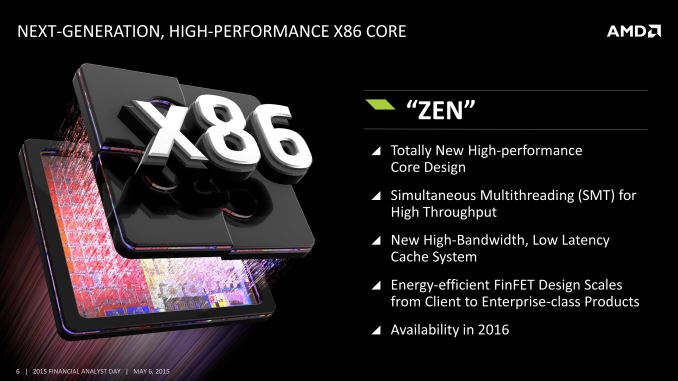
As this is a fairly complex deal, I first want to jump into the technical aspects of the joint venture. In a brief call with AMD, the company made it clear that this is an x86 play for the Chinese server market, with AMD licensing/contributing their high performance x86 IP along with their SoC IP. AMD’s GPU and ARM IP is not part of the deal, and at this time AMD is not specifying which precise x86 IP is part of the deal. However given the timing of the announcement and the necessary ramp-up for products, I believe it’s very likely that the bulk of the x86 IP will be from AMD’s forthcoming Zen x86 processor. Either way, this a very straightforward play towards expanding x86 server processor usage inside of China.

However what those products will be remains to be seen. While AMD is announcing the formation of the joint venture, their participation, and what they stand to gain, any actual product announcements are the responsibility of the joint venture. What AMD is emphasizing at this time is that this is a joint venture for high performance processors, that it is designed to complement AMD’s existing server efforts, and that the SoCs will be leading-edge products. Just what a high performance processor is – and whether that means a multicore-heavy design or something using fewer, higher performing cores – will definitely be a burning question between now and the joint venture’s own product announcements. Overall, at this point what AMD is describing does not sound like the joint venture will simply be developing cheaper, lower performing processors for the Chinese market.

More obvious of an answer however is why AMD and partner THATIC would want to enter into this agreement. China as a whole continues to heavily invest in modern semiconductor technologies, both on the IP side and the manufacturing side, as semiconductors have historically been highly profitable for the winner and a good proxy for other technology development. At the same time ongoing geopolitical issues have called into question whether China can truly trust processors designed groups in foreign nations, and as a result there’s great incentive to design their own processors internally with security features specifically designed by and for the Chinese market.

As AMD does not develop much of their own security technology – they use ARM’s TrustZone – this complements those needs well, seeing as how THATIC would need to contribute security technology anyhow. The end result is that this will allow the joint venture – essentially a Chinese entity – to design their own high performance x86 server SoCs to meet the performance, compatibility, and security needs of the Chinese market.

This comes as the latest event in AMD’s efforts to further develop themselves into a full spectrum firm that develops processors internally and develops semi-custom designs alongside clients. The joint venture in turn takes it one step further, with AMD essentially providing IP to an outside entity and their semi-custom design, rather than the entity coming to AMD. At the same time the parallels with Intel’s own efforts in the Chinese SoC market are significant. Intel’s SoFIA program to develop Atom-based SoCs for China and other emerging markets by pairing up with Chinese SoC designers is quite similar in ambition, though aimed at the opposite end of the market.


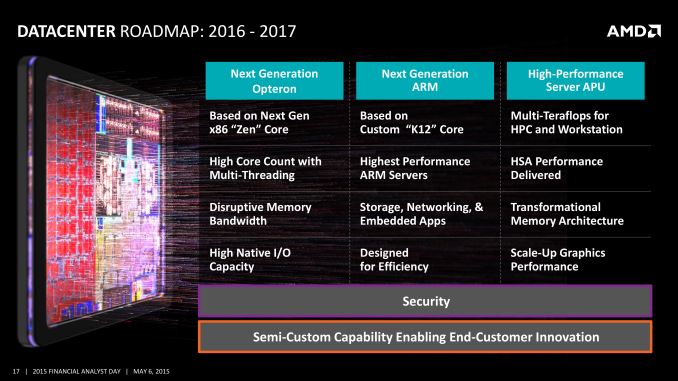
For Reference: AMD’s Most Recent Datacenter Roadmap

For AMD this represents a crucial opportunity to re-enter the server market. In the long run AMD sees a greater presence in servers and the enterprise as being key to their success, as the server market is overall much more profitable than the client market, not to mention growing at a time where the client PC market is at best stagnant. Going this route means that AMD can attempt to get back into the market without facing Intel entirely head-on, by providing a product (or rather the IP behind it) that Intel currently cannot. Meanwhile it also provides AMD some leverage in the long run for further increasing the sales of their own x86 Opteron processors; if the joint venture’s x86 SoCs are successful, then AMD’s job convincing other customers that their products offer the right mix of technology, performance, and cost will be all that much easier. This has been something of a challenge for AMD in recent years as Intel has largely sewn up the server market, and customers have become hesitant to leave Intel.

Meanwhile, one other technical detail we’re going to have to wait on the joint venture itself to announce is where these products will be fabbed. AMD describes the venture as an initiative to produce leading-edge chips, which if taken at its word implies that the resulting chips would be produced on current-generation FinFET technology as employed by Intel, TSMC, and the Samsung/GlobalFoundries duoship. At the same time however, given the desire to produce chips specifically for the Chinese market, the joint venture may also want to use a Chinese fab. In which case it’s not immediately obvious who they might use.

Also not immediately obvious is where this falls under the Intel/AMD x86 cross-licensing agreement. AMD has of course done their own research and says that this doesn’t violate the agreement. However whether Intel agrees with that remains to be seen; it will likely take them some time to form their own legal opinion. In the meantime and at first glance, because this is a joint venture, it would appear that AMD is in the clear here as they aren’t giving the technology to another business, but rather are using it as part of a new line of products they are developing, albeit in conjunction with an outside firm.

Finally, let’s talk about the financials and other business aspects of the deal. Overall this is a pure technology investment for AMD; they are not putting any money into the joint venture, but they are contributing a significant amount of technology and technological expertise. It will be partner THATIC that supplies the funding for the venture, along with the remaining IP and expertise. Importantly, this means AMD doesn’t have any financial risk in the joint venture, and should it not pan out then AMD doesn’t lose any of their already limited financial resources.

On the up side however, AMD stands to gain significantly from the deal if it goes well. The initial joint venture licensing agreement calls for AMD to be paid $293 million – spread out over multiple payments that are contingent on the joint venture hitting certain milestones – while AMD will also receive royalty payments on future processors. At a time when AMD is still trying to pull back into the black, the agreement and promise of royalties is significant. And since the company already had a virtually non-existent presence in the Chinese x86 server processor market, while this deal does, from a practical perspective, limit AMD’s ability to sell Opteron processors to China, a fraction of even a moderately successful product line would represent a significant improvement for AMD.

At this point we don’t have any further information on when the joint venture will be announcing their first products, but we’ll be keeping a close eye on the development of AMD’s newest venture. Although China calling on AMD can’t alone turn around the company’s fortunes, for AMD this represents their best chance in years to get back into the server market, and re-attain the profitability that they badly need.

China Calling: AMD Forms Joint Venture for x86 Server SoCs in China

China Calling: AMD Forms Joint Venture for x86 Server SoCs in China

As part of the release of AMD’s Q1 2016 financial results (more on that later today) the company is announcing that they are forming a new joint venture to develop x86 SoCs for the Chinese market. The hereto unnamed joint venture will see AMD pair up with Tianjin Haiguang Advanced Technology Investment Co., Ltd (THATIC), who is an investment arm of the Chinese Academy of Sciences. The deal will, in a nutshell, see AMD provide the joint venture with x86 and SoC IP, along with significant engineering and other technical resources, while THATIC provides the remaining technical resources and the financing behind the venture. Overall the deal will net AMD $293 million from the licensing agreement, plus further royalties in the future.

As this is a fairly complex deal, I first want to jump into the technical aspects of the joint venture. In a brief call with AMD, the company made it clear that this is an x86 play for the Chinese server market, with AMD licensing/contributing their high performance x86 IP along with their SoC IP. AMD’s GPU and ARM IP is not part of the deal, and at this time AMD is not specifying which precise x86 IP is part of the deal. However given the timing of the announcement and the necessary ramp-up for products, I believe it’s very likely that the bulk of the x86 IP will be from AMD’s forthcoming Zen x86 processor. Either way, this a very straightforward play towards expanding x86 server processor usage inside of China.

However what those products will be remains to be seen. While AMD is announcing the formation of the joint venture, their participation, and what they stand to gain, any actual product announcements are the responsibility of the joint venture. What AMD is emphasizing at this time is that this is a joint venture for high performance processors, that it is designed to complement AMD’s existing server efforts, and that the SoCs will be leading-edge products. Just what a high performance processor is – and whether that means a multicore-heavy design or something using fewer, higher performing cores – will definitely be a burning question between now and the joint venture’s own product announcements. Overall, at this point what AMD is describing does not sound like the joint venture will simply be developing cheaper, lower performing processors for the Chinese market.

More obvious of an answer however is why AMD and partner THATIC would want to enter into this agreement. China as a whole continues to heavily invest in modern semiconductor technologies, both on the IP side and the manufacturing side, as semiconductors have historically been highly profitable for the winner and a good proxy for other technology development. At the same time ongoing geopolitical issues have called into question whether China can truly trust processors designed groups in foreign nations, and as a result there’s great incentive to design their own processors internally with security features specifically designed by and for the Chinese market.

As AMD does not develop much of their own security technology – they use ARM’s TrustZone – this complements those needs well, seeing as how THATIC would need to contribute security technology anyhow. The end result is that this will allow the joint venture – essentially a Chinese entity – to design their own high performance x86 server SoCs to meet the performance, compatibility, and security needs of the Chinese market.

This comes as the latest event in AMD’s efforts to further develop themselves into a full spectrum firm that develops processors internally and develops semi-custom designs alongside clients. The joint venture in turn takes it one step further, with AMD essentially providing IP to an outside entity and their semi-custom design, rather than the entity coming to AMD. At the same time the parallels with Intel’s own efforts in the Chinese SoC market are significant. Intel’s SoFIA program to develop Atom-based SoCs for China and other emerging markets by pairing up with Chinese SoC designers is quite similar in ambition, though aimed at the opposite end of the market.


For Reference: AMD’s Most Recent Datacenter Roadmap

For AMD this represents a crucial opportunity to re-enter the server market. In the long run AMD sees a greater presence in servers and the enterprise as being key to their success, as the server market is overall much more profitable than the client market, not to mention growing at a time where the client PC market is at best stagnant. Going this route means that AMD can attempt to get back into the market without facing Intel entirely head-on, by providing a product (or rather the IP behind it) that Intel currently cannot. Meanwhile it also provides AMD some leverage in the long run for further increasing the sales of their own x86 Opteron processors; if the joint venture’s x86 SoCs are successful, then AMD’s job convincing other customers that their products offer the right mix of technology, performance, and cost will be all that much easier. This has been something of a challenge for AMD in recent years as Intel has largely sewn up the server market, and customers have become hesitant to leave Intel.

Meanwhile, one other technical detail we’re going to have to wait on the joint venture itself to announce is where these products will be fabbed. AMD describes the venture as an initiative to produce leading-edge chips, which if taken at its word implies that the resulting chips would be produced on current-generation FinFET technology as employed by Intel, TSMC, and the Samsung/GlobalFoundries duoship. At the same time however, given the desire to produce chips specifically for the Chinese market, the joint venture may also want to use a Chinese fab. In which case it’s not immediately obvious who they might use.

Also not immediately obvious is where this falls under the Intel/AMD x86 cross-licensing agreement. AMD has of course done their own research and says that this doesn’t violate the agreement. However whether Intel agrees with that remains to be seen; it will likely take them some time to form their own legal opinion. In the meantime and at first glance, because this is a joint venture, it would appear that AMD is in the clear here as they aren’t giving the technology to another business, but rather are using it as part of a new line of products they are developing, albeit in conjunction with an outside firm.

Finally, let’s talk about the financials and other business aspects of the deal. Overall this is a pure technology investment for AMD; they are not putting any money into the joint venture, but they are contributing a significant amount of technology and technological expertise. It will be partner THATIC that supplies the funding for the venture, along with the remaining IP and expertise. Importantly, this means AMD doesn’t have any financial risk in the joint venture, and should it not pan out then AMD doesn’t lose any of their already limited financial resources.

On the up side however, AMD stands to gain significantly from the deal if it goes well. The initial joint venture licensing agreement calls for AMD to be paid $293 million – spread out over multiple payments that are contingent on the joint venture hitting certain milestones – while AMD will also receive royalty payments on future processors. At a time when AMD is still trying to pull back into the black, the agreement and promise of royalties is significant. And since the company already had a virtually non-existent presence in the Chinese x86 server processor market, while this deal does, from a practical perspective, limit AMD’s ability to sell Opteron processors to China, a fraction of even a moderately successful product line would represent a significant improvement for AMD.

At this point we don’t have any further information on when the joint venture will be announcing their first products, but we’ll be keeping a close eye on the development of AMD’s newest venture. Although China calling on AMD can’t alone turn around the company’s fortunes, for AMD this represents their best chance in years to get back into the server market, and re-attain the profitability that they badly need.