News


The OCZ Trion 150 SSD Review

The OCZ Trion 150 is the latest entry-level SSD from Toshiba’s subsidiary. It makes almost no hardware changes from the Trion 100 aside from using Toshiba’s newer 15nm TLC NAND, but it ends up being a very different drive, especially given current market conditions.

Intel Rolls Out New PCIe SSDs for Cloud Datacenters

Intel Rolls Out New PCIe SSDs for Cloud Datacenters

Intel on Thursday introduced several new PCIe SSDs designed for cloud datacenters. The new drives increase capacities, shrink latencies and offer higher throughput in order to follow demands of new datacenters deployed by various companies these days. Some of the new SSDs are based on Intel’s 3D NAND memory, whereas other feature NVMe 1.2 technology and dual-port U.2 capability to increase performance of mission-critical data-storage applications.

Intel hopes that in the future SSDs will be used not only to store hot, frequently used data, but also data that is currently stored on highly-reliable high-performance hard drives. To replace 10K and 15K RPM HDDs in the datacenter, Intel needs to offer improved reliability, high endurance, unbeatable performance, lower costs and additional features impossible on HDDs. The new SSDs from the company bring a number of improvements to the datacenter compared to previous-generation drives.

The new Intel SSD DC P3320 and P3520 families of SSDs are based on 32-layer 3D NAND flash memory developed and produced by Intel and Micron. The drives are powered by unspecified controllers, and support end-to-end data protection as well as some other functions important in the datacenters. Intel claims that that its 3D NAND has better endurance than planar NAND flash memory, which is common knowledge at this point, but does not provide any exact numbers for their NAND. The DC P3320 comes in 2.5” or HHHL card form-factor and uses either PCIe 3.0 x4 or U.2 to connect to the host. The DC P3320 is being pitched as a step up from Intel’s SATA-based datacenter SSDs, while the DC P3520 will presumably be replacing the DC P3500 series.

Specifications of Intel DC P3320 SSDs
  450 GB 1.2 TB 2 TB
Form Factor 2.5″ drive 2.5″ drive/HHHL card
Controller unknown
Interface U.2 U.2 or PCIe 3.0 x4
Protocol NVMe
DRAM unknown
NAND 256 Gb MLC
32-layer 3D NAND
256 Gb MLC
32-layer 3D NAND
256 Gb MLC
32-layer 3D NAND
Sequential Read 1100 MB/s 1600 MB/s 1600 MB/s
Sequential Write 500 MB/s 1000 MB/s 1400 MB/s
4KB Random Read (QD32) 130K IOPS 275K IOPS 365K IOPS
4KB Random Write (QD32) 17K IOPS 22K IOPS 22K IOPS
Launch Date Q1 2016

The DC P3320 SSDs offer a range of capacities, including 450 GB, 1.2 TB and 2 TB models and are designed for read-intensive applications. The new drives are rated to offer maximum sequential read/write speed of up to 1600/1400 MB/s. Maximum random 4K read/write speed declared by Intel for the DC P3320 is 365K/22K IOPS (input/output operations per second). Intel does not reveal any details about the DC P3520, but claims that these drives were designed to deliver “significant” performance and latency improvements over the DC P3320 (which probably indicates higher parallelism and higher capacities, which Intel does not want to talk about at the moment).

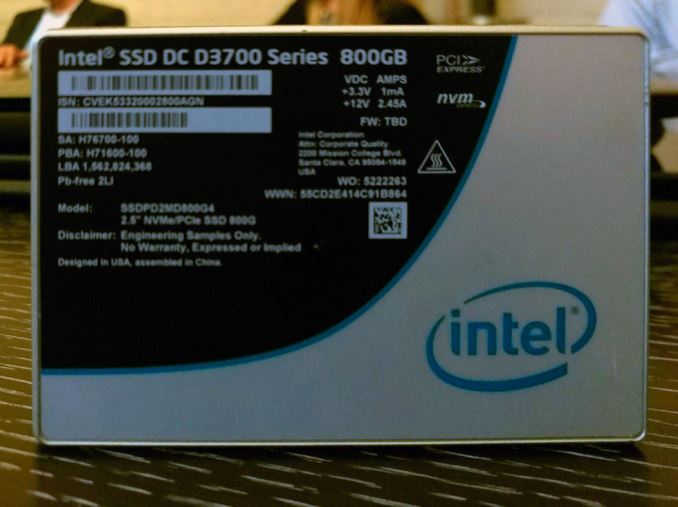
Meanwhile the new Intel DC D3600/3700 SSDs (not to be confused with the P or S series) are designed for mission-critical storage applications that should function 24/7, which is why they utilize proven MLC NAND flash memory with high-endurance technology (HET) as well as controllers that support NVMe 1.2 technology with various high-availability features and support for up to 80 I/O queues. Intel does not disclose which controller it uses, but claims that they feature an integrated memory buffer and dynamic multiple namespaces management technology to improve efficiency of data management across drives in one machine, an exclusive feature (which potentially means that Intel uses a custom controller for these SSDs). The drives sport an active/active dual-port design that connects through a compatible backplane to two host systems simultaneously (which enables run-time recovery during failover when one of the hosts is unavailable) and support hot-plug capability. The DC D3600/D3700 drives also feature end-to-end data protection, power-loss data protection with self-test and thermal throttling and monitoring to ensure maximum reliability. The SSDs utilize PCIe 3.0 x4 interface and U.2 connectors. Since each drive has only a single U.2 connector, their dual-port mode relies on the backplane routing two PCIe lanes to each of the two host systems.

Specifications of Intel DC D3600 and D3700 SSDs
  DC3700  800 GB DC3600 1 TB DC3700 1.6 TB DC3600 2 TB
Form Factor 2.5″ drive with U.2 interface
Controller unknown
Interface U.2/PCIe 3.0 x4
Protocol NVMe 1.2
DRAM unknown
NAND MLC NAND with HET (high-endurance technology)
Sequential Read 1900 MB/s 1800 MB/s 2100 MB/s 2100 MB/s
Sequential Write 970 MB/s 940 MB/s 1500 MB/s 1500 MB/s
4KB Random Read (QD32) 450K IOPS 450 K IOPS 470K IOPS 470K IOPS
4KB Random Write (QD32) 65K IOPS 25K IOPS 95K IOPS 30K IOPS
Launch Date Q1 2016

Intel’s DC D3600/D3700 solid-state drives will be available in 800 GB, 1.6 TB (D3700) as well as 1 TB and 2 TB (D3600) configurations. According to Intel, the new SSDs, deliver sequential read speeds of up to 2100 MB/s and sequential write performance of up to 1500 MB/s. The new SSDs can also perform up to 470K random read IOPS (4KB) and up to 95K random write IOPS (4KB).

Since SSDs with U.2 interface are not compatible with existing SAS or SATA backplanes (because they do not support PCIe), they need support from makers of storage solutions for datacenters. Intel claims that companies like EMC, Huawei, Quanta, Wistron and X-IO Technologies are ready to produce mission-critical storage ecosystem for PCIe-based SSDs, but does not provide further details.

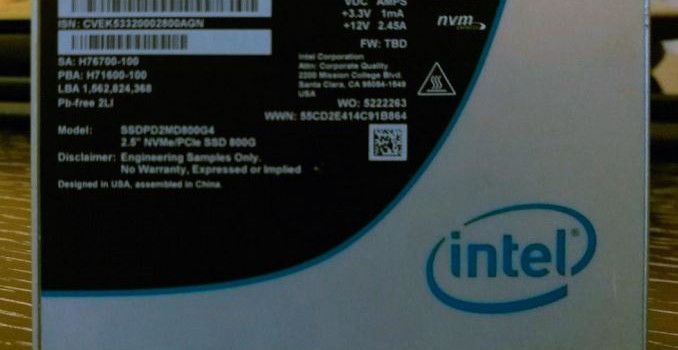
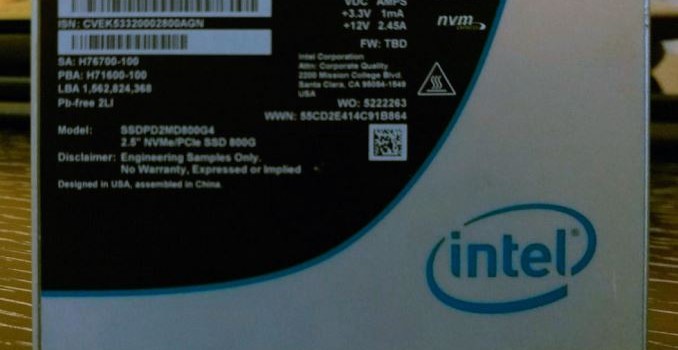
A hands-on look at a sample of the DC D3700 revealed that Intel has changed the design of the heatsink on the bottom of the drive to allow for airflow in two directions across the back half of the drive where the controller most likely resides.

Intel did not touch upon price and availability details about its new SSDs, but expect them to arrive later this year. Keeping in mind that there are not a lot of mission-critical PCIe backplanes in the wild at the moment, it will take some time before Intel’s DC D3600/D3700 get more or less widespread.

Intel Rolls Out New PCIe SSDs for Cloud Datacenters

Intel Rolls Out New PCIe SSDs for Cloud Datacenters

Intel on Thursday introduced several new PCIe SSDs designed for cloud datacenters. The new drives increase capacities, shrink latencies and offer higher throughput in order to follow demands of new datacenters deployed by various companies these days. Some of the new SSDs are based on Intel’s 3D NAND memory, whereas other feature NVMe 1.2 technology and dual-port U.2 capability to increase performance of mission-critical data-storage applications.

Intel hopes that in the future SSDs will be used not only to store hot, frequently used data, but also data that is currently stored on highly-reliable high-performance hard drives. To replace 10K and 15K RPM HDDs in the datacenter, Intel needs to offer improved reliability, high endurance, unbeatable performance, lower costs and additional features impossible on HDDs. The new SSDs from the company bring a number of improvements to the datacenter compared to previous-generation drives.

The new Intel SSD DC P3320 and P3520 families of SSDs are based on 32-layer 3D NAND flash memory developed and produced by Intel and Micron. The drives are powered by unspecified controllers, and support end-to-end data protection as well as some other functions important in the datacenters. Intel claims that that its 3D NAND has better endurance than planar NAND flash memory, which is common knowledge at this point, but does not provide any exact numbers for their NAND. The DC P3320 comes in 2.5” or HHHL card form-factor and uses either PCIe 3.0 x4 or U.2 to connect to the host. The DC P3320 is being pitched as a step up from Intel’s SATA-based datacenter SSDs, while the DC P3520 will presumably be replacing the DC P3500 series.

Specifications of Intel DC P3320 SSDs
  450 GB 1.2 TB 2 TB
Form Factor 2.5″ drive 2.5″ drive/HHHL card
Controller unknown
Interface U.2 U.2 or PCIe 3.0 x4
Protocol NVMe
DRAM unknown
NAND 256 Gb MLC
32-layer 3D NAND
256 Gb MLC
32-layer 3D NAND
256 Gb MLC
32-layer 3D NAND
Sequential Read 1100 MB/s 1600 MB/s 1600 MB/s
Sequential Write 500 MB/s 1000 MB/s 1400 MB/s
4KB Random Read (QD32) 130K IOPS 275K IOPS 365K IOPS
4KB Random Write (QD32) 17K IOPS 22K IOPS 22K IOPS
Launch Date Q1 2016

The DC P3320 SSDs offer a range of capacities, including 450 GB, 1.2 TB and 2 TB models and are designed for read-intensive applications. The new drives are rated to offer maximum sequential read/write speed of up to 1600/1400 MB/s. Maximum random 4K read/write speed declared by Intel for the DC P3320 is 365K/22K IOPS (input/output operations per second). Intel does not reveal any details about the DC P3520, but claims that these drives were designed to deliver “significant” performance and latency improvements over the DC P3320 (which probably indicates higher parallelism and higher capacities, which Intel does not want to talk about at the moment).

Meanwhile the new Intel DC D3600/3700 SSDs (not to be confused with the P or S series) are designed for mission-critical storage applications that should function 24/7, which is why they utilize proven MLC NAND flash memory with high-endurance technology (HET) as well as controllers that support NVMe 1.2 technology with various high-availability features and support for up to 80 I/O queues. Intel does not disclose which controller it uses, but claims that they feature an integrated memory buffer and dynamic multiple namespaces management technology to improve efficiency of data management across drives in one machine, an exclusive feature (which potentially means that Intel uses a custom controller for these SSDs). The drives sport an active/active dual-port design that connects through a compatible backplane to two host systems simultaneously (which enables run-time recovery during failover when one of the hosts is unavailable) and support hot-plug capability. The DC D3600/D3700 drives also feature end-to-end data protection, power-loss data protection with self-test and thermal throttling and monitoring to ensure maximum reliability. The SSDs utilize PCIe 3.0 x4 interface and U.2 connectors. Since each drive has only a single U.2 connector, their dual-port mode relies on the backplane routing two PCIe lanes to each of the two host systems.

Specifications of Intel DC D3600 and D3700 SSDs
  DC3700  800 GB DC3600 1 TB DC3700 1.6 TB DC3600 2 TB
Form Factor 2.5″ drive with U.2 interface
Controller unknown
Interface U.2/PCIe 3.0 x4
Protocol NVMe 1.2
DRAM unknown
NAND MLC NAND with HET (high-endurance technology)
Sequential Read 1900 MB/s 1800 MB/s 2100 MB/s 2100 MB/s
Sequential Write 970 MB/s 940 MB/s 1500 MB/s 1500 MB/s
4KB Random Read (QD32) 450K IOPS 450 K IOPS 470K IOPS 470K IOPS
4KB Random Write (QD32) 65K IOPS 25K IOPS 95K IOPS 30K IOPS
Launch Date Q1 2016

Intel’s DC D3600/D3700 solid-state drives will be available in 800 GB, 1.6 TB (D3700) as well as 1 TB and 2 TB (D3600) configurations. According to Intel, the new SSDs, deliver sequential read speeds of up to 2100 MB/s and sequential write performance of up to 1500 MB/s. The new SSDs can also perform up to 470K random read IOPS (4KB) and up to 95K random write IOPS (4KB).

Since SSDs with U.2 interface are not compatible with existing SAS or SATA backplanes (because they do not support PCIe), they need support from makers of storage solutions for datacenters. Intel claims that companies like EMC, Huawei, Quanta, Wistron and X-IO Technologies are ready to produce mission-critical storage ecosystem for PCIe-based SSDs, but does not provide further details.

A hands-on look at a sample of the DC D3700 revealed that Intel has changed the design of the heatsink on the bottom of the drive to allow for airflow in two directions across the back half of the drive where the controller most likely resides.

Intel did not touch upon price and availability details about its new SSDs, but expect them to arrive later this year. Keeping in mind that there are not a lot of mission-critical PCIe backplanes in the wild at the moment, it will take some time before Intel’s DC D3600/D3700 get more or less widespread.

EVGA Rolls Out SC17: High-End Gaming Laptop Designed for Overclocking

EVGA Rolls Out SC17: High-End Gaming Laptop Designed for Overclocking

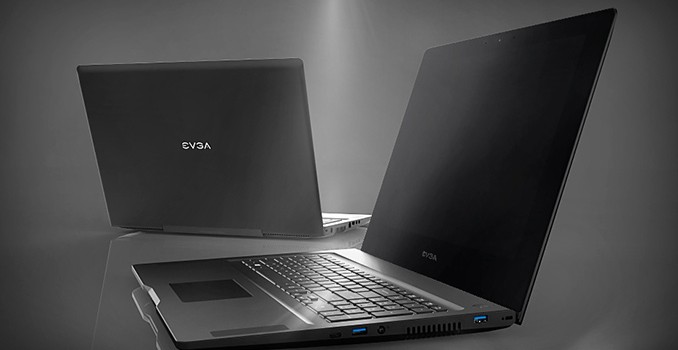
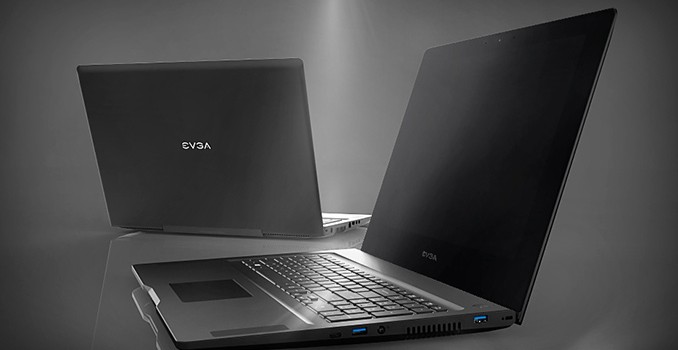
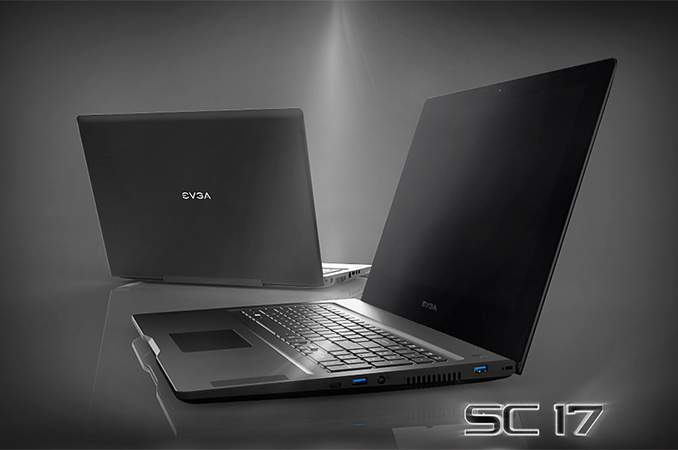
EVGA this week officially introduced its SC17 laptop designed for demanding gamers, which combines rather high performance with UHD display. The system features an Intel Core i7 microprocessor with unlocked multiplier, a high-end NVIDIA GeForce GTX graphics adapter, a combination of fast and capacious storage devices as well as a 4K display Two key features of the system are its ability to fine-tune microprocessor’s voltages in a bid to maximize overclocking potential as well as GPU overclocking support.

The EVGA SC17 laptop was designed by the company’s engineers completely in-house in a bid to offer functionality not available on other high-end notebooks. While EVGA is primarily known for its video cards and motherboards, keep in mind that that the company hired engineering team from Epox, a legendary maker of mainboards for enthusiasts, sometimes in mid-2000s (in fact, Andrew Han, a co-founder of EVGA, was also a co-founder of Epox), and thus has a lot of experienced talent when it comes to platform development. As a result, the EVGA SC17 sports a fully-fledged UEFI BIOS, which gives users control over many aspects of system’s performance, including CPU voltages, memory timings and so on. In fact, even the GPU can be overclocked from the BIOS, which is not a feature that you can typically find on notebooks. For those, who want to get maximum out of their systems, there is even a “clear CMOS” button on the chassis in order to reset settings in case of a malfunction. For users, who do not want to hevaily tweak their PC, the SC17 supports EVGA Express OC (EOC) technology that lets to easily overclock the system to gain performance, or downclock it to prolong battery life, with a press of two button.

EVGA’s new gaming laptop is based on the Intel Core i7-6820HK processor (four cores with Hyper-Threading, 2.70 GHz/3.60 GHz frequency, 8 MB L3 cache, HD Graphics 530, 45 W TDP) with unlocked multiplier, which was designed with overclocking in mind. The SC17 notebook is also equipped with NVIDIA’s GeForce GTX 980M graphics processing unit with 8 GB of GDDR5 memory, 32 GB of G.Skill’s DDR4-2666 memory, a 256 GB M.2 SSD with NVMe protocol (PCIe 3.0 x4 interface) as well as a 1 TB hard drive with 7200 RPM spindle speed. Just like other high-end laptops, the EVGA SC17 sports a full-HD webcam, built-in speakers with subwoofer, a Gigabit Ethernet controller, a IEEE 802.11ac Wi-Fi + Bluetooth 4.2  module, one USB 3.1 type-C port, two USB 3.0 ports, mDP as well as HDMI display outputs and so on.

EVGA’s engineers remained loyal to their overclocking origin and incorporated a rather advanced cooling system with two fans and eight vents into the SC17. The cooling system is designed to ensure that the Core i7-6820K and the GeForce GTX 980M receive enough cool air even when they are overclocked. It should be noted that NVIDIA is not particularly enthusiastic about mobile GPU overclocking these days, meaning EVGA would have had to do some extra work to offer this for customers.

Another important aspect of the EVGA SC17 is its 17.3” display. The 4K (3840×2160) screen is based on an IPS panel by Sharp. It is unknown whether Sharp has applied its IGZO backplane technology to the panel to make for better power efficiency but it’s a reasonably fair bet given the display size and resolution.

EVGA’s SC17 should offer performance levels comparable to good gaming PCs featuring Intel’s Core i7 “Skylake” CPU as well as NVIDIA’s GeForce GTX 970 GPU. This should be enough not only for mainstream gaming, but also for VR gaming, something that may be interesting to many people these days. Despite of rather high performance, the SC17 is not too bulky or heavy: it is 1.05” (26.9 mm) thick and weighs 3.69 kilograms (8.14 pounds), which is low compared to many other 17” notebooks.

While EVGA this week officially introduced the laptop, it did not reveal when exactly it plans to start selling it, but expect the mobile PCs to arrive in the coming weeks. The price of the notebook in the default configuration is $2699.99, which is not very high given the unlocked Core i7 processor as well as the GeForce GTX 980M inside.

EVGA Rolls Out SC17: High-End Gaming Laptop Designed for Overclocking

EVGA Rolls Out SC17: High-End Gaming Laptop Designed for Overclocking

EVGA this week officially introduced its SC17 laptop designed for demanding gamers, which combines rather high performance with UHD display. The system features an Intel Core i7 microprocessor with unlocked multiplier, a high-end NVIDIA GeForce GTX graphics adapter, a combination of fast and capacious storage devices as well as a 4K display Two key features of the system are its ability to fine-tune microprocessor’s voltages in a bid to maximize overclocking potential as well as GPU overclocking support.

The EVGA SC17 laptop was designed by the company’s engineers completely in-house in a bid to offer functionality not available on other high-end notebooks. While EVGA is primarily known for its video cards and motherboards, keep in mind that that the company hired engineering team from Epox, a legendary maker of mainboards for enthusiasts, sometimes in mid-2000s (in fact, Andrew Han, a co-founder of EVGA, was also a co-founder of Epox), and thus has a lot of experienced talent when it comes to platform development. As a result, the EVGA SC17 sports a fully-fledged UEFI BIOS, which gives users control over many aspects of system’s performance, including CPU voltages, memory timings and so on. In fact, even the GPU can be overclocked from the BIOS, which is not a feature that you can typically find on notebooks. For those, who want to get maximum out of their systems, there is even a “clear CMOS” button on the chassis in order to reset settings in case of a malfunction. For users, who do not want to hevaily tweak their PC, the SC17 supports EVGA Express OC (EOC) technology that lets to easily overclock the system to gain performance, or downclock it to prolong battery life, with a press of two button.

EVGA’s new gaming laptop is based on the Intel Core i7-6820HK processor (four cores with Hyper-Threading, 2.70 GHz/3.60 GHz frequency, 8 MB L3 cache, HD Graphics 530, 45 W TDP) with unlocked multiplier, which was designed with overclocking in mind. The SC17 notebook is also equipped with NVIDIA’s GeForce GTX 980M graphics processing unit with 8 GB of GDDR5 memory, 32 GB of G.Skill’s DDR4-2666 memory, a 256 GB M.2 SSD with NVMe protocol (PCIe 3.0 x4 interface) as well as a 1 TB hard drive with 7200 RPM spindle speed. Just like other high-end laptops, the EVGA SC17 sports a full-HD webcam, built-in speakers with subwoofer, a Gigabit Ethernet controller, a IEEE 802.11ac Wi-Fi + Bluetooth 4.2  module, one USB 3.1 type-C port, two USB 3.0 ports, mDP as well as HDMI display outputs and so on.

EVGA’s engineers remained loyal to their overclocking origin and incorporated a rather advanced cooling system with two fans and eight vents into the SC17. The cooling system is designed to ensure that the Core i7-6820K and the GeForce GTX 980M receive enough cool air even when they are overclocked. It should be noted that NVIDIA is not particularly enthusiastic about mobile GPU overclocking these days, meaning EVGA would have had to do some extra work to offer this for customers.

Another important aspect of the EVGA SC17 is its 17.3” display. The 4K (3840×2160) screen is based on an IPS panel by Sharp. It is unknown whether Sharp has applied its IGZO backplane technology to the panel to make for better power efficiency but it’s a reasonably fair bet given the display size and resolution.

EVGA’s SC17 should offer performance levels comparable to good gaming PCs featuring Intel’s Core i7 “Skylake” CPU as well as NVIDIA’s GeForce GTX 970 GPU. This should be enough not only for mainstream gaming, but also for VR gaming, something that may be interesting to many people these days. Despite of rather high performance, the SC17 is not too bulky or heavy: it is 1.05” (26.9 mm) thick and weighs 3.69 kilograms (8.14 pounds), which is low compared to many other 17” notebooks.

While EVGA this week officially introduced the laptop, it did not reveal when exactly it plans to start selling it, but expect the mobile PCs to arrive in the coming weeks. The price of the notebook in the default configuration is $2699.99, which is not very high given the unlocked Core i7 processor as well as the GeForce GTX 980M inside.