Vik


CORSAIR ONE PC Announced
CORSAIR ONE PC Announced

Corsair is very well known and well regarded for their ever-expanding line of PC cases, components and peripherals. After recently branching out to barebones PC kits with their Bulldog line, Corsair is now making the leap to fully-assembled systems.

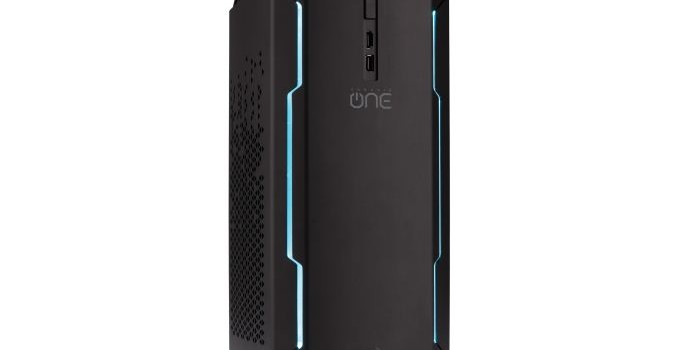
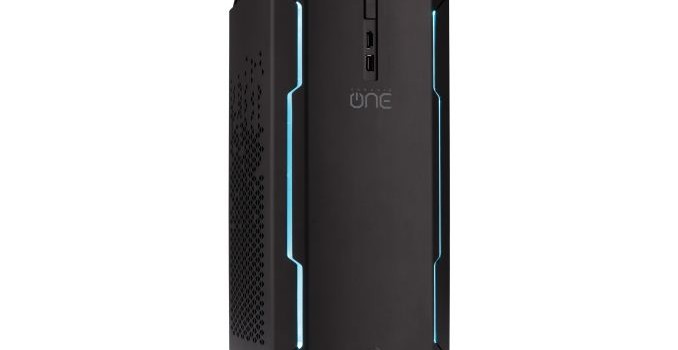
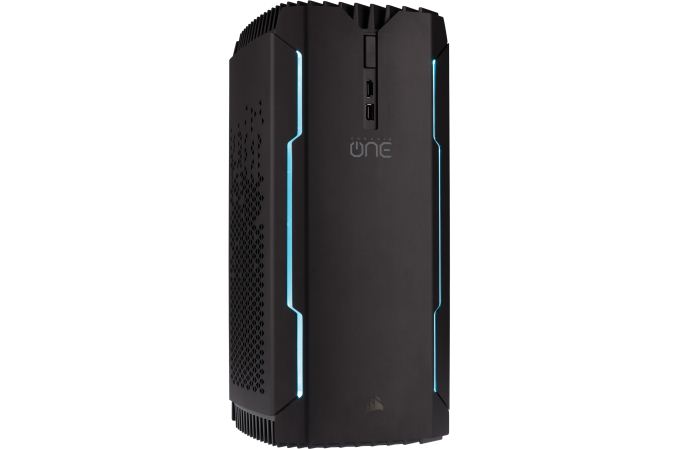
The Corsair ONE is their first ready-to-run PC, a compact tower system with familiar design traits of angular shapes and a dark brushed aluminum finish. Aesthetically, the front of the Corsair ONE most closely resembles their Carbide 330R and Obsidian 550D cases, but overall the Corsair ONE’s design is not as minimalist. The top and bottom have a finned structure reminiscent of a large heatsink, and the side panels are perforated with triangular ventilation holes. Corsair is not sharing technical specifications yet, but the accent lighting betrays a clear gaming focus. The tower is too shallow to contain a full ATX motherboard, but given the thoroughly ventilated side panels it should have no trouble accommodating high-power desktop components. Their PR photos also show that the Corsair ONE has an HDMI port on the front in addition to USB, allowing for easy use of a VR headset. There is no evidence of an optical drive bay.

While engineering a complete PC system should be no trouble for a company that already provides so many key components, the Corsair ONE will require a big shift in sales and support strategy for Corsair: The target audience will mostly be consumers who aren’t interested in the hassle of assembling a system based on the Bulldog or Corsair’s other products. A high-end VR-ready gaming PC will also be several times more expensive than any other product Corsair has sold. As a ready-to-run machine, the Corsair ONE will require broader post-sale customer support including supporting the pre-installed operating system and software.

Pricing and availability for the Corsair ONE have not been announced.

Gallery: CORSAIR ONE

CORSAIR ONE PC Announced

CORSAIR ONE PC Announced

Corsair is very well known and well regarded for their ever-expanding line of PC cases, components and peripherals. After recently branching out to barebones PC kits with their Bulldog line, Corsair is now making the leap to fully-assembled systems.

The Corsair ONE is their first ready-to-run PC, a compact tower system with familiar design traits of angular shapes and a dark brushed aluminum finish. Aesthetically, the front of the Corsair ONE most closely resembles their Carbide 330R and Obsidian 550D cases, but overall the Corsair ONE’s design is not as minimalist. The top and bottom have a finned structure reminiscent of a large heatsink, and the side panels are perforated with triangular ventilation holes. Corsair is not sharing technical specifications yet, but the accent lighting betrays a clear gaming focus. The tower is too shallow to contain a full ATX motherboard, but given the thoroughly ventilated side panels it should have no trouble accommodating high-power desktop components. Their PR photos also show that the Corsair ONE has an HDMI port on the front in addition to USB, allowing for easy use of a VR headset. There is no evidence of an optical drive bay.

While engineering a complete PC system should be no trouble for a company that already provides so many key components, the Corsair ONE will require a big shift in sales and support strategy for Corsair: The target audience will mostly be consumers who aren’t interested in the hassle of assembling a system based on the Bulldog or Corsair’s other products. A high-end VR-ready gaming PC will also be several times more expensive than any other product Corsair has sold. As a ready-to-run machine, the Corsair ONE will require broader post-sale customer support including supporting the pre-installed operating system and software.

Pricing and availability for the Corsair ONE have not been announced.

Gallery: CORSAIR ONE

CORSAIR ONE PC Announced

CORSAIR ONE PC Announced

Corsair is very well known and well regarded for their ever-expanding line of PC cases, components and peripherals. After recently branching out to barebones PC kits with their Bulldog line, Corsair is now making the leap to fully-assembled systems.

The Corsair ONE is their first ready-to-run PC, a compact tower system with familiar design traits of angular shapes and a dark brushed aluminum finish. Aesthetically, the front of the Corsair ONE most closely resembles their Carbide 330R and Obsidian 550D cases, but overall the Corsair ONE’s design is not as minimalist. The top and bottom have a finned structure reminiscent of a large heatsink, and the side panels are perforated with triangular ventilation holes. Corsair is not sharing technical specifications yet, but the accent lighting betrays a clear gaming focus. The tower is too shallow to contain a full ATX motherboard, but given the thoroughly ventilated side panels it should have no trouble accommodating high-power desktop components. Their PR photos also show that the Corsair ONE has an HDMI port on the front in addition to USB, allowing for easy use of a VR headset. There is no evidence of an optical drive bay.

While engineering a complete PC system should be no trouble for a company that already provides so many key components, the Corsair ONE will require a big shift in sales and support strategy for Corsair: The target audience will mostly be consumers who aren’t interested in the hassle of assembling a system based on the Bulldog or Corsair’s other products. A high-end VR-ready gaming PC will also be several times more expensive than any other product Corsair has sold. As a ready-to-run machine, the Corsair ONE will require broader post-sale customer support including supporting the pre-installed operating system and software.

Pricing and availability for the Corsair ONE have not been announced.

Gallery: CORSAIR ONE

Western Digital Announces SanDisk Skyhawk Enterprise NVMe SSDs

Western Digital Announces SanDisk Skyhawk Enterprise NVMe SSDs

Today Western Digital announced the first enterprise NVMe SSDs under their SanDisk brand. The new SanDisk Skyhawk series are 2.5″ U.2 SSDs intended for datacenter use. While Western Digital’s HGST division already has NVMe SSDs like the Ultrastar SN200 series and their consumer-oriented WD brand recently added the WD Black M.2 NVMe SSD, SanDisk’s previous PCIe SSDs have been based on their proprietary Fusion-IO architecture.

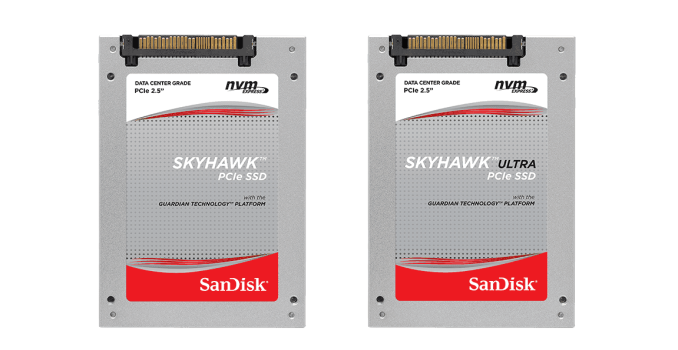
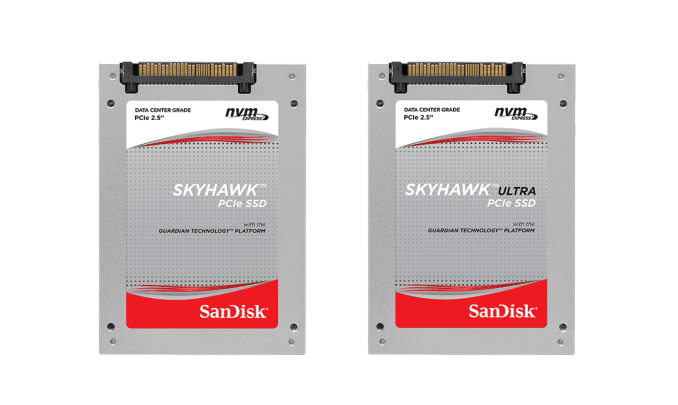
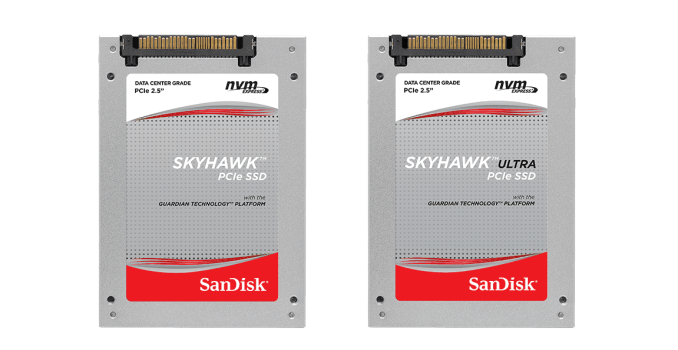
The SanDisk Skyhawk series includes 2TB and 4TB class drives. The standard Skyhawk models have usable capacities of 1920GB and 3840GB, while the Skyhawk Ultra models reserve more spare area and offer usable capacities of 1600GB and 3200GB. All four SKUs are based on a common platform with an unspecified PCIe 3.0 NVMe 1.2 controller. Performance and power consumption ratings are substantially lower than the HGST Ultrastar SN200 series, which use Microsemi’s Flashtec controllers and draw up to 25 W compared to just 10.5 W average and 12 W maximum for the Skyhawk. The SanDisk Skyhawk SSDs do not support the U.2 dual-port mode that top of the line enterprise SSDs like the HGST Ultrastar SN200 and Intel SSD DC D3600 and D3700 are capable of using, but otherwise the SanDisk Skyhawk has the usual features expected of a datacenter SSD.

 Series Specifications
  Skyhawk Skyhawk Ultra
Capacities 1,920 GB 3,840 GB 1,600 GB 3,200 GB
Form Factor 2.5″/15mm U.2
Interface PCIe 3.0 x4 (NVMe 1.2)
Controller unspecified
NAND 15nm MLC
Sequential Read (128 kB QD128) up to 1500 MB/s up to 1700 MB/s
Sequential Write (128 kB QD128) up to 1170 MB/s up to 1200 MB/s
Random Read (4 kB QD128) IOPS up to 250k IOPS up to 250k IOPS
Random Write (4 kB QD128) IOPS up to 47k IOPS up to 83k IOPS
Mixed Random Read/Write
( 70%R/30%W, 4kB QD128)
up to 99k IOPS up to 150k IOPS
Average Random Read Latency (4kB QD32) 128 µs 127 µs 125 µs 126 µs
Average Random Write Latency (4kB QD32) 718 µs 1331 µs 351 µs 693 µs
Power Idle 5.6 W
Operating 10.5 W
Endurance 0.6 DWPD 0.5 DWPD 1.7 DWPD 1.2 DWPD
Encryption None
Power Loss Protection Full in-flight data protection
MTBF 2 million hours
Warranty 5 years

Pricing for the SanDisk Skyhawk SSDs has not been announced. The drives are currently sampling to select OEMs and will be generally available in Q2.

Western Digital Announces SanDisk Skyhawk Enterprise NVMe SSDs

Western Digital Announces SanDisk Skyhawk Enterprise NVMe SSDs

Today Western Digital announced the first enterprise NVMe SSDs under their SanDisk brand. The new SanDisk Skyhawk series are 2.5″ U.2 SSDs intended for datacenter use. While Western Digital’s HGST division already has NVMe SSDs like the Ultrastar SN200 series and their consumer-oriented WD brand recently added the WD Black M.2 NVMe SSD, SanDisk’s previous PCIe SSDs have been based on their proprietary Fusion-IO architecture.

The SanDisk Skyhawk series includes 2TB and 4TB class drives. The standard Skyhawk models have usable capacities of 1920GB and 3840GB, while the Skyhawk Ultra models reserve more spare area and offer usable capacities of 1600GB and 3200GB. All four SKUs are based on a common platform with an unspecified PCIe 3.0 NVMe 1.2 controller. Performance and power consumption ratings are substantially lower than the HGST Ultrastar SN200 series, which use Microsemi’s Flashtec controllers and draw up to 25 W compared to just 10.5 W average and 12 W maximum for the Skyhawk. The SanDisk Skyhawk SSDs do not support the U.2 dual-port mode that top of the line enterprise SSDs like the HGST Ultrastar SN200 and Intel SSD DC D3600 and D3700 are capable of using, but otherwise the SanDisk Skyhawk has the usual features expected of a datacenter SSD.

 Series Specifications
  Skyhawk Skyhawk Ultra
Capacities 1,920 GB 3,840 GB 1,600 GB 3,200 GB
Form Factor 2.5″/15mm U.2
Interface PCIe 3.0 x4 (NVMe 1.2)
Controller unspecified
NAND 15nm MLC
Sequential Read (128 kB QD128) up to 1500 MB/s up to 1700 MB/s
Sequential Write (128 kB QD128) up to 1170 MB/s up to 1200 MB/s
Random Read (4 kB QD128) IOPS up to 250k IOPS up to 250k IOPS
Random Write (4 kB QD128) IOPS up to 47k IOPS up to 83k IOPS
Mixed Random Read/Write
( 70%R/30%W, 4kB QD128)
up to 99k IOPS up to 150k IOPS
Average Random Read Latency (4kB QD32) 128 µs 127 µs 125 µs 126 µs
Average Random Write Latency (4kB QD32) 718 µs 1331 µs 351 µs 693 µs
Power Idle 5.6 W
Operating 10.5 W
Endurance 0.6 DWPD 0.5 DWPD 1.7 DWPD 1.2 DWPD
Encryption None
Power Loss Protection Full in-flight data protection
MTBF 2 million hours
Warranty 5 years

Pricing for the SanDisk Skyhawk SSDs has not been announced. The drives are currently sampling to select OEMs and will be generally available in Q2.