Vik


Launch of Intel’s Apollo Lake NUCs Gets Closer as Intel Lists Them on Web Site
Launch of Intel’s Apollo Lake NUCs Gets Closer as Intel Lists Them on Web Site

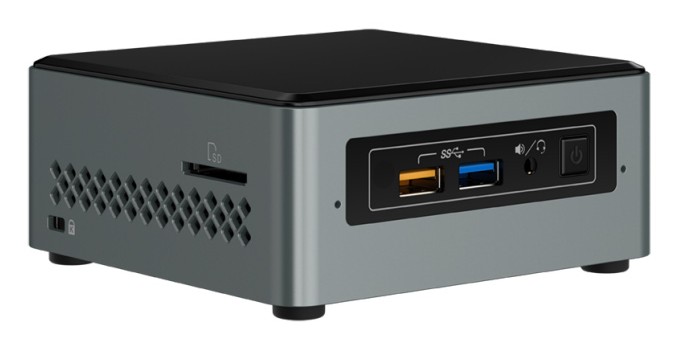
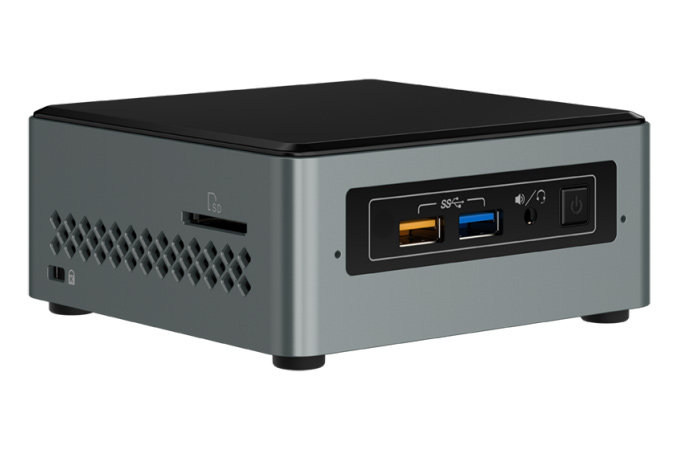
Intel has quietly published detailed specifications of miniature NUC systems based on the Apollo Lake platform on its web site. As revealed earlier this year, Intel offers two systems that can be used for both everyday computing as well as for media playback in the living room. The publication of details indicates that Intel either has started to ship the systems to customers or intends to begin their shipments in a short while.

Intel’s family of NUCs based on the Apollo Lake platform, codenamed Arches Canyon, consists of two systems: the NUC6CAYS and the NUC6CAYH. Both systems use the Intel Celeron J3455 processor (four Goldmont cores clocked at 1.5/2.3 GHz, 2 MB cache, dual-channel DRAM controller, HD Graphics 500, 10W TDP) that feature Intel’s ninth-generation graphics architecture (Gen9) as well as improved media playback engine with hardware-accelerated playback of 4K video encoded using HEVC and VP9 codecs.

The Intel NUC6CAYS is a fully populated PC that works out of the box and comes with 2 GB of DDR3L-1866 memory, 32 GB eMMC storage (from SanDisk, SK Hynix or Kingston), a wireless keyboard as well as pre-installed Windows 10 Home x64 OS. By contrast, the Intel NUC6CAYH comes as barebones, requiring DRAM and storage to work. Other than that, both Arches Canyon systems are exactly the same: they support up to 8 GB of DDR3L memory, one 2.5”/9.5 mm SSD/HDD, a 1×1 wireless module supporting IEEE 802.11ac Wi-Fi and Bluetooth 4.2, a HDMI 2.0 display output, four USB 3.0 Type-A ports (one supports charging), an SDXC card reader, a TRRS mini-jack for audio and so on. One of the noteworthy features is that the entry-level NUCs have a D-Sub connector on the back to allow connectivity with cheap displays and other applications that use this header. Typically a legacy port is done at a request of one of their large customers, and/or the company intends to sell the new NUCs in developing countries.

Intel Arches Canyon NUC PCs
  NUC6CAYS NUC6CAYH
CPU Intel Celeron J3455
4C/4T Goldmont
1.5 – 2.3 GHz
2MB cache
10 W TDP
Graphics HD Graphics 500
12 EUs
250 – 750 MHz
PCH Integrated into CPU
Memory 2 GB DDR3L-1866 pre-installed
Two SO-DIMM slots,
up to 8 GB of DDR3L-1866

Two SO-DIMM slots,
up to 8 GB of DDR3L-1866
On-Board Storage Capacity 32 GB None
Type eMMC 5.1/5.0
Model SanDisk SDINADF4-32G-H (5.1)
Kingston EMMC32G-M525-A53 (5.1)
SK Hynix H26M64103EMR (5.0)
2.5″ bay One 2.5″/9.5 mm bay, SATA3
M.2 Slot None
Wi-Fi/BT Intel Wireless-AC 316x (802.11ac 1×1 + BT 4.2)
M.2-2230 card with WiDi support
Ethernet Intel Gigabit Ethernet controller
Display Outputs D-Sub (implemented using the ITE IT6516BFN DisplayPort to VGA bridge)
HDMI 2.0 (implemented using the MegaChips MCDP2800-BCT DisplayPort 1.2a to HDMI 2.0 LSPCON)
Audio 3.5 mm TRRS audio jack
TOSLINK
7.1 channel audio output via HDMI
IR Consumer Infrared (CIR) sensor on the front panel
USB 4 USB 3.0 Type-A (5 Gbps), one with charging
Other I/O SDXC card reader with UHS-I support
Dimensions 115 × 111 × 51 mm
PSU External, 65 W
OS Pre-installed Microsoft Windows 10 Home x64 with Intel Remote Keyboard Compatible with Windows 7/8.1/10
Detailed Specifications PDF

Given the rich multimedia capabilities of Intel’s latest Apollo Lake SoCs, HDMI 2.0 connectivity as well as compatibility with 2.5” storage devices, the Arches Canyon NUCs could serve quite well as 4K-capable HTPCs. Still, keep in mind that the systems only support HDCP 1.4/1.2 and PAVP 2.0 and thus will not playback Ultra HD Blu-rays even if equipped with an appropriate external drive.

At press time, the Intel NUC6CAYS and the Intel NUC6CAYH SFF PCs were not available for sale anywhere. Official MSRPs for the systems are unknown, but one of the online stores known for taking pre-orders on unreleased items lists the NUC6CAYS for $225 and the NUC6CAYH for $158. The prices are relatively high for these kind of PCs, so we expect the actual MSRPs to be lower.

Related Reading:
Micron Completes Acquisition of Inotera Memories

Micron Completes Acquisition of Inotera Memories

Micron this month completed acquisition of Inotera Memories, a DRAM production company it has co-owned for eight years controlled its output for three years. The acquisition is designed to help Micron to increase its profit margins and enable the company to better manage the transition of Inotera’s production capacity to newer fabrication technologies. In the meantime, Nanya Technology, a former co-owner of Inotera, gets $4.1 billion and options to license Micron’s two 10 nm-class DRAM manufacturing processes.

Inotera was established in early 2003 as a joint venture between Nanya and Infineon, with Nanya controlling two-thirds of the company. Under the terms of the agreement, Infineon developed process technologies in exchange for part of the Inotera output (technology-for-capacity deals were common in the DRAM industry back then), whereas Nanya licensed those technologies to produce memory in its own fab. Eventually, Infineon spun its DRAM operations off as an independent company called Qimonda in 2006, and Qimonda sold its stake in Inotera to Micron in 2008 (and then went bankrupt in 2009). Micron managed to amend the agreement with Nanya in early 2013 and got exclusive right to buy all of Inotera’s output at a market price that included a profit margin shared between the owners of the manufacturer.

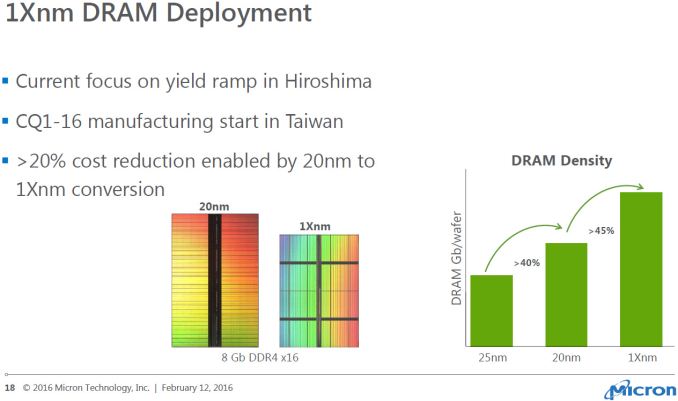
Inotera’s Fab 11 manufacturing facility is located in Taoyuan, Taiwan, and reportedly accounts for 35% of Micron’s total output. As a result it is an important source of DRAM for the company. Late last year Micron and Nanya finally reached an agreement under which the former would acquire the remaining stake it did not own in Inotera for $4.1 billion, comprised of cash and equity, whereas the latter would get the money along with options to license for two generations of Micron’s DRAM process technologies following the current 20 nm (at present, the technologies are known as 1X and 1Y nm). Under the license agreements negotiated a year ago, in each case when Nanya licenses Micron’s processes, the U.S.-based DRAM maker will get an equity stake in Nanya as well as royalties based on revenues from products (subject to an agreed cap). The stakes would give Micron access to profits earned by Nanya in general. It is also important to note that the licenses will be limited to a specific facility footprint and subject to a quarterly cap on production, something that significantly lowers Nanya’s opportunities to compete against Micron in terms of volumes. Moreover, the licenses are non-transferrable and terminate if Nanya is acquired by a third party.

Now that Micron assumes full control over Inotera, it will get its output at production costs, which will be immediately beneficial to the company’s profit margins and other financial metrics. Going forward, Micron will have a full control of the fab and will thus be able to manage upgrades and align them with its other DRAM manufacturing operations in Japan and Taiwan. It is interesting to note that according to DRAMeXchange/TrendForce, Inotera transited to Micron’s 20 nm process technology quicker than Micron’s own fabs, an indicator that the production facility is a good asset with an agile management team.

In the meantime, Nanya got at least $3.1 billion in cash and access to two of Micron’s 10 nm-class fabrication technologies, which will enable it to be competitive against other DRAM makers in terms of costs, chip capacities and performance for at least four more years. It is also important that Nanya will ensure its lead over other Taiwan-based DRAM makers, Winbond and Powerchip, by using leading-edge manufacturing nodes. What happens four years down the road is hard to tell, but for some time the company will not need to collaborate with other DRAM makers to develop process technologies. At the same time, restrictions imposed by the license agreements will limit Nanya’s ability to expand its market share beyond ~3% of the global output it controls now.

Related Reading:

Micron Completes Acquisition of Inotera Memories

Micron Completes Acquisition of Inotera Memories

Micron this month completed acquisition of Inotera Memories, a DRAM production company it has co-owned for eight years controlled its output for three years. The acquisition is designed to help Micron to increase its profit margins and enable the company to better manage the transition of Inotera’s production capacity to newer fabrication technologies. In the meantime, Nanya Technology, a former co-owner of Inotera, gets $4.1 billion and options to license Micron’s two 10 nm-class DRAM manufacturing processes.

Inotera was established in early 2003 as a joint venture between Nanya and Infineon, with Nanya controlling two-thirds of the company. Under the terms of the agreement, Infineon developed process technologies in exchange for part of the Inotera output (technology-for-capacity deals were common in the DRAM industry back then), whereas Nanya licensed those technologies to produce memory in its own fab. Eventually, Infineon spun its DRAM operations off as an independent company called Qimonda in 2006, and Qimonda sold its stake in Inotera to Micron in 2008 (and then went bankrupt in 2009). Micron managed to amend the agreement with Nanya in early 2013 and got exclusive right to buy all of Inotera’s output at a market price that included a profit margin shared between the owners of the manufacturer.

Inotera’s Fab 11 manufacturing facility is located in Taoyuan, Taiwan, and reportedly accounts for 35% of Micron’s total output. As a result it is an important source of DRAM for the company. Late last year Micron and Nanya finally reached an agreement under which the former would acquire the remaining stake it did not own in Inotera for $4.1 billion, comprised of cash and equity, whereas the latter would get the money along with options to license for two generations of Micron’s DRAM process technologies following the current 20 nm (at present, the technologies are known as 1X and 1Y nm). Under the license agreements negotiated a year ago, in each case when Nanya licenses Micron’s processes, the U.S.-based DRAM maker will get an equity stake in Nanya as well as royalties based on revenues from products (subject to an agreed cap). The stakes would give Micron access to profits earned by Nanya in general. It is also important to note that the licenses will be limited to a specific facility footprint and subject to a quarterly cap on production, something that significantly lowers Nanya’s opportunities to compete against Micron in terms of volumes. Moreover, the licenses are non-transferrable and terminate if Nanya is acquired by a third party.

Now that Micron assumes full control over Inotera, it will get its output at production costs, which will be immediately beneficial to the company’s profit margins and other financial metrics. Going forward, Micron will have a full control of the fab and will thus be able to manage upgrades and align them with its other DRAM manufacturing operations in Japan and Taiwan. It is interesting to note that according to DRAMeXchange/TrendForce, Inotera transited to Micron’s 20 nm process technology quicker than Micron’s own fabs, an indicator that the production facility is a good asset with an agile management team.

In the meantime, Nanya got at least $3.1 billion in cash and access to two of Micron’s 10 nm-class fabrication technologies, which will enable it to be competitive against other DRAM makers in terms of costs, chip capacities and performance for at least four more years. It is also important that Nanya will ensure its lead over other Taiwan-based DRAM makers, Winbond and Powerchip, by using leading-edge manufacturing nodes. What happens four years down the road is hard to tell, but for some time the company will not need to collaborate with other DRAM makers to develop process technologies. At the same time, restrictions imposed by the license agreements will limit Nanya’s ability to expand its market share beyond ~3% of the global output it controls now.

Related Reading: