Vik


AnandTech Call for Writers: 2016

The Call for Writers has become something of an annual tradition over here at AnandTech. As anyone who follows the site knows very well, the list of things we have to review/cover usually exceeds our available time. So the call for writers gives us a chance to find new talent and new opportunities to grow, be it into new coverage areas entirely or just covering more of the existing products our readers have come to enjoy over the years.

The ultimate purpose of the Call for Writers is to find new talent. To continue to grow and improve our content, we need your help. We’re looking for writers with a true passion for the technology we cover, a deep understanding of what’s out there and a thirst for more knowledge.

We’re looking for contributors to help out both with reviews as well as our short to medium form Pipeline coverage. The areas in particular we’re looking for help with are listed below:

  • News/Pipeline (US & Euro)
  • Systems/Laptops (US-only)
  • GPUs (US-only)
  • Mobile/Smartphones
  • Wearables
  • Podcast Editor
  • Networking
  • Memory
  • Monitors
  • Home Automation/IoT
  • Professional Graphics/GPU

If you find yourself at the intersection of knowledge and passion about any of those areas, and have some time to contribute, you’re exactly what we’re looking for. These are paid, part-time positions that we’re looking to fill, with most positions open on a world-wide basis, and certain positions primed for a quick promotion to full-time. What I need is a writing sample that demonstrates your ability to talk about any one of these topics. Your sample can be in the form of a review, a pipeline post or an analysis piece – it should be something that looks like it would fit in on AnandTech.

Once you’ve produced it, send it on over to [email protected]. Please also include a description of what subject(s) you would be interested in writing about, and some basic information about your background and where you’re located. We’ll read through all samples but can’t guarantee a reply due to the sheer volume of submissions we tend to receive. If we like what you’ve sent and there’s a potential fit on the team, we’ll be in touch.

I’ll conclude this post with a passage from our About page:

In the early days of technology reporting on the web the focus was almost exclusively on depth. We had a new medium for content that didn’t come with the same restrictions as more traditional forms. We could present as much data as we felt was necessary and we could do it quicker.

As the web grew, so did the approach to gaining readership. In many cases, publishers learned from the tips and tricks of more traditional media to growing their audience. The focus shifted away from ultimate understanding of what was being reported, to producing content significantly motivated by increasing traffic, or revenue, or both. Thorough observations were out; sensationalism, link baiting, and the path to shallow 10-o’clock-news reporting were in.

While I believe it’s definitely easier to produce content by going this route, I don’t believe it’s the only way to build a well read website.

If the above resonates with you and you’d like to help by being a part of something different, I’d encourage you to submit a writing sample.

Frequently Asked Questions

Q: How old do I need to be to work for AnandTech?
A: You need to be old enough to legally work in your country of residence without significant restriction. Otherwise we have no specific requirements so long as you can do the job well. Anand started the site at 14, after all…

Q: Do I need to be located in the United States to work for AnandTech?
A: Some positions do require that you be in the US for logistical reasons, and those specific positions are noted. However unless otherwise noted, most positions are open on a world-wide basis.

Q: Do I need to supply my own products for testing or contacts at companies? (i.e. do I need to be an insider?)
A: No. Assuming for the moment you have a computer to write on, then you already have the most important piece of equipment that you need. Meanwhile you will need some knowledge of the field at hand, but we will introduce you to the people you need to know for your position at AnandTech.

Q: Can I really work for AnandTech even though I don’t have a Ph.D in electrical engineering?
A: Yes! We are first and foremost looking for people with a passion to learn, and the knack to make it happen. There’s a certain degree of baseline knowledge needed for any given position, but if you can read existing AnandTech articles then you’re already half-way there.

Q: Is there a submission deadline?
A: We have a tentative end point for the middle of November.
AnandTech Call for Writers: 2016

The Call for Writers has become something of an annual tradition over here at AnandTech. As anyone who follows the site knows very well, the list of things we have to review/cover usually exceeds our available time. So the call for writers gives us a chance to find new talent and new opportunities to grow, be it into new coverage areas entirely or just covering more of the existing products our readers have come to enjoy over the years.

The ultimate purpose of the Call for Writers is to find new talent. To continue to grow and improve our content, we need your help. We’re looking for writers with a true passion for the technology we cover, a deep understanding of what’s out there and a thirst for more knowledge.

We’re looking for contributors to help out both with reviews as well as our short to medium form Pipeline coverage. The areas in particular we’re looking for help with are listed below:

  • News/Pipeline (US & Euro)
  • Systems/Laptops (US-only)
  • GPUs (US-only)
  • Mobile/Smartphones
  • Wearables
  • Podcast Editor
  • Networking
  • Memory
  • Monitors
  • Home Automation/IoT
  • Professional Graphics/GPU

If you find yourself at the intersection of knowledge and passion about any of those areas, and have some time to contribute, you’re exactly what we’re looking for. These are paid, part-time positions that we’re looking to fill, with most positions open on a world-wide basis, and certain positions primed for a quick promotion to full-time. What I need is a writing sample that demonstrates your ability to talk about any one of these topics. Your sample can be in the form of a review, a pipeline post or an analysis piece – it should be something that looks like it would fit in on AnandTech.

Once you’ve produced it, send it on over to [email protected]. Please also include a description of what subject(s) you would be interested in writing about, and some basic information about your background and where you’re located. We’ll read through all samples but can’t guarantee a reply due to the sheer volume of submissions we tend to receive. If we like what you’ve sent and there’s a potential fit on the team, we’ll be in touch.

I’ll conclude this post with a passage from our About page:

In the early days of technology reporting on the web the focus was almost exclusively on depth. We had a new medium for content that didn’t come with the same restrictions as more traditional forms. We could present as much data as we felt was necessary and we could do it quicker.

As the web grew, so did the approach to gaining readership. In many cases, publishers learned from the tips and tricks of more traditional media to growing their audience. The focus shifted away from ultimate understanding of what was being reported, to producing content significantly motivated by increasing traffic, or revenue, or both. Thorough observations were out; sensationalism, link baiting, and the path to shallow 10-o’clock-news reporting were in.

While I believe it’s definitely easier to produce content by going this route, I don’t believe it’s the only way to build a well read website.

If the above resonates with you and you’d like to help by being a part of something different, I’d encourage you to submit a writing sample.

Frequently Asked Questions

Q: How old do I need to be to work for AnandTech?
A: You need to be old enough to legally work in your country of residence without significant restriction. Otherwise we have no specific requirements so long as you can do the job well. Anand started the site at 14, after all…

Q: Do I need to be located in the United States to work for AnandTech?
A: Some positions do require that you be in the US for logistical reasons, and those specific positions are noted. However unless otherwise noted, most positions are open on a world-wide basis.

Q: Do I need to supply my own products for testing or contacts at companies? (i.e. do I need to be an insider?)
A: No. Assuming for the moment you have a computer to write on, then you already have the most important piece of equipment that you need. Meanwhile you will need some knowledge of the field at hand, but we will introduce you to the people you need to know for your position at AnandTech.

Q: Can I really work for AnandTech even though I don’t have a Ph.D in electrical engineering?
A: Yes! We are first and foremost looking for people with a passion to learn, and the knack to make it happen. There’s a certain degree of baseline knowledge needed for any given position, but if you can read existing AnandTech articles then you’re already half-way there.

Q: Is there a submission deadline?
A: We have a tentative end point for the middle of November.
ASUS ROG GT51 Desktop: Overclocked i7-6700K, GTX 1080 SLI, 64 GB DDR4, $4999

ASUS ROG GT51 Desktop: Overclocked i7-6700K, GTX 1080 SLI, 64 GB DDR4, $4999

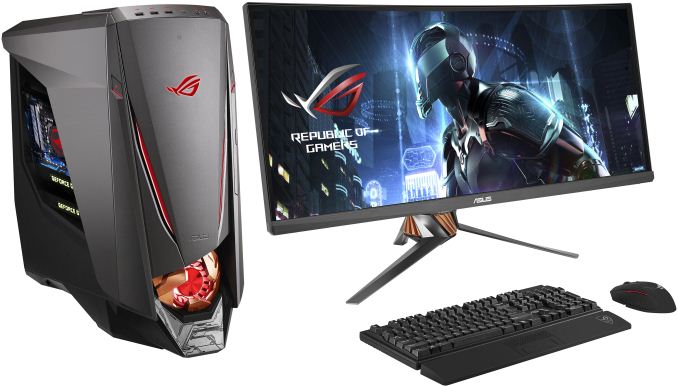
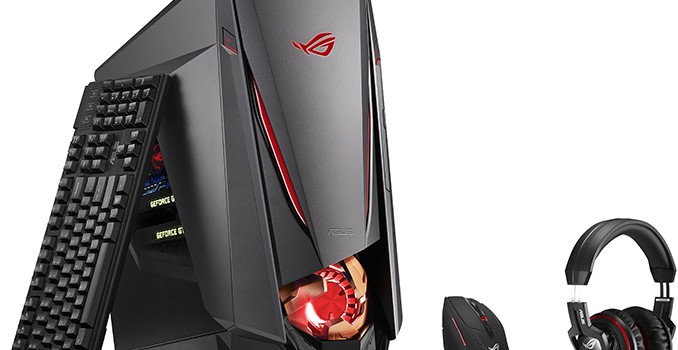
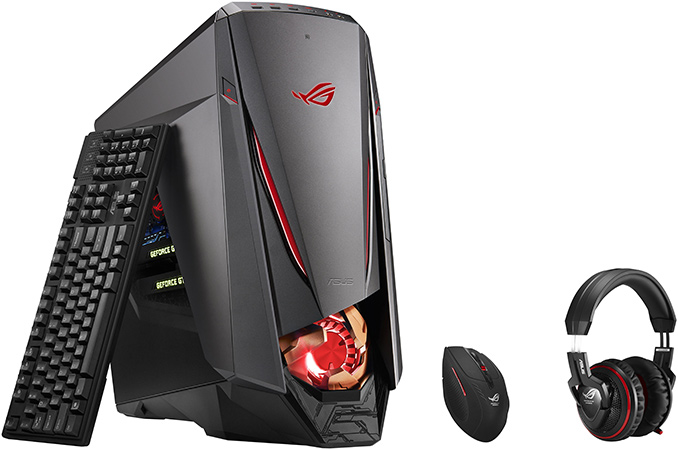
ASUS this month finally began to sell its high-end ROG GT51 desktop in the U.S. The system comes equipped with a factory-overclocked Intel Core i7 processor, two GeForce GTX graphics cards in SLI mode as well as two NVMe PCIe SSDs in RAID 0 to maximize performance. The fully configured ROG GT51 system costs $4999 and marks ASUS’ entry on the market of high-performance desktop PCs.

ASUSTeK Computer was established in 1989 with the purpose to develop and build computer motherboards. The company quickly became famous for its mainboards and by the early 2000s it was the world’s No. 1 producer of mainboards and a leading maker of PC components in general. Starting from 2002~2003, ASUS began to diversify its business and started to make products like notebooks and various peripherals, and in 2006 the company established its Republic of Gamers (ROG) sub-brand for computer components designed specifically for gamers. Eventually, ASUS came up with high-end ROG laptops as well as gaming displays and even became the largest supplier of the aforementioned product categories (at least, according to its own statements). However, despite the fact that ROG-branded motherboards have been used by performance enthusiasts and a variety of boutique PC makers for their builds for a while, ASUS itself did not actively engage into desktop PC market until circa 2014, when it introduced its ROG G20 SFF PC and ROG GR8 console based on custom form factor designs. Over the last couple of years, ASUS has showcased various region specific builds, but the GT51 is the company’s first gaming desktop build to challenge high-end machines from well-known brands. It took the company quite a while to finalize the design and it is finally available for purchase.

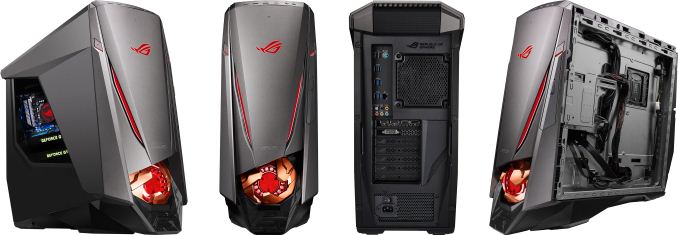
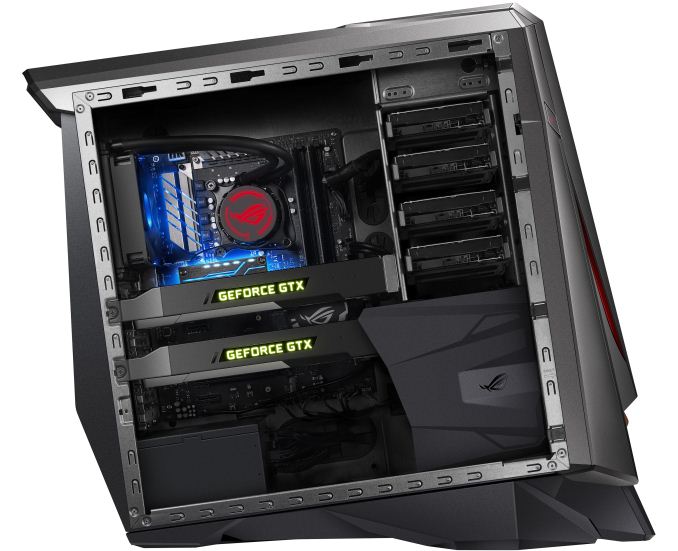
The ASUS ROG GT51CA is based on Intel’s Core i7-6700K CPU that can be overclocked in one click to 4.60 GHz as well as a proprietary Intel Z170-based motherboard. The processor is cooled using an ROG-branded closed-loop liquid-cooling system, which fan also acts like an exhaust fan for the whole PC. The system comes equipped with two ASUS GeForce GTX 1080 graphics cards running in SLI mode, 64 GB of DDR4-2800 memory (4×16 GB), two Samsung SM951 512 GB M.2 SSDs operating in RAID 0 mode and with a 1 TB HDD (which has 7200 RPM spindle speed). Since we are talking about a serious gaming PC that has to compete against products from companies like Alienware and Origin PC, the ROG GT51CA can be further customized by their owners, but not built-to-order by retailers. For example, the end users may install faster memory, up to five 3.5”/2.5” HDDs or SSDs, different M.2 drives and so on.

Specifications of ASUS ROG GT51
  ASUS ROG GT51CA
CPU Intel Core i7-6700K at 4.6 GHz
PCH Intel Z170
Motherboard ASUS SKU-Specific Custom
Graphics Up to two NVIDIA GeForce GTX 1080
Cooling ASUS closed-loop liquid cooling with 120 mm radiator
Memory Four DIMM slots, 64 GB of DDR4-2800
M.2 Two Samsung SM951 512 GB in RAID 0
Two M.2 (PCIe 3.0 x4) slots for up to two M.2 2280 SSDs
HDD 1 TB HDD with 7200 RPM spindle speed
SATA connectors 6
Storage bays 5×3.5″/2.5″
1×5.25″
Wireless 2×2 802.11ac + BT 4.0
Optional NFC
Ethernet Gigabit Ethernet (Intel I219-V ?)
Display Outputs HDMI/DP/DVI – according to GPU specs
Audio Five 7.1-channel audio connectors
(Realtek ALC1150?)
a mini-jack for headphones
a mini-jack for microphone
Optical S/PDIF
USB 8 × USB 3.0 Type-A (5 Gbps)
1 × USB 3.1 Type-A (10 Gbps)
1 × USB 3.1 Type-C (10 Gbps)
2 × USB 2.0
Dimensions 23″ (H) x 10.3″ (W) x 23″ (D)
58.7 cm (H) x 58.4 cm (W) x 26.2 cm (D)
PSU 700 W PSU by ASUS
Visual Aesthetics Custom lighting:
– Four lighting zones
– Eight color modes
– Motherboard lighting
Price $4999
NB! Exact specifications may vary as ASUS
and partners may offer different configurations.

As for connectivity, the ASUS ROG GT51CA has gigabit ethernet, 802.11ac 8×2 Wi-Fi, multiple USB 3.0 Type-A ports (including two on the front), one USB 3.1 Type-A (10 Gbps) and one USB 3.1 Type-C (10 Gbps) port (both on the front). The audio of the PC clearly deserves a mention because ASUS has installed an audiophile-grade ESS Sabre headphone DAC and amplifier to improve audio quality to the front audio outputs. Meanwhile, for some reason the company decided not to equip its top-of-the-range system with one of its Xonar discrete audio cards and the ROG GT51CA still relies on a 7.1-channel integrated audio solution (which is typically an improved ALC1150 audio solution from ASUS).

Yet another exclusive capability of the ROG GT51CA is the ROG Band, which can be used to access a hidden hard drive space as well as the overclocking mode.

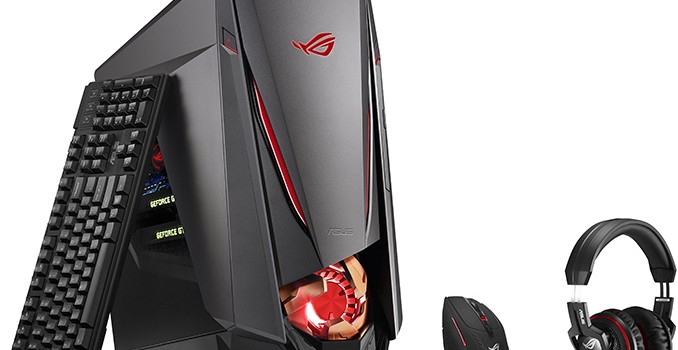
Like systems from boutique PC makers, the ASUS ROG GT51CA has custom dynamic LED lighting effects (eight million colors, four zones) and comes with a mechanical keyboard and a gaming grade mouse with matching design. Unfortunately, at this time ASUS does not offer aerography for its machine.

The ASUS ROG GT51CA premium desktop is available from Amazon, B&H Photo and some other retailers.

Related Reading:

ASUS ROG GT51 Desktop: Overclocked i7-6700K, GTX 1080 SLI, 64 GB DDR4, $4999

ASUS ROG GT51 Desktop: Overclocked i7-6700K, GTX 1080 SLI, 64 GB DDR4, $4999

ASUS this month finally began to sell its high-end ROG GT51 desktop in the U.S. The system comes equipped with a factory-overclocked Intel Core i7 processor, two GeForce GTX graphics cards in SLI mode as well as two NVMe PCIe SSDs in RAID 0 to maximize performance. The fully configured ROG GT51 system costs $4999 and marks ASUS’ entry on the market of high-performance desktop PCs.

ASUSTeK Computer was established in 1989 with the purpose to develop and build computer motherboards. The company quickly became famous for its mainboards and by the early 2000s it was the world’s No. 1 producer of mainboards and a leading maker of PC components in general. Starting from 2002~2003, ASUS began to diversify its business and started to make products like notebooks and various peripherals, and in 2006 the company established its Republic of Gamers (ROG) sub-brand for computer components designed specifically for gamers. Eventually, ASUS came up with high-end ROG laptops as well as gaming displays and even became the largest supplier of the aforementioned product categories (at least, according to its own statements). However, despite the fact that ROG-branded motherboards have been used by performance enthusiasts and a variety of boutique PC makers for their builds for a while, ASUS itself did not actively engage into desktop PC market until circa 2014, when it introduced its ROG G20 SFF PC and ROG GR8 console based on custom form factor designs. Over the last couple of years, ASUS has showcased various region specific builds, but the GT51 is the company’s first gaming desktop build to challenge high-end machines from well-known brands. It took the company quite a while to finalize the design and it is finally available for purchase.

The ASUS ROG GT51CA is based on Intel’s Core i7-6700K CPU that can be overclocked in one click to 4.60 GHz as well as a proprietary Intel Z170-based motherboard. The processor is cooled using an ROG-branded closed-loop liquid-cooling system, which fan also acts like an exhaust fan for the whole PC. The system comes equipped with two ASUS GeForce GTX 1080 graphics cards running in SLI mode, 64 GB of DDR4-2800 memory (4×16 GB), two Samsung SM951 512 GB M.2 SSDs operating in RAID 0 mode and with a 1 TB HDD (which has 7200 RPM spindle speed). Since we are talking about a serious gaming PC that has to compete against products from companies like Alienware and Origin PC, the ROG GT51CA can be further customized by their owners, but not built-to-order by retailers. For example, the end users may install faster memory, up to five 3.5”/2.5” HDDs or SSDs, different M.2 drives and so on.

Specifications of ASUS ROG GT51
  ASUS ROG GT51CA
CPU Intel Core i7-6700K at 4.6 GHz
PCH Intel Z170
Motherboard ASUS SKU-Specific Custom
Graphics Up to two NVIDIA GeForce GTX 1080
Cooling ASUS closed-loop liquid cooling with 120 mm radiator
Memory Four DIMM slots, 64 GB of DDR4-2800
M.2 Two Samsung SM951 512 GB in RAID 0
Two M.2 (PCIe 3.0 x4) slots for up to two M.2 2280 SSDs
HDD 1 TB HDD with 7200 RPM spindle speed
SATA connectors 6
Storage bays 5×3.5″/2.5″
1×5.25″
Wireless 2×2 802.11ac + BT 4.0
Optional NFC
Ethernet Gigabit Ethernet (Intel I219-V ?)
Display Outputs HDMI/DP/DVI – according to GPU specs
Audio Five 7.1-channel audio connectors
(Realtek ALC1150?)
a mini-jack for headphones
a mini-jack for microphone
Optical S/PDIF
USB 8 × USB 3.0 Type-A (5 Gbps)
1 × USB 3.1 Type-A (10 Gbps)
1 × USB 3.1 Type-C (10 Gbps)
2 × USB 2.0
Dimensions 23″ (H) x 10.3″ (W) x 23″ (D)
58.7 cm (H) x 58.4 cm (W) x 26.2 cm (D)
PSU 700 W PSU by ASUS
Visual Aesthetics Custom lighting:
– Four lighting zones
– Eight color modes
– Motherboard lighting
Price $4999
NB! Exact specifications may vary as ASUS
and partners may offer different configurations.

As for connectivity, the ASUS ROG GT51CA has gigabit ethernet, 802.11ac 8×2 Wi-Fi, multiple USB 3.0 Type-A ports (including two on the front), one USB 3.1 Type-A (10 Gbps) and one USB 3.1 Type-C (10 Gbps) port (both on the front). The audio of the PC clearly deserves a mention because ASUS has installed an audiophile-grade ESS Sabre headphone DAC and amplifier to improve audio quality to the front audio outputs. Meanwhile, for some reason the company decided not to equip its top-of-the-range system with one of its Xonar discrete audio cards and the ROG GT51CA still relies on a 7.1-channel integrated audio solution (which is typically an improved ALC1150 audio solution from ASUS).

Yet another exclusive capability of the ROG GT51CA is the ROG Band, which can be used to access a hidden hard drive space as well as the overclocking mode.

Like systems from boutique PC makers, the ASUS ROG GT51CA has custom dynamic LED lighting effects (eight million colors, four zones) and comes with a mechanical keyboard and a gaming grade mouse with matching design. Unfortunately, at this time ASUS does not offer aerography for its machine.

The ASUS ROG GT51CA premium desktop is available from Amazon, B&H Photo and some other retailers.

Related Reading:

HTC Announces the HTC Bolt - A Sprint-Exclusive Smartphone for LTE Plus

HTC Announces the HTC Bolt – A Sprint-Exclusive Smartphone for LTE Plus

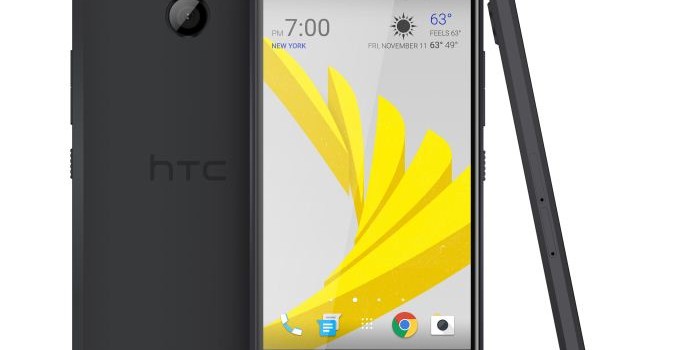
Early this morning HTC took the wraps off of a new phone that will be exclusive to Sprint, the Bolt. Not to be confused with the old HTC Thunderbolt, the Bolt is a somewhat less than flagship phone that roughly follows the same path as last year’s HTC One A9, offering another take on a high-end phone design with a slightly different configuration. Coupled with its change in hardware, the Bolt also serves as a network showcase of sorts for Sprint and their latest-generation LTE Plus network.

  HTC One M9 HTC 10 HTC Bolt
SoC Snapdragon 810
4x Cortex-A57 @ 2Ghz
4x Cortex-A53 @ 1.5GHz
Adreno 430

(TSMC 20SoC)

Snapdragon 820
2x Kryo @ 2.15GHz
2x Kryo @ 1.6GHz
Adreno 530

(Samsung 14LPP)

Snapdragon 810
4x Cortex-A57 @ 2Ghz
4x Cortex-A53 @ 1.5GHz
Adreno 430

(TSMC 20SoC)

RAM 3GB LPDDR4 4GB LPDDR4 3GB LPDDR4
NAND 32GB NAND + microSD 32/64GB NAND + microSD 32 NAND + microSD
Display 5” 1080p
Super LCD3
5.2” 1440p
Super LCD5
5.5” 1440p
Super LCD3
Network 2G / 3G / 4G LTE (Category 6/9 LTE) 2G / 3G / 4G LTE (Category 6/9 LTE) 2G / 3G / 4G LTE (Category 6/9 LTE)
Dimensions 144.6 x 69.7 x 9.61mm, 157g 145.9 x 71.9 x 3-9mm, 161g 153.6 x 77.3 x 3.7-8.1mm, 174g
Camera 20MP Rear Facing f/2.2, 1.12µm, 1/2.4″ (Toshiba T4KA7) 12MP Rear Facing w/ OIS and laser AF, f/1.8, 1.55µm, 1/2.3″
(Sony IMX377)
16MP Rear Facing w/ OIS and PDAF, f/1.7
4MP Front Facing, f/2.0, 2µm
(OmniVision OV4688)
5MP Front Facing w/ OIS, f/1.8, 1.34µm
(Samsung S5K4E6)
8MP Front Facing
Battery 2840 mAh (10.93 Whr) 3000 mAh (11.55 Whr) 3200 mAh (12.32 Whr)
OS Android 5 w/ HTC Sense 7 Android 6 w/ HTC Sense Android 7 w/ HTC Sense
Connectivity 1×1 802.11a/b/g/n/ac,
BT 4.1, (BCM4356),
USB2.0, GPS/GLONASS, NFC
2×2 802.11a/b/g/n/ac,
BT 4.2, (BCM4359)
USB-C, USB3.1,
GPS/GLONASS (US, JP)
GPS/GLONASS/Beidou (EU, Asia)
NFC
802.11a/b/g/n/ac,
BT 4.1, NFC,
USB-C (2.0)
GPS/GLONASS
Fingerprint Sensor N/A Capacitive Capacitive
SIM NanoSIM NanoSIM NanoSIM
Launch Price $649 $699 $600

Starting as always with the specs, while it’s obvious from the announcement that the Bolt is not meant to be a true competitor to the 10, I must admit the choice of hardware surprised me. HTC has opted to go with Qualcomm’s struggling (and at this point relatively old) Snapdragon 810 SoC, a staple of 2015 flagship phones that combined 4 ARM Cortex-A57 cores with 4 ARM Cortex-A53 cores and built on TSMC’s 20nm process. The fact that this phone is meant to be below the HTC 10 rules out Snapdragon 820. And HTC stated that one of Sprint’s requirements was the ability to do 3x carrier aggregation, which rules out the Snapdragon 600 series. The Bolt’s development cycle was also shorter than usual, so HTC needed to stick with an SoC it had previous experience with. Using the Snapdragon 810 does give us a good idea of what to expect for phone performance, and performance stability, though.

In terms of physical design, the Bolt is not much different than the 10, and I imagine that was intentional. With a 5.5-inch 2560×1440 display the phone is larger than the HTC 10, but it retains the former’s general curved design and button placement. This gives HTC’s latest phones a common style to them, which for HTC helps them stand apart from the likes of Samsung and the other Android handset vendors. The display itself is one of HTC’s Super LCD3 panels, the same generation as the HTC One M9.

The big news for HTC and Sprint here is of course the cellular connectivity. Backed by the Snapdragon 810’s integrated X10 mode, the Bolt is meant to showcase Sprint’s LTE Plus network. LTE Plus specifically takes advantage of carrier aggregation, with Sprint offering LTE on 800MHz, 1900MHz, and their recently recovered 2.5GHz spectrum. In the case of the Bolt, this allows for aggregating up to 3 20MHz channels over those bands. And though it’s beyond the scope of a news article, I’m curious as to how well 2.5GHz is working in practice for Sprint, given the greater hurdles that come from its reduced ability to penetrate buildings.

Otherwise many of the phone’s features and specifications are consistent with other high-end Android phones, including a fingerprint sensor and USB Type-C connectivity (albeit only 2.0 speeds). Meanwhile, relative to the HTC 10, HTC has gone with a higher resolution rear camera here, utilizing a 16MP sensor versus the HTC 10’s 12MP. Though specific sensor information isn’t available, the overall camera module is on the higher end, incorporating OIS and phase-detection auto focus. Further in the Bolt’s favor, the phone is IP57 rated. This is a rating we don’t see too often, and relative to the more common IP67 means that it has the same degree of water resistance as some other phones, but lower dust resistance, merely being protected against dust, but not completely sealed against it.

Powering the phone is a size-appropriate 3200mAh battery, which means we’re looking at a 7% capacity increase versus the battery found in the 5.2-inch HTC 10. And as this is a Snapdragon 810-based phone, it supports Qualcomm’s Quick Charge 2.0 rapid charging technology. However on the other hand, inexplicably missing is a 3.5mm headphone jack; despite the fact that this phone is larger than HTC’s other phones, the company has gone the Apple route and removed it. Instead HTC offers a set of USB-C headphones, otherwise you’ll need to track down a USB-C audio adapter. On the plus side, however, the phone does feature a microSD card slot, for users who find the single 32GB configuration to be too small.

Finally, the Bolt is the first HTC phone that will ship with Android 7. As usual, HTC is applying their Sense UI to Android, which has itself been upgraded to keep up with the latest release of Android.

Wrapping things up, as a Sprint exclusive, Sprint will of course be handling distribution. The carrier is listing the phone at $600 ($25 x 24 months), and while the Bolt is not being positioned as a flagship-level phone, the pricing unfortunately isn’t going to be too far off. As we noted in yesterday’s buyer’s guide, you can already find the HTC 10 for $549, which makes the Bolt the de facto more expensive phone, a somewhat awkward position, all things considered.

Gallery: HTC Bolt