Vik


Update: NVIDIA Releases 375.63 WHQL Driver update

Update: NVIDIA Releases 375.63 WHQL Driver update

Update 10/23: NVIDIA has yanked the 375.57 drivers this weekend and replaced them with a new build, 375.63. The updated driver set fixes an especially annoying bug with tiles on Windows 10 that the previous driver introduced. They can be downloaded here.


Following suit as this fall’s major games hit the (virtual) store shelves, NVIDIA has packaged another bundle of Game Ready updates for the latest releases. In the 375.57 WHQL update we get a few fixes, new game support, and some VR as well.

This time we have the first version out for driver release 375. In the list of fixes we start with Mirrors Edge Catalyst, which is no longer flicking in the Ansel UI when the image is moved with the mouse pointer on systems running a SLI GTX 980M setup. There is no longer get corruption from decals in Overwatch and there are also no longer issues changing the refresh rate on BenQ ZOWIE monitors, were before we saw cases of system crashes and signal loss to the monitor when changing the refresh rate. Lastly there is a fix for an issue with the GeForce GTX 650 causing dots on all the characters in GTA V.

As a new feature in this release NVIDIA improved the performance and quality of the “motion vectors provided by the Motion-Estimation-Only mode of the video encoder, specifically in stereo VR use cases”. Though a bit of a mouthful for a description, this enhancement seems to apply to improving NVIDIA’s recording quality with stereo VR games.

Moving on to the most interesting reason for updating our drivers, the Game Ready updates start with Battlefield 1, which came out this week. We can also find support for Sid Meier’s Civilization VI which was released in lockstep next to Battlefield 1. Titanfall 2 made the roster for this update though we won’t be seeing that game’s release until next Friday on the 28th. We also have a new section in the release notes labeled Game Ready VR, which means that VR experiences join in on the party starting with the classic series Serious Sam in Serious Sam VR: The Last Hope and the incoming Eagle Flight VR From Ubisoft. We have also been given a new SLI profile for the MMORPG Lineage Eternal: Twilight Resistance.

Anyone interested can download the updated drivers through GeForce Experience or on the NVIDIA driver download page. More information on this update and further issues can be found in the 375.57 release notes.
Samsung Introduces 8 GB LPDDR4-4266 Package for Mobile Devices

Samsung Introduces 8 GB LPDDR4-4266 Package for Mobile Devices

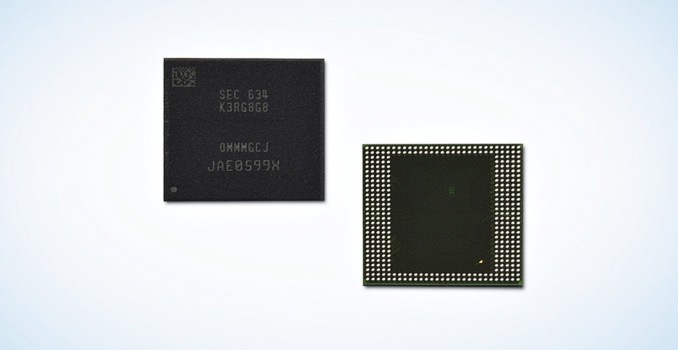
Samsung this week announced its first LPDDR4 memory chips made using its 10nm-class DRAM fabrication technology. The new DRAM ICs feature the industry’s highest density of 16 Gb, are rated to run at 4266 MT/s data rate, and open the door to more mobile devices with 8 GB of DRAM.

Earlier this year Samsung started to produce DDR4 memory using its 10nm-class DRAM manufacturing process (which is believed to be 18 nm) and recently the firm began to use it to make LPDDR4 memory devices, just as it planned. The thinner fabrication technology allowed Samsung to increase capacity of a single LPDDR4 DRAM IC to 16 Gb (up from 12 Gb at 20nm introduced in August, 2015) while retaining a 4266 MT/s transfer rate.

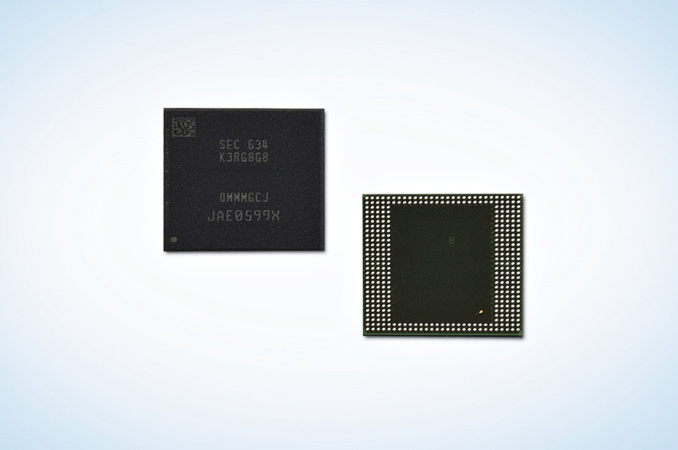
The first product to use the 16 Gb ICs is Samsung’s 8 GB LPDDR4-4266 mobile DRAM package for smartphones, tablets, and other applications that can use LPDDR4. The device stacks four memory ICs and provides up to 34 GB/s of bandwidth when connected to an SoC using a 64-bit memory bus. The 8 GB DRAM package comes in a standard 15 mm x 15 mm x 1 mm form-factor, which is compatible with typical mobile devices, but Samsung can also make the package thinner than 1 mm to enable PoP stacking with a mobile application processor or a UFS NAND storage device.

Samsung’s 8 GB LPDDR4 DRAM Package
  SEC 634
K3RG8G8
DRAM IC Capacity 16 Gb
Number of DRAM ICs 4
Data Rate 4266 MT/s
Bus Width x64
Bandwidth 34 GB/s
Package 15 mm x 15 mm x 1 mm
Process Technology 10nm-class (18nm?)

Samsung has not revealed a lot about the cost efficiency or power consumption of the 16 Gb LPDDR4 ICs, nor have they discussed those details for the 8 GB LPDDR4 package either. What little Samsung has said is that the latter consumes approximately the same amount of power as a 4 GB LPDDR4-3200 device (four 8 Gb ICs) made using its 20 nm-class process technology. Taken at face value, one can extrapolate that the switch to the 10nm-class fabrication process allowed Samsung to double the capacity and increase performance by 33% at the same power. Unfortunately, we do not know anything about the geometry scaling of the new ICs relative to Samsung’s older ICs, so it’s hard to even guess how much Samsung’s newest DDR4 costs to fab.

Samsung has not officially commented on when it plans to start commercial shipments of its 8 GB LPDDR4 packages, but it is reasonable to assume that the company will commence sales of such devices in the coming months, with actual products hitting the market in 2017.

Samsung Introduces 8 GB LPDDR4-4266 Package for Mobile Devices

Samsung Introduces 8 GB LPDDR4-4266 Package for Mobile Devices

Samsung this week announced its first LPDDR4 memory chips made using its 10nm-class DRAM fabrication technology. The new DRAM ICs feature the industry’s highest density of 16 Gb, are rated to run at 4266 MT/s data rate, and open the door to more mobile devices with 8 GB of DRAM.

Earlier this year Samsung started to produce DDR4 memory using its 10nm-class DRAM manufacturing process (which is believed to be 18 nm) and recently the firm began to use it to make LPDDR4 memory devices, just as it planned. The thinner fabrication technology allowed Samsung to increase capacity of a single LPDDR4 DRAM IC to 16 Gb (up from 12 Gb at 20nm introduced in August, 2015) while retaining a 4266 MT/s transfer rate.

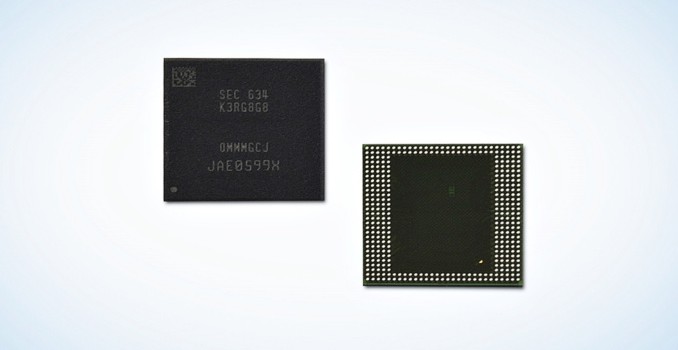
The first product to use the 16 Gb ICs is Samsung’s 8 GB LPDDR4-4266 mobile DRAM package for smartphones, tablets, and other applications that can use LPDDR4. The device stacks four memory ICs and provides up to 34 GB/s of bandwidth when connected to an SoC using a 64-bit memory bus. The 8 GB DRAM package comes in a standard 15 mm x 15 mm x 1 mm form-factor, which is compatible with typical mobile devices, but Samsung can also make the package thinner than 1 mm to enable PoP stacking with a mobile application processor or a UFS NAND storage device.

Samsung’s 8 GB LPDDR4 DRAM Package
  SEC 634
K3RG8G8
DRAM IC Capacity 16 Gb
Number of DRAM ICs 4
Data Rate 4266 MT/s
Bus Width x64
Bandwidth 34 GB/s
Package 15 mm x 15 mm x 1 mm
Process Technology 10nm-class (18nm?)

Samsung has not revealed a lot about the cost efficiency or power consumption of the 16 Gb LPDDR4 ICs, nor have they discussed those details for the 8 GB LPDDR4 package either. What little Samsung has said is that the latter consumes approximately the same amount of power as a 4 GB LPDDR4-3200 device (four 8 Gb ICs) made using its 20 nm-class process technology. Taken at face value, one can extrapolate that the switch to the 10nm-class fabrication process allowed Samsung to double the capacity and increase performance by 33% at the same power. Unfortunately, we do not know anything about the geometry scaling of the new ICs relative to Samsung’s older ICs, so it’s hard to even guess how much Samsung’s newest DDR4 costs to fab.

Samsung has not officially commented on when it plans to start commercial shipments of its 8 GB LPDDR4 packages, but it is reasonable to assume that the company will commence sales of such devices in the coming months, with actual products hitting the market in 2017.

Seagate Launches FireCuda SSHDs: Up to 2 TB, SMR, 8 GB of NAND

Seagate Launches FireCuda SSHDs: Up to 2 TB, SMR, 8 GB of NAND

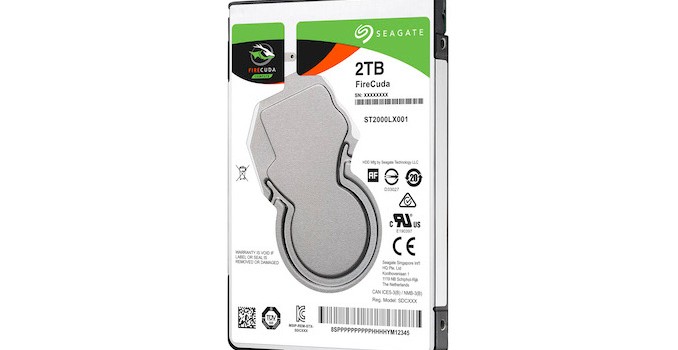
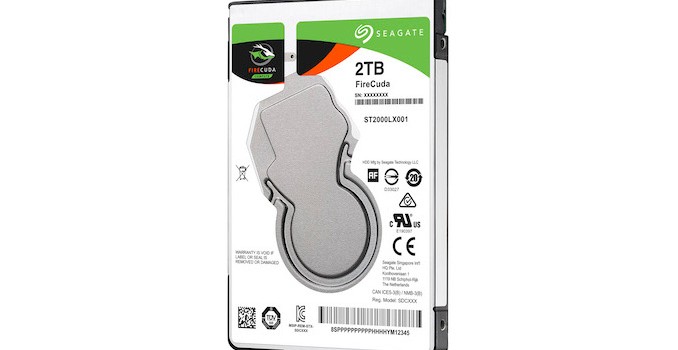
Seagate has officially introduced its fifth-generation solid-state hybrid drives (SSHDs) under the FireCuda brand name. They have a thinner form-factor compared to previous-gen solutions. The drives use Seagate’s 1 TB SMR platters as well as the company’s multi-tier cache technology. The FireCuda 2.5” are the first SSHDs to use shingled magnetic recording (SMR).

The Seagate FireCuda 2.5” family will offer 500 GB, 1 TB and 2 TB capacities and will be compatible with both desktops and thin laptops, thanks to its 7 mm z-height (down from 9.5 mm in case of the Laptop SSHD drives). To a large extent, the Seagate FireCuda SSHDs resemble the recently announced BarraCuda 2.5” HDDs: the drives are also based on the 1 TB SMR platters which have an areal density of more than 1.3 Tb/in2 (note that the areal density of the FireCuda products is higher compared to that of BarraCuda devices). They feature 5400 RPM spindle speed and come with 128 MB of DRAM cache buffer. The maximum transfer rate and average latency for the BarraCuda 2.5” and FireCuda 2.5” are the same: 140 MB/s and 5.6 ms.

Seagate FireCuda 2.5″ SSHDs
  2 TB 1 TB 500 GB
NAND 8 GB MLC
Platters/Heads 2/4 1/2
Spindle Speed 5400 RPM
Cache 128 MB + multi-tier caching technology
Transfer Rate 140 MB/s
Avg Latency 5.6 ms
Areal Density 1327 Gb/in² avg
Recording Density 2296 Kb/in avg
Track Density 580 Ktracks/inch avg
Idle Power 0.5 W 0.45 W
Read/Write Power 1.7/1.8 W 1.6/1.7 W
Interface SATA 6 Gbps
Form-Factor 2.5″/7 mm
Model Number ST2000LX001 ST1000LX015 ST500LX025

The differentiating aspect of the FireCuda SSHDs is their 8 GB NAND buffer. It caches data from frequently used sectors to enable faster boot times and shorter load times for certain applications. Therefore, when it comes to real-world performance, FireCuda 2.5” SSHDs should provide better performance compared to the BarraCuda 2.5” HDDs. However, it is unknown how the FireCuda 2.5” drive stack up against the Laptop SSHDs based on PMR platters. Seagate has not revealed whether the new FireCuda SSHDs use a new caching algorithm compared to the previous-gen hybrid hard drives, but this is certainly a possibility given the use of SMR platters. As before, the company says that the algorithm is continuously trying to optimize performance of FireCuda SSHDs.

Seagate has started to ship the FireCuda drives to its customers, but has not listed official prices or market availability dates. The latter depends on retailers and/or PC makers. Seagate tells us that the FireCuda 2.5″ 2 TB will cost around $100, but the supply/demand situation is bound to affect that pricing. Meanwhile, Amazon offers the FireCuda 2.5″ 1 TB for $70. All of the previous-gen Laptop SSHDs ended up in retail, so, it is a question of time before the whole FireCuda 2.5″ family will be up for grabs. One of the advantages of Seagate’s hybrid drives is their five-year warranty, which is longer than that of typical HDDs.

Seagate Launches FireCuda SSHDs: Up to 2 TB, SMR, 8 GB of NAND

Seagate Launches FireCuda SSHDs: Up to 2 TB, SMR, 8 GB of NAND

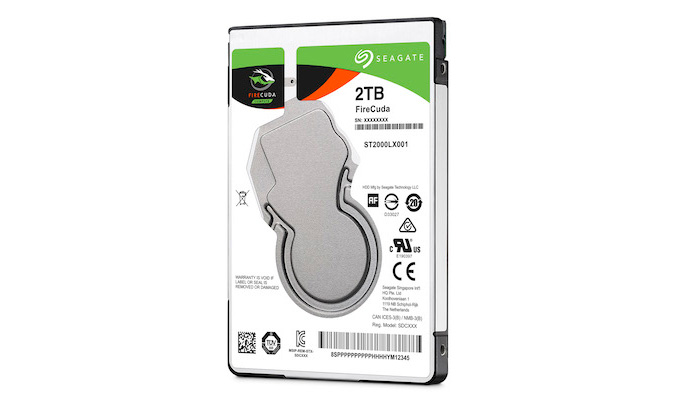
Seagate has officially introduced its fifth-generation solid-state hybrid drives (SSHDs) under the FireCuda brand name. They have a thinner form-factor compared to previous-gen solutions. The drives use Seagate’s 1 TB SMR platters as well as the company’s multi-tier cache technology. The FireCuda 2.5” are the first SSHDs to use shingled magnetic recording (SMR).

The Seagate FireCuda 2.5” family will offer 500 GB, 1 TB and 2 TB capacities and will be compatible with both desktops and thin laptops, thanks to its 7 mm z-height (down from 9.5 mm in case of the Laptop SSHD drives). To a large extent, the Seagate FireCuda SSHDs resemble the recently announced BarraCuda 2.5” HDDs: the drives are also based on the 1 TB SMR platters which have an areal density of more than 1.3 Tb/in2 (note that the areal density of the FireCuda products is higher compared to that of BarraCuda devices). They feature 5400 RPM spindle speed and come with 128 MB of DRAM cache buffer. The maximum transfer rate and average latency for the BarraCuda 2.5” and FireCuda 2.5” are the same: 140 MB/s and 5.6 ms.

Seagate FireCuda 2.5″ SSHDs
  2 TB 1 TB 500 GB
NAND 8 GB MLC
Platters/Heads 2/4 1/2
Spindle Speed 5400 RPM
Cache 128 MB + multi-tier caching technology
Transfer Rate 140 MB/s
Avg Latency 5.6 ms
Areal Density 1327 Gb/in² avg
Recording Density 2296 Kb/in avg
Track Density 580 Ktracks/inch avg
Idle Power 0.5 W 0.45 W
Read/Write Power 1.7/1.8 W 1.6/1.7 W
Interface SATA 6 Gbps
Form-Factor 2.5″/7 mm
Model Number ST2000LX001 ST1000LX015 ST500LX025

The differentiating aspect of the FireCuda SSHDs is their 8 GB NAND buffer. It caches data from frequently used sectors to enable faster boot times and shorter load times for certain applications. Therefore, when it comes to real-world performance, FireCuda 2.5” SSHDs should provide better performance compared to the BarraCuda 2.5” HDDs. However, it is unknown how the FireCuda 2.5” drive stack up against the Laptop SSHDs based on PMR platters. Seagate has not revealed whether the new FireCuda SSHDs use a new caching algorithm compared to the previous-gen hybrid hard drives, but this is certainly a possibility given the use of SMR platters. As before, the company says that the algorithm is continuously trying to optimize performance of FireCuda SSHDs.

Seagate has started to ship the FireCuda drives to its customers, but has not listed official prices or market availability dates. The latter depends on retailers and/or PC makers. Seagate tells us that the FireCuda 2.5″ 2 TB will cost around $100, but the supply/demand situation is bound to affect that pricing. Meanwhile, Amazon offers the FireCuda 2.5″ 1 TB for $70. All of the previous-gen Laptop SSHDs ended up in retail, so, it is a question of time before the whole FireCuda 2.5″ family will be up for grabs. One of the advantages of Seagate’s hybrid drives is their five-year warranty, which is longer than that of typical HDDs.