
Vik


OpenCAPI Unveiled: AMD, IBM, Google, Xilinx, Micron and Mellanox Join Forces in the Heterogenous Computing Era

OpenCAPI Unveiled: AMD, IBM, Google, Xilinx, Micron and Mellanox Join Forces in the Heterogenous Computing Era

Some of you may remember AMD announcing the “Torrenza” technology 10 years ago. The idea was to offer a fast and coherent interface between the CPU and various types of “accelerators” (via Hyper Transport). It was one of the first initiatives to enable “heterogeneous computing”.

We now have technology that could be labeled “heterogeneous computing”, the most popular form being GPU computing. There have been also encryption, compression and network accelerators, but the advantages of those accelerators were never really clear, as shifting data back and forth to the CPU was in many cases less efficient than letting the CPU process it with optimized instructions. Heterogeneous computing was in the professional world mostly limited to HPC; in the consumer world a “nice to have”.

But times are changing. The sensors of the Internet of Things, the semantic web and the good old www are creating a massive and exponentially growing flood of data that can not be stored and analyzed by traditional means. Machine learning offers a way of classifying all that data and finding patterns “automatically”. As a result, we witnessed a “machine learning renaissance”, with quite a few breakthroughs. Google had to deal with this years ago before most other companies, and released some of those AI breakthroughs of the Google Brain Team in the Open Source world, one example being “TensorFlow”. And when Google releases important technology into the Open Source world, we know we got to pay attention. When Google released the Google File System and Big Table back in 2004 for example, a little bit later the big data revolution with Hadoop, HDFS and NoSQL databases erupted.
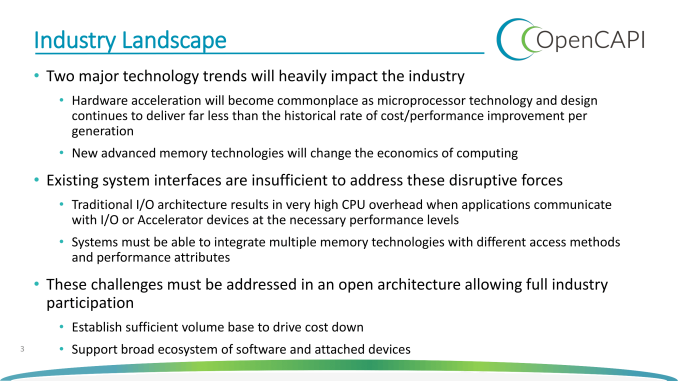
Big Data thus needs big brains: we need more processing power than ever. As Moore’s law is dead (the end of CMOS scaling), we can not expect much from process technology advancements. The processing power has to come from ASICs (see Google’s TPU), FPGAs (see Microsoft’s project Catapult) and GPUs.

Those accelerators need a new “Torrenza technology”, a fast, coherent interconnect to the CPU. NVIDIA was first with NVLink, but an open standard would be even better. IBM on the other hand was willing to share the CAPI interface.

To that end, Google, AMD, Xilinx, Micron and Mellanox have joined forces with IBM to create a “coherent high performance bus interface” based on a new bus standard called “Open Coherent Accelerator Processor Interface” (OpenCAPI). Capable of a 25Gbits per second per lane data rate, OpenCAPI outperforms the current PCIe specification, which offers a maximum data transfer rate of 8Gbits per second for a PCIe 3.0 lane. We assume that the total bandwidth will be a lot higher for quite a few OpenCAPI devices, as OpenCAPI lanes will be bundled together.
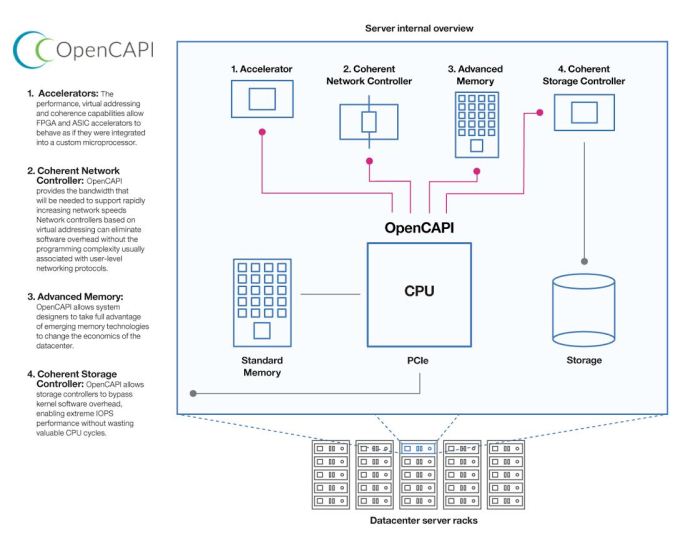
It is a win, win for everybody besides Intel. It is clear now that IBM’s OpenPOWER initiative is gaining a lot of traction and that IBM is deadly serious about offering an alternative to the Intel dominated datacenter. IBM will implement the OpenCAPI interface in the POWER9 servers in 2017. Those POWER9s will not only have a very fast interface to NVIDIA GPUs (via NVLink), but also to Google’s ASICs and Xilinx FPGAs accelerators.
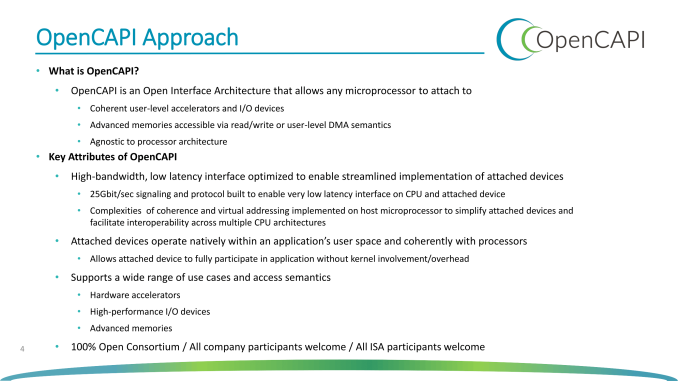
Meanwhile this benefits AMD as they get access to an NVLink alternative to link up the Radeon GPU power to the upcoming Zen based server processors. Micron can link faster (and more profitable than DRAM) memory to the CPU. Mellanox can do the same for networking. OpenCAPI is even more important for the Xilinx FPGAs as a coherent interface can make FPGAs attractive for a much wider range of applications than today.

And guess what, Dell/EMC has joined this new alliance just a few days ago. Intel has to come up with an answer…

Update: courtesy of commenter Yojimbo: NVIDIA is a member of the OpenCAPI consortium, at the “contributor level”, which is the same level Xilinx has. The same is true for HPE (HP Enterprise)”.

This is even bigger than we thought. Probably the biggest announcement in the server market this year.


OpenCAPI Unveiled: AMD, IBM, Google, Xilinx, Micron and Mellanox Join Forces in the Heterogenous Computing Era

OpenCAPI Unveiled: AMD, IBM, Google, Xilinx, Micron and Mellanox Join Forces in the Heterogenous Computing Era

Some of you may remember AMD announcing the “Torrenza” technology 10 years ago. The idea was to offer a fast and coherent interface between the CPU and various types of “accelerators” (via Hyper Transport). It was one of the first initiatives to enable “heterogeneous computing”.

We now have technology that could be labeled “heterogeneous computing”, the most popular form being GPU computing. There have been also encryption, compression and network accelerators, but the advantages of those accelerators were never really clear, as shifting data back and forth to the CPU was in many cases less efficient than letting the CPU process it with optimized instructions. Heterogeneous computing was in the professional world mostly limited to HPC; in the consumer world a “nice to have”.

But times are changing. The sensors of the Internet of Things, the semantic web and the good old www are creating a massive and exponentially growing flood of data that can not be stored and analyzed by traditional means. Machine learning offers a way of classifying all that data and finding patterns “automatically”. As a result, we witnessed a “machine learning renaissance”, with quite a few breakthroughs. Google had to deal with this years ago before most other companies, and released some of those AI breakthroughs of the Google Brain Team in the Open Source world, one example being “TensorFlow”. And when Google releases important technology into the Open Source world, we know we got to pay attention. When Google released the Google File System and Big Table back in 2004 for example, a little bit later the big data revolution with Hadoop, HDFS and NoSQL databases erupted.

Big Data thus needs big brains: we need more processing power than ever. As Moore’s law is dead (the end of CMOS scaling), we can not expect much from process technology advancements. The processing power has to come from ASICs (see Google’s TPU), FPGAs (see Microsoft’s project Catapult) and GPUs.

Those accelerators need a new “Torrenza technology”, a fast, coherent interconnect to the CPU. NVIDIA was first with NVLink, but an open standard would be even better. IBM on the other hand was willing to share the CAPI interface.

To that end, Google, AMD, Xilinx, Micron and Mellanox have joined forces with IBM to create a “coherent high performance bus interface” based on a new bus standard called “Open Coherent Accelerator Processor Interface” (OpenCAPI). Capable of a 25Gbits per second per lane data rate, OpenCAPI outperforms the current PCIe specification, which offers a maximum data transfer rate of 8Gbits per second for a PCIe 3.0 lane. We assume that the total bandwidth will be a lot higher for quite a few OpenCAPI devices, as OpenCAPI lanes will be bundled together.

It is a win, win for everybody besides Intel. It is clear now that IBM’s OpenPOWER initiative is gaining a lot of traction and that IBM is deadly serious about offering an alternative to the Intel dominated datacenter. IBM will implement the OpenCAPI interface in the POWER9 servers in 2017. Those POWER9s will not only have a very fast interface to NVIDIA GPUs (via NVLink), but also to Google’s ASICs and Xilinx FPGAs accelerators.

Meanwhile this benefits AMD as they get access to an NVLink alternative to link up the Radeon GPU power to the upcoming Zen based server processors. Micron can link faster (and more profitable than DRAM) memory to the CPU. Mellanox can do the same for networking. OpenCAPI is even more important for the Xilinx FPGAs as a coherent interface can make FPGAs attractive for a much wider range of applications than today.

And guess what, Dell/EMC has joined this new alliance just a few days ago. Intel has to come up with an answer…

Update: courtesy of commenter Yojimbo: NVIDIA is a member of the OpenCAPI consortium, at the “contributor level”, which is the same level Xilinx has. The same is true for HPE (HP Enterprise)”.

This is even bigger than we thought. Probably the biggest announcement in the server market this year.


Update: Samsung Officially Halts All Note7 Sales & Exchanges, Now Recalling All Devices

Update: Samsung Officially Halts All Note7 Sales & Exchanges, Now Recalling All Devices

Update 10/13: After earlier asking customers to stop using the Note7, today the company has expanded the matter to a full recall in the United States. All Note7s, originals and replacements, are now being recalled by the company. As most users are expected to want to swap to another phone, the actual processing of the recall is being handled by both Samsung (for direct sales customers), and retailers/carriers for remaining customers.

Meanwhile, along with the refunds/partial rebates being offered by retailers to either cover the cost of the phone or the price difference between it and its replacement, Samsung has also announced that they are expanding their US bill credit program. In short, customers who stay with Samsung will receive a $100 bill credit, while customers who replace their Note7 with another manufacturer’s phone or opt for a full refund will receive a $25 bill credit.

U.S. Note7 Refund and Exchange Program

Under the terms of the U.S. Note7 Refund and Exchange Program, you have the following choices and can take these next steps beginning October 13, 2016 at 3pm ET:

  1. Exchange your current Galaxy Note7 for any Samsung smartphone and replacement of any Galaxy Note7 specific accessories with a refund of the price difference between devices
  2. Obtain a refund at your point of purchase

In addition, you may be eligible for additional incentives described below:

What if I want to exchange my Galaxy Note7 for another Samsung smartphone?

As a sign of our appreciation for your patience and loyalty, we are offering up to a $100 bill credit from select carrier or retail outlets if you exchange your Galaxy Note7 for another Samsung smartphone, less any incentive credits already received.

What if I already exchanged my Galaxy Note7 for another Samsung smartphone?

If you already exchanged your Galaxy Note7 device for another Samsung smartphone, you will receive up to a $75 bill credit from select carrier or retail outlets in addition to the $25 you previously received.

What if I want a refund for my Galaxy Note7?

If you choose to obtain a refund, you will receive up to a $25 bill credit from select carrier or retail outlets as a token of our appreciation and acknowledgement of your inconvenience, less any incentive credits already received.

What if I want to exchange my Galaxy Note7 for another brand of smartphone?

If you choose to exchange your Galaxy Note7 for another brand of smartphone, you will receive up to a $25 bill credit from select carrier or retail outlets as a token of our appreciation and acknowledgement of your inconvenience, less any incentive credits already received.


Update 10/12: Seemingly set to put an end to this saga, the Wall Street Journal is reporting that Samsung has informed South Korean regulators that it intends to permanently cease production of the phone. Given the issues Samsung has experienced, it goes without saying that this is not surprising, and this will mean that the Note7 will not get a third shot in the market.


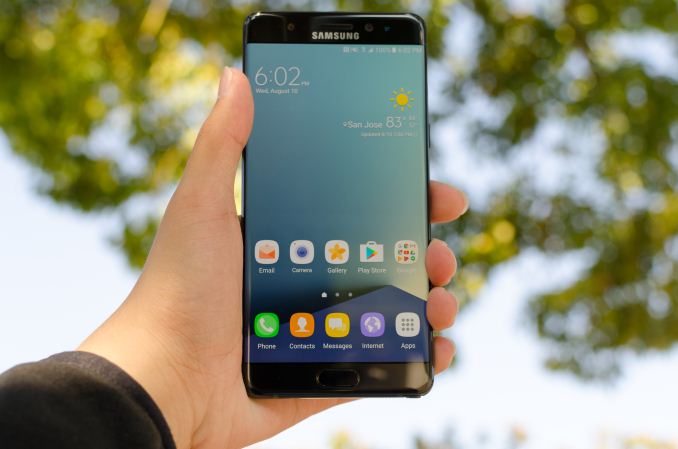
Samsung made it official today that it is suspending all sales and exchanges of its beleaguered Galaxy Note7 smartphone, and it is also asking all partners to do the same.

After reports of several phones catching on fire after it initially went on sale, Samsung initiated a global recall while it investigated the source of the problem, which traced the issue to defective batteries from a specific supplier (Samsung sources batteries from more than one supplier). With the problem seemingly solved, Samsung initiated an exchange program where customers could trade in their defective Note7s for new, supposedly safe, ones or a new Galaxy S7 or S7 edge instead.

Unfortunately, it did not take long for fresh reports of battery fires to surface. Several of the replacement Note7s have caught fire too, including one that forced a Southwest Airlines flight in Louisville, Kentucky to be evacuated on October 5th. Another replacement Note7 caught fire in a Farmington, Minnesota girl’s hand on October 7th.

Here’s Samsung’s official statement:

We are working with the US Consumer Product Safety Commission (CPSC) to investigate the recently reported cases involving the Galaxy Note7. Because consumers’ safety remains our top priority, Samsung will ask all carrier and retail partners globally to stop sales and exchanges of the Galaxy Note7 while the investigation is taking place.
 
We remain committed to working diligently with the CPSC, carriers and our retail partners to take all necessary steps to resolve the situation. Consumers with an original Galaxy Note7 or replacement Galaxy Note7 should power down and take advantage of the remedies available, including a refund at their place of purchase. For more information, consumers should visit samsung.com/us/note7recall or contact 1-844-365-6197.

These new incidents suggest that the Note7’s issue is not limited to a single battery supplier like Samsung first thought. The Note7 is clearly a safety risk at this point, and we recommend that anyone that currently owns a Note7 heed Samsung’s advice and immediately power down the device and store it in a fire-safe location until it can be returned or exchanged.