Vik


Apple Announces Q3 FY 2016 Results: App Store Up, Hardware Down
Apple Announces Q3 FY 2016 Results: App Store Up, Hardware Down

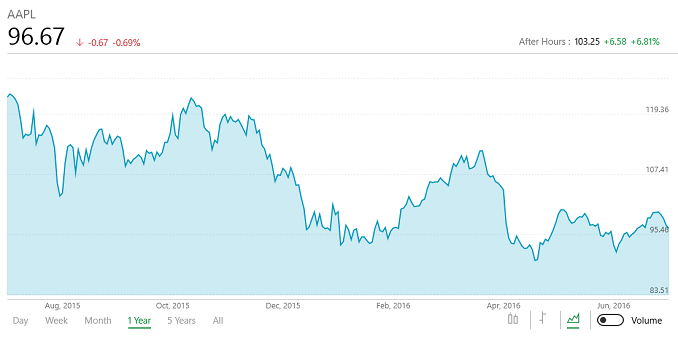
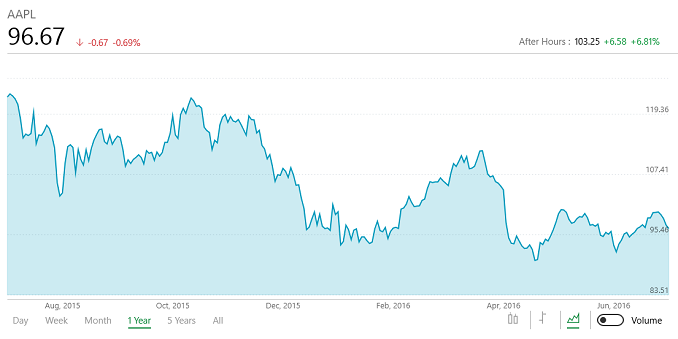
Today Apple announced their third quarter results for their fiscal year 2016. Much like last quarter, Apple has struggled to maintain the sales pace of the iPhone 6s, compared to the iPhone 6. For the quarter, Apple had revenues of $42.358 billion, which is down 11% from a year ago. Gross margin was $16.106 billion, down from $19.681 billion in Q3 2015, and percentage wise it is 38.0%. Operating income was $10.1 billion, down from $14.1 billion last year, and net income was down almost $3 billion to $7.8 billion. Diluted earnings per share were $1.42, down from $1.85 a year ago. Despite the lower quarter, Apple did beat expectations which has helped their share price in after-hours trading.

Apple Q3 2016 Financial Results (GAAP)
  Q3’2016 Q2’2015 Q3’2015
Revenue (in Billions USD) $42.358 $50.557 $49.605
Gross Margin (in Billions USD) $16.106 $19.921 $19.681
Operating Income (in Billions USD) $10.105 $13.987 $14.473
Net Income (in Billions USD) $7.796 $10.516 $10.677
Margins 38.0% 39.4% 39.7%
Earnings per Share (in USD) $1.42 $1.90 $1.85

Apple announced a dividend of $0.57 per share payable on August 11th to shareholders of record as of August 8th. They also returned over $13 billion during Q3 through share buy-backs and dividends, and they have completed almost $177 billion of their $250 billion capital return program.

iPhone sales are far and away the largest part of the company, and this quarter Apple sold 40.4 million handsets. That is down from the 51.2 million last quarter, and 47.5 million in Q3 2015, meaning iPhone sales were down 15% year-over-year. This resulted in revenue of $24 billion, down 23% from a year ago. It’s certainly a noticeable drop, and it shows just how successful the iPhone 6 was when it launched.

Moving on, iPad sales continued their slow and steady decline. Sales of the tablet were just a hair under ten million for the quarter, which is a drop of 9% year-over-year. Revenue was $4.9 billion, which is up 7%. A year ago, the average selling price of the iPad was $415, but this quarter, average selling price for the iPad rose $85 to $490. Declining sales of the iPad Mini, as well as new sales of the higher priced iPad Pro are certainly the case, but Apple doesn’t break out the numbers for individual models to know just how much each was a factor.

The Mac didn’t fare very well either, with unit sales of 4.25 million, which is down 11% year-over-year. This resulted in revenue of $5.24 billion, down 13%. With basically no Mac refreshes in a long time, they are no longer outperforming the PC market as a whole, which was the case for the last while.

Apple’s “Other Products” includes Apple TV, Apple Watch, Beats, iPods, and accessories, and while none of this is broken down by sub-category, the Other Products as a whole also fell 16% in revenue compared to Q3 2015, with revenues for this quarter of $2.22 billion.

Apple Q3 2016 Device Sales (thousands)
  Q3’2016 Q2’2016 Q3’2015 Seq Change Year/Year Change
iPhone 40,399 51,193 47,534 -21% -15%
iPad 9,950 10,251 10,931 -3% -9%
Mac 4,252 4,034 4,796 +5% -11%

The one segment in which Apple had strong growth was their Services segment. Services grew by 19% compared to Q3 2015, with revenue of $5.976 billion, which is up almost a billion or 19% year-over-year. Q2 2016 revenue was pretty much the same at $5.991 billion, meaning services have once again outpaced both Mac and iPad sales, and now represent the second largest segment at Apple.

Apple Q3 2016 Revenue by Product (billions)
  Q3’2016 Q2’2016 Q3’2015 Revenue for current quarter
iPhone $24.048 $32.857 $31.368 56.8%
iPad $4.876 $4.413 $4.538 11.5%
Mac $5.239 $5.107 $6.030 12.4%
iTunes/Software/Services $5.976 $5.991 $5.028 14.1%
Other Products $2.219 $2.189 $2.641 5.2%

Overall, it’s the second consecutive quarter of revenue loss, and last quarter was the first time that happened since Q1 2003, so Apple is in somewhat unfamiliar territory. Their guidance for next quarter is $45.5 to $47.5 billion, and margins between 37.5% and 38%. That guidance is also for a loss of revenue, since Q4 2015 had the company coming in at $51.5 billion, and 39.9% margins. It will be interesting to see if hardware refreshes in the fall can stop the drop in sales.

Source: Apple Investor Relations

HP Updates The Z240 Workstation With The Core i7-6700K

HP Updates The Z240 Workstation With The Core i7-6700K

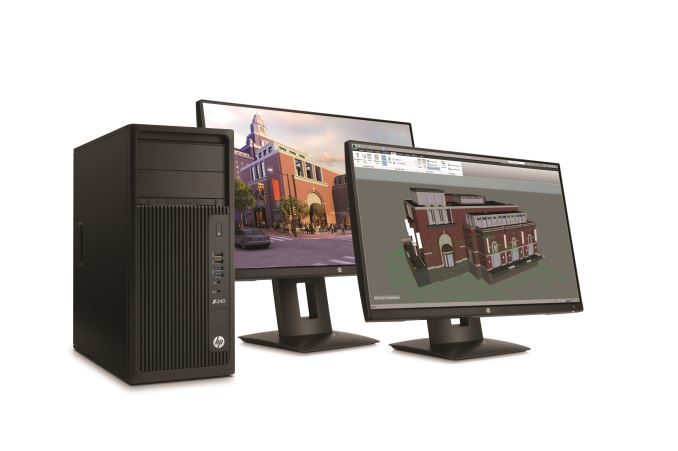
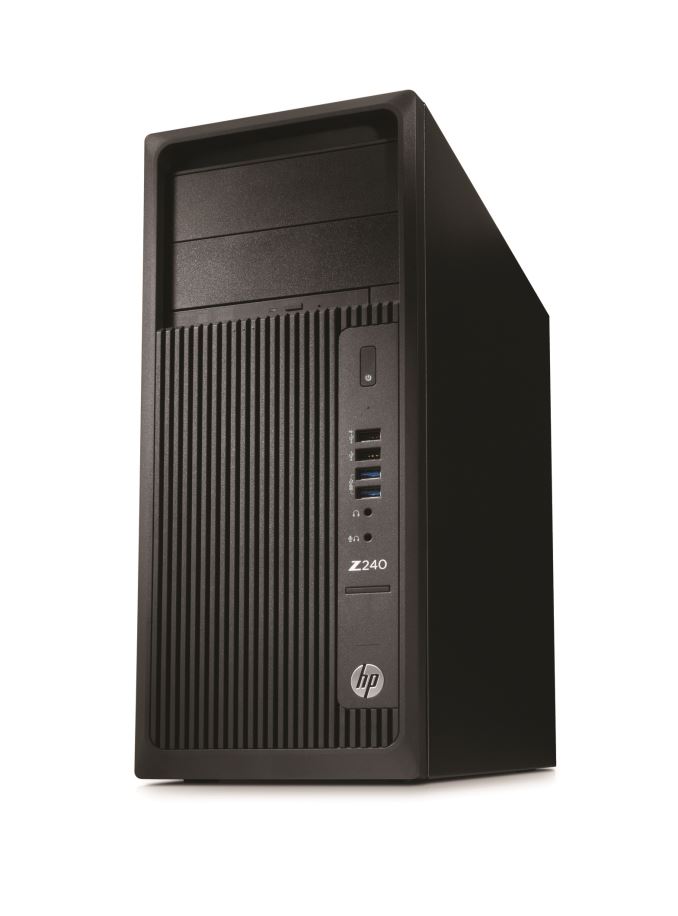
HP has an interesting announcement today – they are refreshing their existing Z240 workstation, which is targeted towards small and medium-sized businesses, with a non-Xeon Core i7 based processor. It was already available with Skylake based Xeon CPUs, up to the Intel Xeon E3-1280 v5. That’s a 3.7-4.0 GHz Xeon, with 4 cores, 8 MB of cache, with an 80-Watt Thermal Design Power (TDP). That’s certainly an excellent choice for a lot of workloads that workstations are tasked with, and with support for ECC memory, reliability under load is also a key factor. But HP has been talking to their customers and found that many of them have been choosing to forgo the error checking capabilities of ECC and have been building or buying equivalent gaming-focused machines in order to get more performance for the money. Specifically, they have been building desktops with the Core i7-6700K, which is an unlocked 4.0-4.2 GHz quad-core design, with a 91-Watt TDP, and in pure frequency can offer up to 13% more performance than the fastest Skylake Xeon.

So armed with this data, HP has refreshed the Z240 line today, with the usual Skylake Xeons in tow but also an option for the Core i7-6700K. This desktop sized workstation supports up to 64 GB of DDR4-2133, with ECC available on the Xeon processors only. It’s a pretty interesting move, but can make a lot of sense if most customers would probably rather purchase a workstation from a company like HP so that they get the testing and support offerings found with workstation class machines. If some of them had to resort to building their own in order to get the best CPU performance, HP has made a wise decision to offer this.

Despite the higher TDP, HP has created fan profiles which they say will allow full turbo performance with no thermal throttling, while at the same time not exceeding their acoustic threshold which I was told was a mere 31 dB. Although they have offered closed loop liquid cooling on their workstations in the past, the Z240 achieves this thermal performance with more traditional air cooling.

(Edit from Ian: It has not been stated if HP will implement a variation of MultiCore Turbo/Acceleration at this time, but given the limited BIOS options of the major OEMs in recent decades, this has probably been overlooked. Frankly, I would be surprised if the BIOS engineers had even heard of mainstream motherboard manufacturers implementing the feature, though I will happily be proved wrong.)

The Z240 is currently offered with a wide range of professional graphics, if required, including the NVIDIA NVS 310, 315, and 510, and Quadro up to the M4000. With yesterday’s announcement of the Pascal Quadro, and today’s announcement of the new Radeon Pro WX, they are likely to offer these soon. If a user requires AMD professional graphics, HP will offer the FirePro W2100, W5100, W4300, and the W7100 with 8 GB of memory.

A simple device refresh mid-cycle is far from unexpected, but it is pretty interesting that by talking to their customers HP has found that many of them would prefer higher single threaded performance with a Core i7-6700K, rather than the Xeon ecosystem with a focus on stability and ECC. It will be interesting to see if Intel reacts to this, since the Xeon is a nice high margin product.

As a small comparison, the highest clocked Xeon E3 v5 is the E3-1280 v5 at 3.7-4.0 GHz, and has a recommended customer price of $612 on Intel Ark. The one underneath is the E3-1275 v5 at 3.6-4.0 GHz, but is a more palatable $350. This latter part compares in price to the Core i7-6700K, which is at $350 list price also, however the i7-6700K has the margin on frequency at 4.0-4.2 GHz. Comparing the two Xeons to the Core i7, HP can offer a bit more performance with the trade-off of no ECC support, and in the case of the peak Xeon, save some money as well. For those that need the top raw CPU performance available especially for single-threaded workloads, short of overclocking, this is the way to go.

Source: HP

HP Updates The Z240 Workstation With The Core i7-6700K

HP Updates The Z240 Workstation With The Core i7-6700K

HP has an interesting announcement today – they are refreshing their existing Z240 workstation, which is targeted towards small and medium-sized businesses, with a non-Xeon Core i7 based processor. It was already available with Skylake based Xeon CPUs, up to the Intel Xeon E3-1280 v5. That’s a 3.7-4.0 GHz Xeon, with 4 cores, 8 MB of cache, with an 80-Watt Thermal Design Power (TDP). That’s certainly an excellent choice for a lot of workloads that workstations are tasked with, and with support for ECC memory, reliability under load is also a key factor. But HP has been talking to their customers and found that many of them have been choosing to forgo the error checking capabilities of ECC and have been building or buying equivalent gaming-focused machines in order to get more performance for the money. Specifically, they have been building desktops with the Core i7-6700K, which is an unlocked 4.0-4.2 GHz quad-core design, with a 91-Watt TDP, and in pure frequency can offer up to 13% more performance than the fastest Skylake Xeon.

So armed with this data, HP has refreshed the Z240 line today, with the usual Skylake Xeons in tow but also an option for the Core i7-6700K. This desktop sized workstation supports up to 64 GB of DDR4-2133, with ECC available on the Xeon processors only. It’s a pretty interesting move, but can make a lot of sense if most customers would probably rather purchase a workstation from a company like HP so that they get the testing and support offerings found with workstation class machines. If some of them had to resort to building their own in order to get the best CPU performance, HP has made a wise decision to offer this.

Despite the higher TDP, HP has created fan profiles which they say will allow full turbo performance with no thermal throttling, while at the same time not exceeding their acoustic threshold which I was told was a mere 31 dB. Although they have offered closed loop liquid cooling on their workstations in the past, the Z240 achieves this thermal performance with more traditional air cooling.

(Edit from Ian: It has not been stated if HP will implement a variation of MultiCore Turbo/Acceleration at this time, but given the limited BIOS options of the major OEMs in recent decades, this has probably been overlooked. Frankly, I would be surprised if the BIOS engineers had even heard of mainstream motherboard manufacturers implementing the feature, though I will happily be proved wrong.)

The Z240 is currently offered with a wide range of professional graphics, if required, including the NVIDIA NVS 310, 315, and 510, and Quadro up to the M4000. With yesterday’s announcement of the Pascal Quadro, and today’s announcement of the new Radeon Pro WX, they are likely to offer these soon. If a user requires AMD professional graphics, HP will offer the FirePro W2100, W5100, W4300, and the W7100 with 8 GB of memory.

A simple device refresh mid-cycle is far from unexpected, but it is pretty interesting that by talking to their customers HP has found that many of them would prefer higher single threaded performance with a Core i7-6700K, rather than the Xeon ecosystem with a focus on stability and ECC. It will be interesting to see if Intel reacts to this, since the Xeon is a nice high margin product.

As a small comparison, the highest clocked Xeon E3 v5 is the E3-1280 v5 at 3.7-4.0 GHz, and has a recommended customer price of $612 on Intel Ark. The one underneath is the E3-1275 v5 at 3.6-4.0 GHz, but is a more palatable $350. This latter part compares in price to the Core i7-6700K, which is at $350 list price also, however the i7-6700K has the margin on frequency at 4.0-4.2 GHz. Comparing the two Xeons to the Core i7, HP can offer a bit more performance with the trade-off of no ECC support, and in the case of the peak Xeon, save some money as well. For those that need the top raw CPU performance available especially for single-threaded workloads, short of overclocking, this is the way to go.

Source: HP

MSI Shows New Radeon RX 480 Gaming Cards, with an 8-pin

MSI Shows New Radeon RX 480 Gaming Cards, with an 8-pin

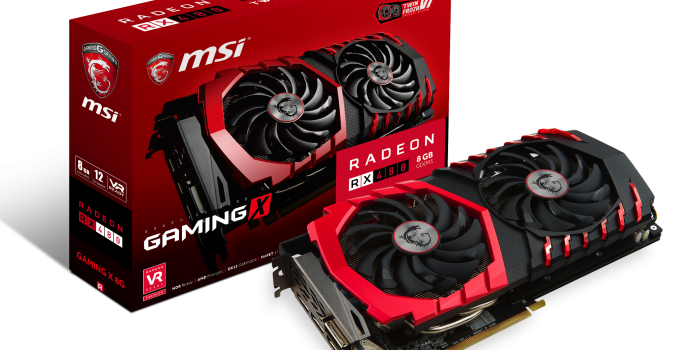
Today MSI is announcing the latest entry in the Gaming X GPU line with the Radeon RX 480 Gaming X 8G/4G cards as well as non-X variants. The main difference between the non-X and X cards is in the core and memory frequencies, with the X card having th…

MSI Shows New Radeon RX 480 Gaming Cards, with an 8-pin

MSI Shows New Radeon RX 480 Gaming Cards, with an 8-pin

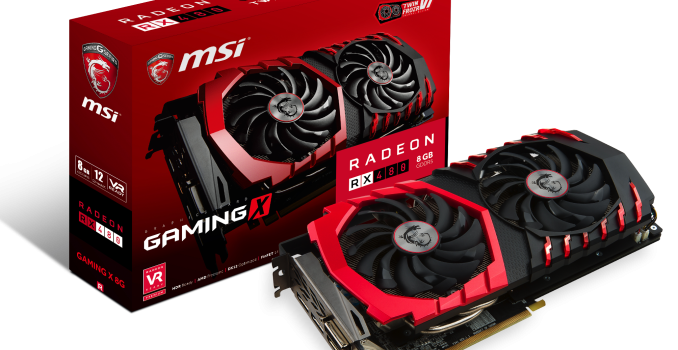
Today MSI is announcing the latest entry in the Gaming X GPU line with the Radeon RX 480 Gaming X 8G/4G cards as well as non-X variants. The main difference between the non-X and X cards is in the core and memory frequencies, with the X card having th…