Vik


AMD Reports Q4 2015 Results And FY 2015 Earnings
AMD Reports Q4 2015 Results And FY 2015 Earnings

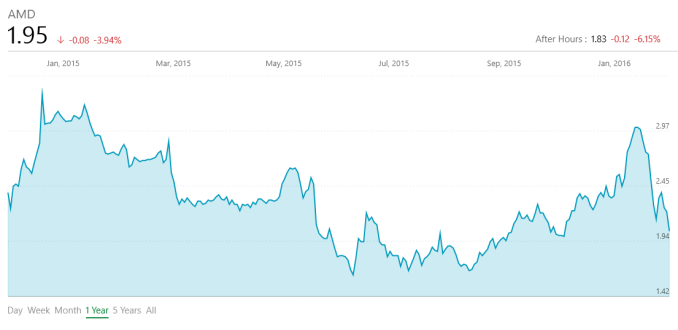
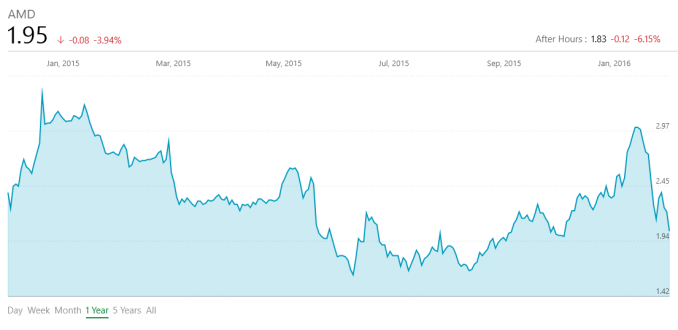
Today AMD released their quarterly earnings for Q4 of Fiscal Year 2015. AMD continues to struggle financially, and for Q4 they had revenues of $958 million, down 10% from last quarter and down 23% since a year ago. Gross margin for the quarter did increase to 30% after last quarter’s $65 million inventory write-down, and for the full year gross margin was 27%, impacted heavily by the write-down last quarter. For Q4, AMD had an operating loss of $49 million, and a net loss of $102 million, or $0.13 per share. For the full year, the operating loss was $481 million and the net loss was $660 million, or $0.84 per share.

AMD Q3 2015 Financial Results (GAAP)
  Q4’2015 Q3’2015 Q4’2014
Revenue $958M $1.06B $1.24B
Gross Margin 30% 23% 29%
Operating Income -$49M -$158M -$330M
Net Income -$102M -$197M -$364M
Earnings Per Share -$0.13 -$0.25 -$0.47

On a non-GAAP basis, AMD reports an operating loss for the quarter of $39 million, and a net loss of $79 million. For the full year 2015, the operating loss of $253 million, down from a non-GAAP operating income of $316 million in 2014. This amounts to a per share loss of $0.53 using non-GAAP numbers.

AMD Q4 2015 Financial Results (Non-GAAP)
  Q4’2015 Q3’2015 Q4’2014
Revenue $958M $1.06B $1.24B
Gross Margin 30% 23% 34%
Operating Income -$39M -$97M $52M
Net Income -$79M -$136M $18M
Earnings Per Share -$0.10 -$0.17 $0.02

Looking at the individual segments, the Computing and Graphics segment had revenue of $470 million for the quarter, up 11% since last quarter but down 29% year-over-year. AMD had more notebook processor sales compared to last quarter, but lower client processor sales compared to last year. This segment had an operating loss of $99 million, compared to $181 million last quarter and $56 million last year. The inventory write-down last quarter was the main reason for the improvement this quarter, and lower sales caused the year-over-year drop. One good nugget for AMD is that average selling price (ASP) increase sequentially for processors, although it is down year-over-year, but GPU ASP increased both sequentially and year-over-year.

AMD Q4 2015 Computing and Graphics
  Q4’2015 Q3’2015 Q4’2014
Revenue $470M $424M $662M
Operating Income -$99M -$181M -$56M

The Enterprise, Embedded, and Semi-Custom segment had revenue of $488 million, down 23% from last quarter and 15% year-over-year. Operating income was $59 million, down from $84 million last quarter and $109 million last year. AMD attributes the seasonally lower sales of semi-custom SoCs as the reason for the drop from last quarter, and the year-over-year drop is due to lower game console royalties, and lower server and embedded sales.

AMD Q4 2015 Enterprise, Embedded and Semi-Custom
  Q4’2015 Q3’2015 Q4’2014
Revenue $488M $637M $577M
Operating Income $59M $84M $109M

The All Other segment had an operating loss of $9 million, an improvement over the $61 million loss last quarter, and a big improvement over the $383 million operating loss in Q4 2014. AMD has made some restructuring charges which affected them last quarter, and the year-over-year improvement was “primarily due to the absence of a goodwill impairment charge, lower restructuring and other special charges, net and a Q4 2014 lower of cost or market inventory adjustment.”

With a less than amazing 2015, for 2016 AMD is resting a lot of hope on their new 4th generation GCN GPU, which they are calling Polaris. On the CPU side, they hope to execute their new Zen platform with a 40% increase in Instructions Per Clock. With AMD getting out of the fab business, they have now been relying on others to move forward on the process side, and we are finally seeing fabs other than Intel now producing FinFET based designs. Clearly AMD has a lot of work to do to not only launch the products, but execute sales of them as well. VR could also be an area where AMD could find some growth, since the requirements for VR will likely drive some GPU sales over the next 12 months.
ECS Goes Skylake with LIVA One

ECS Goes Skylake with LIVA One

At CES 2016, ECS displayed their consumer-focused as well as OEM products to the press and business customers. On the direct-to-consumer side, ECS had some 100-series chipset boards on display, but they were all ones that had been announced before (like the Z170-Claymore). However, my main intention was to check out updates to the LIVA mini-PC lineup and also get some information on the 5×5 form factor that ECS had hinted at prior to the show.

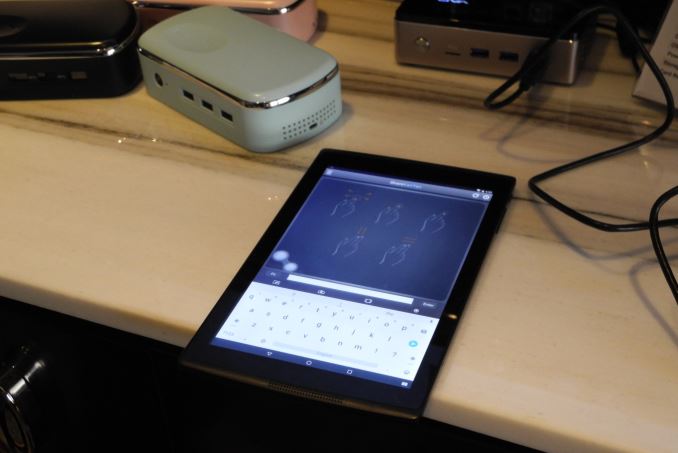
In our Intel Compute Stick review, we had talked about the efforts made by Intel to take advantage of a second screen (such as a tablet or smartphone) when interacting with the PC. ECS also had something similar for the LIVA series. They have tied up with Insyde Tools to install necessary support for ShareKanTan on the LIVA mini-PCs that come with the OS pre-installed. In addition to the input options provided by apps such as the Intel Remote Keyboard, this app also allows for display of media on the PC in the second screen.

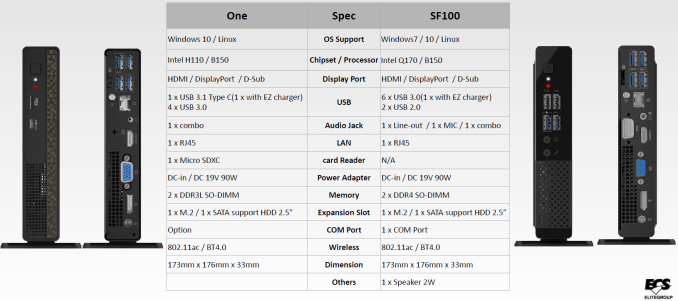
ECS also took the opportunity at CES to show off their latest addition to the LIVA lineup – the LIVA One. LIVA One is a Skylake mini-PC, which uses a 35W TDP -T class processor. Unlike other members of the LIVA family, this one is larger (1L volume – 173mm x 176mm x 33mm) and also actively cooled. The default configuration from ECS utilizes a Core i3-6100T, a LGA processor. The end user can actually upgrade the CPU after purchase, or install any other CPU after buying a barebones configuration. Even processors such as the Core i7-6700T can be used (as long as the CPU is LGA1151 and has a TDP within 35W).

The LIVA One uses 2x DDR3L SO-DIMMs.It has a free 2.5″ SATA drive slot and also a M.2 SSD slot (SATA interface). The industrial design is stylish and functional, with the front panel including a microSD slot and a USB 3.1 port (with rapid charging features). The default configuration contains a 1×1 802.11ac / BT 4.0 WLAN card, but that can be changed by the end user.

ECS has also used the same chassis design for a mini-PC to target business users. This ‘SF100’ model will support Windows 7 officially. It also supports vPro (thanks to the Q170 chipset) and Intel SBA (Small Business Advantage) technology. Unlike the LIVA One’s DDR3L SO-DIMM slots, the SF100 has the costlier DDR4 SO-DIMM slots that can provide better RAM capacity and performance. It also has a RS-232 port as well as a 2W in-built speaker. The SF100 also uses an Intel I219-LM GbE NIC.

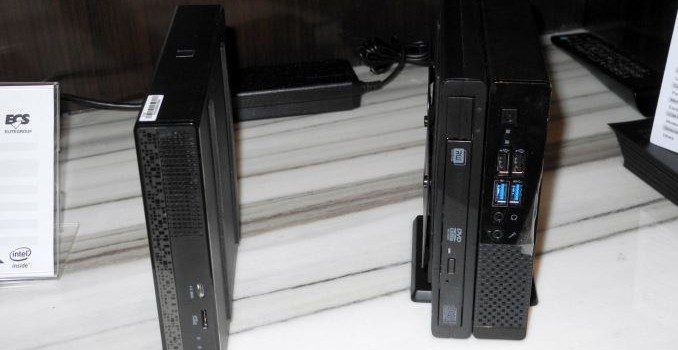
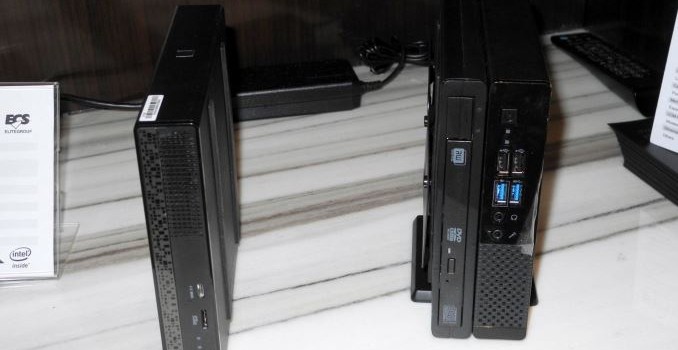
Both the LIVA One and the SF100 can be augmented with an optical drive or extra 2.5″ bay using a special ‘HD Drive Bay’ (shown in the top picture) that connects to the main system via one of the rear USB 3.0 ports. The LIVA One will be priced $168 for the barebones configuration and $450 for the pre-built default configuration. Pricing for the SF100 is not available yet.

Moving on to the mini-STX front (the official name for the 5×5 boards that we first uncovered at IDF 2015), ECS had one of the first motherboards in this form factor on display. The H110SU-02 (with the S standing for the mini-STX form factor in ECS’s nomenclature) is meant for SFF systems, thanks to the low-profile heat sink from Silverstone. ECS and Silverstone have tied up to offer consumers a one-stop shop for those attempting to build a system based on the H110SU-02 mSTX board. The gallery below shows some shots of the motherboard with a low profile heatsink installed.

The full details of the board are provided in the table below. Pricing is not available yet.

ECS H110SU-02 Specifications
Form Factor Intel mSTX Form Factor
Chipset Intel H110/B150 Chipset
Intel i3/i5/i7/Pentium/Celeron Processors (65W)
Memory 2x SO-DIMM DDR4
Networking 1 x M.2 Slot (2230) for WiFi/BT 4.0
1 x RJ45 1Gbps
Storage 1 x M.2 Slot (2280) for SSD
1 x SATA support SSD or HDD or ODD
Display 1 x HDMI 1.4a Output
1 x DP Output
Audio 1 x Audio Combo Jack
External I/O 1 x USB 3.1 Type C (with EZ charger)
2 x USB 3.0 Ports
Dimensions 140(W) x 147(D) mm
Power Supply DC-in 19V 90W
OS / Driver Support Windows 7 / 8.1 / 10 / Linux

On the whole, the consumer products from ECS on display at CES point to where the desktop computing market is headed. The market share for small form factor systems is increasing even as the overall desktop PC market declines. SFF systems are also turning out to be an attractive proposition in the business PC market.

ECS Goes Skylake with LIVA One

ECS Goes Skylake with LIVA One

At CES 2016, ECS displayed their consumer-focused as well as OEM products to the press and business customers. On the direct-to-consumer side, ECS had some 100-series chipset boards on display, but they were all ones that had been announced before (like the Z170-Claymore). However, my main intention was to check out updates to the LIVA mini-PC lineup and also get some information on the 5×5 form factor that ECS had hinted at prior to the show.

In our Intel Compute Stick review, we had talked about the efforts made by Intel to take advantage of a second screen (such as a tablet or smartphone) when interacting with the PC. ECS also had something similar for the LIVA series. They have tied up with Insyde Tools to install necessary support for ShareKanTan on the LIVA mini-PCs that come with the OS pre-installed. In addition to the input options provided by apps such as the Intel Remote Keyboard, this app also allows for display of media on the PC in the second screen.

ECS also took the opportunity at CES to show off their latest addition to the LIVA lineup – the LIVA One. LIVA One is a Skylake mini-PC, which uses a 35W TDP -T class processor. Unlike other members of the LIVA family, this one is larger (1L volume – 173mm x 176mm x 33mm) and also actively cooled. The default configuration from ECS utilizes a Core i3-6100T, a LGA processor. The end user can actually upgrade the CPU after purchase, or install any other CPU after buying a barebones configuration. Even processors such as the Core i7-6700T can be used (as long as the CPU is LGA1151 and has a TDP within 35W).

The LIVA One uses 2x DDR3L SO-DIMMs.It has a free 2.5″ SATA drive slot and also a M.2 SSD slot (SATA interface). The industrial design is stylish and functional, with the front panel including a microSD slot and a USB 3.1 port (with rapid charging features). The default configuration contains a 1×1 802.11ac / BT 4.0 WLAN card, but that can be changed by the end user.

ECS has also used the same chassis design for a mini-PC to target business users. This ‘SF100’ model will support Windows 7 officially. It also supports vPro (thanks to the Q170 chipset) and Intel SBA (Small Business Advantage) technology. Unlike the LIVA One’s DDR3L SO-DIMM slots, the SF100 has the costlier DDR4 SO-DIMM slots that can provide better RAM capacity and performance. It also has a RS-232 port as well as a 2W in-built speaker. The SF100 also uses an Intel I219-LM GbE NIC.

Both the LIVA One and the SF100 can be augmented with an optical drive or extra 2.5″ bay using a special ‘HD Drive Bay’ (shown in the top picture) that connects to the main system via one of the rear USB 3.0 ports. The LIVA One will be priced $168 for the barebones configuration and $450 for the pre-built default configuration. Pricing for the SF100 is not available yet.

Moving on to the mini-STX front (the official name for the 5×5 boards that we first uncovered at IDF 2015), ECS had one of the first motherboards in this form factor on display. The H110SU-02 (with the S standing for the mini-STX form factor in ECS’s nomenclature) is meant for SFF systems, thanks to the low-profile heat sink from Silverstone. ECS and Silverstone have tied up to offer consumers a one-stop shop for those attempting to build a system based on the H110SU-02 mSTX board. The gallery below shows some shots of the motherboard with a low profile heatsink installed.

The full details of the board are provided in the table below. Pricing is not available yet.

ECS H110SU-02 Specifications
Form Factor Intel mSTX Form Factor
Chipset Intel H110/B150 Chipset
Intel i3/i5/i7/Pentium/Celeron Processors (65W)
Memory 2x SO-DIMM DDR4
Networking 1 x M.2 Slot (2230) for WiFi/BT 4.0
1 x RJ45 1Gbps
Storage 1 x M.2 Slot (2280) for SSD
1 x SATA support SSD or HDD or ODD
Display 1 x HDMI 1.4a Output
1 x DP Output
Audio 1 x Audio Combo Jack
External I/O 1 x USB 3.1 Type C (with EZ charger)
2 x USB 3.0 Ports
Dimensions 140(W) x 147(D) mm
Power Supply DC-in 19V 90W
OS / Driver Support Windows 7 / 8.1 / 10 / Linux

On the whole, the consumer products from ECS on display at CES point to where the desktop computing market is headed. The market share for small form factor systems is increasing even as the overall desktop PC market declines. SFF systems are also turning out to be an attractive proposition in the business PC market.