News


Samsung Investing in 3840x1080 and 3840x1200 Curved Displays at 144 Hz

Samsung Investing in 3840×1080 and 3840×1200 Curved Displays at 144 Hz
One of the interesting elements in the new wave of monitor technologies is the types of ideas that panel manufacturers are coming up with. In the enterprise space, custom display configurations occur more frequently than we might expect, but for consumers there tends to be a line of standardization. Samsung, being vertically integrated, gives them the opportunity to experiment more than most. Even then, as a reviewer in the industry, one develops certain expectations of what might be coming in the future. Consider me stumped, as TFTCentral has delved into Samsung’s upcoming roadmaps and panel production schedules to pull out one or two surprises.

49-inch 3840×1080, or ‘Double Full-HD / DFHD’

For readers on the leading-edge of monitor configurations, ultra-wide displays in the 21:9 aspect ratio have been on the radar for about two years. These are monitors that have a 2560×1080 display, stretching the horizontal dimension of a standard 1920×1080 Full-HD monitor and make it easier to display modern cinema widescreen format content with less black bars. They are also claimed to assist with peripheral vision when gaming beyond a standard 1920×1080 display, or when curved, help with immersive content.

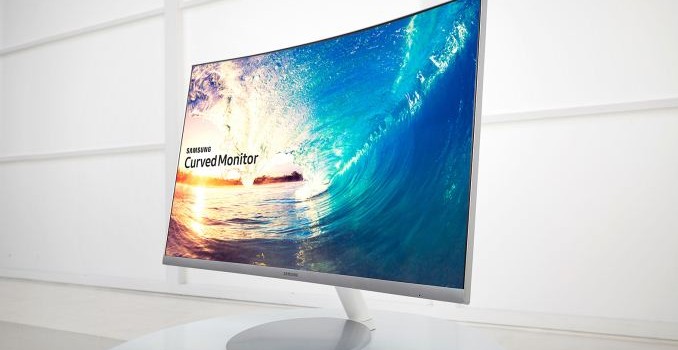
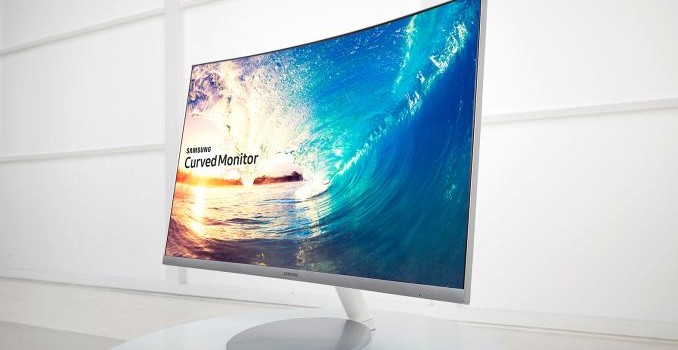
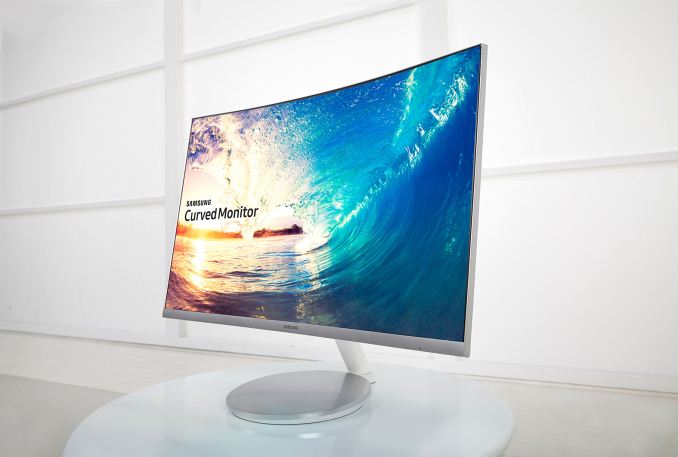
So chalk up some surprise when we hear that Samsung has an even wider format panel in the works. 3840×1080 represents a 32:9 aspect ratio, and the report states that this will be a VA panel with 1800R curvature and a 3-side frameless design. Putting that many pixels in a large display gives a relatively low 81.41 PPI. This panel will be part of Samsung’s ‘Grand Circle’ format, and by supporting up to 144 Hz it is expected that variants of this panel will be included with FreeSync/GSYNC technologies.  One figure to note would be the contrast ratio – 5000:1 (static), which TFTCentral states is higher than current Samsung VA panels.

44-inch 3840×1200

This panel is the equivalent two 24.7-inch 1920×1200 screens put side-by-side, and indicates which market Samsung would be aiming for. The specifications seem to be almost identical to the 3840×1080 panel, such as 1800R curvature, but in a 29:9 aspect ratio with 60 Hz and 144 Hz variants. Pixel density is slightly higher than the other panel too, given the higher resolution and lower diagonal, which gives 91.41 PPI. TFTCentral is listing these panels as having an 8-bit color depth (no word on FRC), and likely to be qualified on some amount of sRGB. Other numbers, such as brightness and response time, are still unknown.

An amusing aside, for any users looking for a 16:10 display, something like two of these stacked on top of each other might be suitable (albeit massive) if these panels also offer a 3-side borderless configuration. I know Ryan has been after a decent 3840×2400 display, but given our discussions with monitor manufacturers, there seems to be no 16:10 demand from consumers.
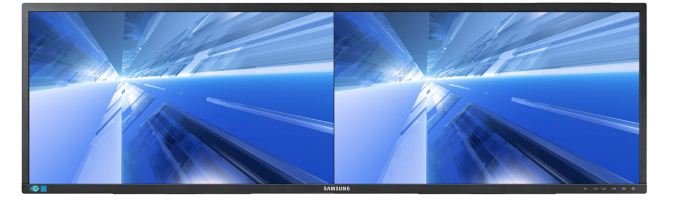

A bad mockup of two non-curved 16:10 displays

So while these two panels aren’t official announcements (they don’t even have official part numbers yet), and production will depend on how well these technologies scale. But by virtue of being on roadmaps and panel lists it is clear that Samsung has at least been doing research towards some wider aspect ratio displays. Information from TFTCentral is claiming mass production for both of these panels in September 2017, which means we might see some early announcements for retail-grade panels at Computex in June, or at IFA at the end of August with some pre-production run models. Full retail then might happen in the second half of the year, or along with further announcements at CES in January. 

Related Reading

Samsung Investing in 3840x1080 and 3840x1200 Curved Displays at 144 Hz

Samsung Investing in 3840×1080 and 3840×1200 Curved Displays at 144 Hz

One of the interesting elements in the new wave of monitor technologies is the types of ideas that panel manufacturers are coming up with. In the enterprise space, custom display configurations occur more frequently than we might expect, but for consumers there tends to be a line of standardization. Samsung, being vertically integrated, gives them the opportunity to experiment more than most. Even then, as a reviewer in the industry, one develops certain expectations of what might be coming in the future. Consider me stumped, as TFTCentral has delved into Samsung’s upcoming roadmaps and panel production schedules to pull out one or two surprises.

49-inch 3840×1080, or ‘Double Full-HD / DFHD’

For readers on the leading-edge of monitor configurations, ultra-wide displays in the 21:9 aspect ratio have been on the radar for about two years. These are monitors that have a 2560×1080 display, stretching the horizontal dimension of a standard 1920×1080 Full-HD monitor and make it easier to display modern cinema widescreen format content with less black bars. They are also claimed to assist with peripheral vision when gaming beyond a standard 1920×1080 display, or when curved, help with immersive content.

So chalk up some surprise when we hear that Samsung has an even wider format panel in the works. 3840×1080 represents a 32:9 aspect ratio, and the report states that this will be a VA panel with 1800R curvature and a 3-side frameless design. Putting that many pixels in a large display gives a relatively low 81.41 PPI. This panel will be part of Samsung’s ‘Grand Circle’ format, and by supporting up to 144 Hz it is expected that variants of this panel will be included with FreeSync/GSYNC technologies.  One figure to note would be the contrast ratio – 5000:1 (static), which TFTCentral states is higher than current Samsung VA panels.

44-inch 3840×1200

This panel is the equivalent two 24.7-inch 1920×1200 screens put side-by-side, and indicates which market Samsung would be aiming for. The specifications seem to be almost identical to the 3840×1080 panel, such as 1800R curvature, but in a 29:9 aspect ratio with 60 Hz and 144 Hz variants. Pixel density is slightly higher than the other panel too, given the higher resolution and lower diagonal, which gives 91.41 PPI. TFTCentral is listing these panels as having an 8-bit color depth (no word on FRC), and likely to be qualified on some amount of sRGB. Other numbers, such as brightness and response time, are still unknown.

An amusing aside, for any users looking for a 16:10 display, something like two of these stacked on top of each other might be suitable (albeit massive) if these panels also offer a 3-side borderless configuration. I know Ryan has been after a decent 3840×2400 display, but given our discussions with monitor manufacturers, there seems to be no 16:10 demand from consumers.


A bad mockup of two non-curved 16:10 displays

So while these two panels aren’t official announcements (they don’t even have official part numbers yet), and production will depend on how well these technologies scale. But by virtue of being on roadmaps and panel lists it is clear that Samsung has at least been doing research towards some wider aspect ratio displays. Information from TFTCentral is claiming mass production for both of these panels in September 2017, which means we might see some early announcements for retail-grade panels at Computex in June, or at IFA at the end of August with some pre-production run models. Full retail then might happen in the second half of the year, or along with further announcements at CES in January. 

Related Reading

AMD Releases Radeon Software ReLive Crimson Edition 17.4.1

AMD Releases Radeon Software ReLive Crimson Edition 17.4.1

The game releases trickle this time of year, but the progression of technology marches on. More specifically VR is still a developing phenomenon, and 8K is just cresting the Horizon. Today’s AMD driver provides its fixes and steps us a little further along and prepares us for things to come.

This week’s AMD Radeon Software Crimson 17.4.1 release brings us Display Driver version 17.10.1061 (Windows Driver Store Version 22.19.156.1) and comes with multiple bug fixes, including a fix for Radeon Settings becoming unresponsive during a driver upgrade, a fix for display flicker when running windowed borderless applications on an AMD FreeSync display, and some improvement of Multi GPU scaling while playing Tom Clancy’s Ghost Recon Wildlands. Additionally, a sudden unplugging of AMD XConnect after installation of Radeon Software will no longer cause a system hang.

Meanwhile As the VR agenda continues to move forward, support for the ecosystem continues to improve. First on the list, this AMD driver release enables support for Oculus’ Asynchronous Spacewarp technology, the company’s latest frame extrapolation feature, on more AMD cards. Async Spacewarp support launched on AMD’s RX 400 series (Polaris) cards last year, and as of this driver update, the Radeon R9 Fury (Fiji), Radeon R9 390, and Radeon R9 290 series (Hawaii) cards have been added to the list. On a similar note, support for Valve’s functionally similar SteamVR Asynchronous Reprojection technology has been added to AMD’s drivers. However also like Spacewarp, AMD is starting slow in adding support for Reprojection; only the Radeon RX 480 and Radeon RX 470 cards on Windows 10 get support for Reprojection today.

On the video interface front, AMD has finally formally enabled DisplayPort 1.4 HBR3 support. The Polaris hardware has been able to support this feature since the start, however as displays are still catching up, AMD is only now finally enabling it. This opens display possibilities requiring much more bandwidth, and listed on the release notes are 8K 30Hz on a single cable and 8K 60Hz on two cables. 8K monitors are slim pickings right now but it’s great for video card vendors to be prepared.

As always, those interested in reading more or installing the updated hotfix drivers for AMD’s desktop, mobile, and integrated GPUs can find them either under the driver update section in Radeon Settings or on AMDs Radeon Software Crimson ReLive Edition download page.

AMD Releases Radeon Software ReLive Crimson Edition 17.4.1

AMD Releases Radeon Software ReLive Crimson Edition 17.4.1

The game releases trickle this time of year, but the progression of technology marches on. More specifically VR is still a developing phenomenon, and 8K is just cresting the Horizon. Today’s AMD driver provides its fixes and steps us a little further along and prepares us for things to come.

This week’s AMD Radeon Software Crimson 17.4.1 release brings us Display Driver version 17.10.1061 (Windows Driver Store Version 22.19.156.1) and comes with multiple bug fixes, including a fix for Radeon Settings becoming unresponsive during a driver upgrade, a fix for display flicker when running windowed borderless applications on an AMD FreeSync display, and some improvement of Multi GPU scaling while playing Tom Clancy’s Ghost Recon Wildlands. Additionally, a sudden unplugging of AMD XConnect after installation of Radeon Software will no longer cause a system hang.

Meanwhile As the VR agenda continues to move forward, support for the ecosystem continues to improve. First on the list, this AMD driver release enables support for Oculus’ Asynchronous Spacewarp technology, the company’s latest frame extrapolation feature, on more AMD cards. Async Spacewarp support launched on AMD’s RX 400 series (Polaris) cards last year, and as of this driver update, the Radeon R9 Fury (Fiji), Radeon R9 390, and Radeon R9 290 series (Hawaii) cards have been added to the list. On a similar note, support for Valve’s functionally similar SteamVR Asynchronous Reprojection technology has been added to AMD’s drivers. However also like Spacewarp, AMD is starting slow in adding support for Reprojection; only the Radeon RX 480 and Radeon RX 470 cards on Windows 10 get support for Reprojection today.

On the video interface front, AMD has finally formally enabled DisplayPort 1.4 HBR3 support. The Polaris hardware has been able to support this feature since the start, however as displays are still catching up, AMD is only now finally enabling it. This opens display possibilities requiring much more bandwidth, and listed on the release notes are 8K 30Hz on a single cable and 8K 60Hz on two cables. 8K monitors are slim pickings right now but it’s great for video card vendors to be prepared.

As always, those interested in reading more or installing the updated hotfix drivers for AMD’s desktop, mobile, and integrated GPUs can find them either under the driver update section in Radeon Settings or on AMDs Radeon Software Crimson ReLive Edition download page.

Honor Announces The Honor 8 Pro: Kirin 960, 5.7-inch QHD

Honor Announces The Honor 8 Pro: Kirin 960, 5.7-inch QHD

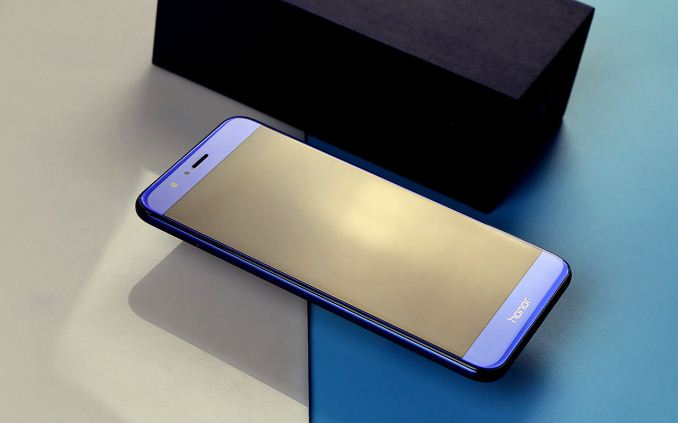
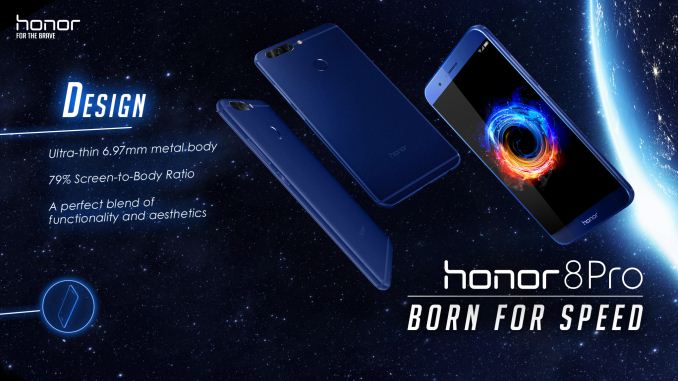
Huawei added another phone to its Honor lineup today. The Honor 8 Pro is the international version of the Honor V9 that was launched in China earlier this year. The Honor 8, which was released last summer, and the new Honor 8 Pro are similar in name only, with the new Pro model sporting a larger screen, a new SoC, different materials, and an updated design.

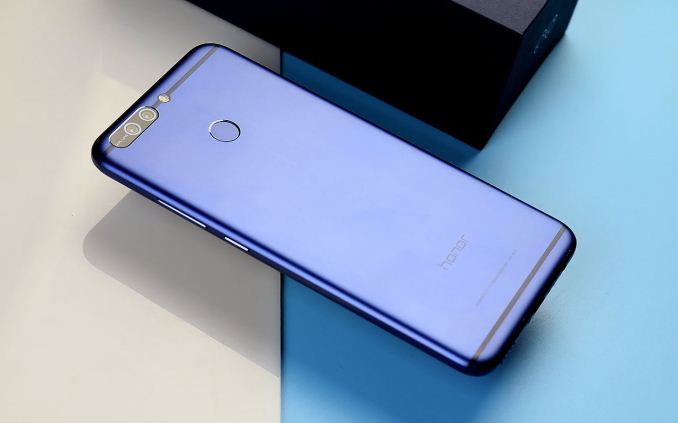
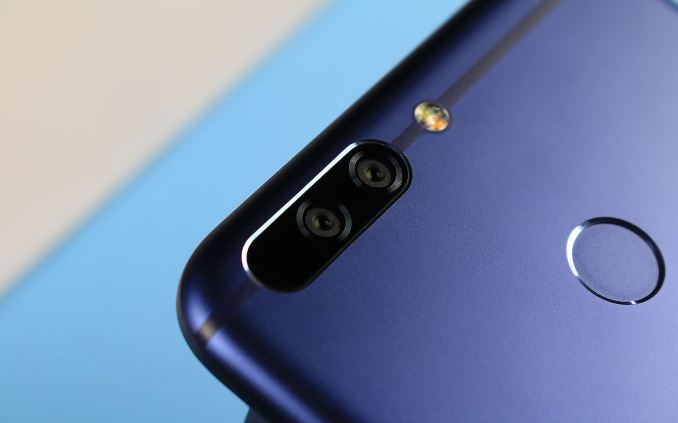
The Honor 8 Pro’s all-aluminum chassis has traditional color-matched, plastic antenna lines running across the back, giving it a premium albeit familiar look. Its dual rear camera module and dual-color LED flash are flush mounted inline with the upper antenna line, which makes it look more like a racing stripe accent than a necessary RF concession. There’s also a circular, recessed fingerprint sensor mounted on the back.

The new device will have the newest Kirin 960 chipset, featuring 4x ARM Cortex-A73 and 4x ARM Cortex-A53 as well as the latest Mali-G71MP8 graphics, as we’ve seen on Huawei devices over the last six months. This will be paired with 6GB of LPDDR4 and 64GB of UFS 2.1 storage. The display moves up from the 5.2-inch Full-HD on the Honor 8 to a 5.7-inch QHD (2560×1440), and a combination of all these features means that Honor is promoting the Honor 8 Pro as a gaming and VR device, although there’s no word on DayDream VR support, but the device will have some bundled VR software and support Google Cardboard. The display will target some form of DCI-P3, although the level of which has not been publicized as of yet.

Honor 8 Series
  Honor 8 Pro
(April 2017)
Honor 8
(August 2016)
SoC HiSilicon Kirin 960

4x Cortex-A73 @ 2.36GHz
4x Cortex-A53 @ 1.84GHz
ARM Mali-G71MP8

HiSilicon Kirin 950

4x Cortex-A72 @ 2.30GHz
4x Cortex-A53 @ 1.81GHz
ARM Mali-T880MP4 @ 900MHz

Display 5.7-inch 2560×1440 IPS LCD 5.2-inch 1920×1080 IPS LCD
Dimensions 157.0 x 77.5 x 6.97 mm
184 grams
145.5 x 71.0 x 7.45 mm
153 grams
RAM 6GB LPDDR4 3GB / 4GB LPDDR4-2666
NAND 64GB (UFS 2.1)
+ microSD
32GB / 64GB (eMMC)
+ microSD
Battery 4000 mAh
non-replaceable
3000 mAh (11.46 Wh)
non-replaceable
Front Camera 8MP, f/2.0 8MP, 1.4μm, f/2.4
Rear Camera 2x 12MP (color + monochrome), 1/2.9” Sony IMX286 Exmor RS, 1.25µm pixels, f/2.2, Laser AF + depth, HDR, dual-tone LED flash 2x 12MP (color + monochrome), 1/2.9” Sony IMX286 Exmor RS, 1.25µm pixels, f/2.2, Laser AF + depth, HDR, dual-tone LED flash
Modem HiSilicon LTE (Integrated)
2G / 3G / 4G LTE (Category 12/13)

FDD-LTE / TD-LTE / TD-SCDMA / WCDMA / GSM

HiSilicon Balong (Integrated)
2G / 3G / 4G LTE (Category 6)

FDD-LTE / TD-LTE / TD-SCDMA / WCDMA / CDMA (China only) / GSM

SIM Size 2x NanoSIM (w/o microSD)
(dual standby)
2x NanoSIM (w/o microSD)
(dual standby)
Wireless 802.11a/b/g/n/ac, BT 4.2 LE, NFC, GPS/GNSS 802.11a/b/g/n/ac, BT 4.2 LE, NFC, IrLED, GPS/GNSS
Connectivity USB 2.0 Type-C, 3.5mm headset USB 2.0 Type-C, 3.5mm headset
Launch OS Android 7.0 with Emotion UI 5.1 Android 6.0 with Emotion UI 4.1

On the battery side, the larger device allows for a 4000 mAh battery. Similar to the Mate 9, this will support Huawei Supercharge with appropriate power adapters for faster charging via the Type-C port on the bottom of the phone. This is still a USB 2.0 port, as per the regular Honor 8.

The Honor 8 Pro uses the same dual-camera setup seen in the Honor 8, using a 12MP RGB and a 12MP monochrome sensor for additional contrast focus capabilities, depth sensing, and bokeh. Given the relationship between Huawei and the Honor brand internally, it might not be a surprise that the Honor 8 Pro doesn’t have the second generation of dual camera design as seen in the Huawei P10 that was launched back in February – it is likely that the Honor 9 will use that when released later in the year (as follows typical Honor cadence). The move to EMUI 5.1 will afford some additional software adjustments with the camera, and one of the features Honor was keen to promote is 4K recording in H.265, as well as an embedded feature called Highlights (co-created with GoPro) to help merge relevant photos and clips taken with the device when the user has a specific journey.

Current plans have the Honor 8 Pro launching in Western Europe (so we assume that means UK, France, Germany, Italy, Spain) to begin with, at a recommended price of 549 Euro or £475 (including tax). The navy blue color from the original Honor 8 will carry forward, along with two other designs in gold or black, although color availability may be region dependent. Pre-orders are currently available at vmall.eu (Honor’s EU storefront), or a full Amazon launch will occur on April 20th.